Wangsuk District: Economy, Ecology, Hyperconnectivity, Happiness City
Gyosan District: Eco-friendly, Transportation, Childcare, Jobs
Gyeyang District: Inclusion, Connectivity, Convergence, Sharing
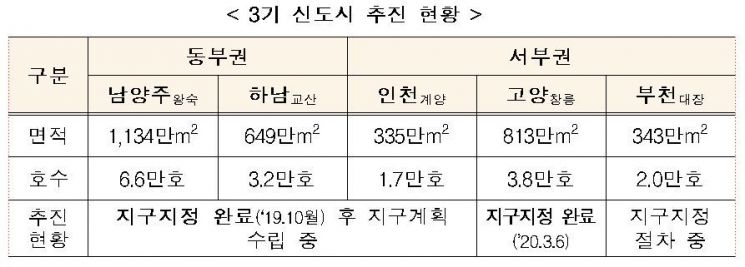
[Asia Economy Reporter Moon Jiwon] The Ministry of Land, Infrastructure and Transport and Korea Land and Housing Corporation (LH) announced the results of the basic concept and three-dimensional urban spatial planning competition for the 3rd generation new towns including Namyangju Wangsuk, Hanam Gyosan, and Incheon Gyeyang on the 30th.
In the Namyangju Wangsuk district, the consortium led by D.A. Group Engineering Comprehensive Architecture Office's "Symbiotic City (共生都市)" was selected as the winner. In the Hanam Gyosan district, the consortium led by Gyeonggando City Design Architecture Office's "Co-Living Platform: A Symbiotic City of Coexistence and Mutual Growth" was chosen as the top prize. In the Incheon Gyeyang district, the consortium led by Site Planning Architecture Office's "2030 Gyeyang, Hyper Era New Town Connecting Hearts HYPER TERRA CITY" was selected.
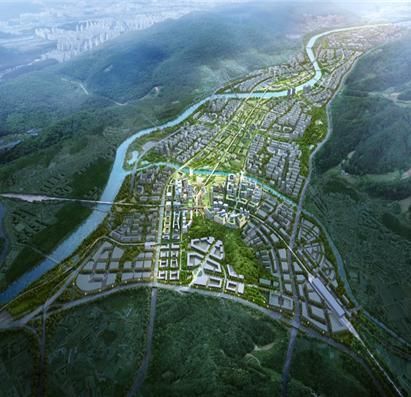 Namyangju Wangsuk District Best Work Bird's-eye View (Photo by Ministry of Land, Infrastructure and Transport)
First, the winning design for the Wangsuk district envisions a symbiotic city with complete urban functions that interacts and grows complementarily with surrounding cities, proposing four development directions: economy, ecology, hyper-connectivity, and happiness city.
The area is divided into nine neighborhood living zones within a 500m radius of residential areas, including public facilities such as parks and schools, and a plan was established to connect all living zones with parks and green spaces.
New transportation facilities such as GTX-B stations and S-BRT will be established to enable public transportation use within a 10-minute walk from home, and by linking with personal mobility, the plan aims to minimize commuting time to workplaces such as advanced industrial complexes and venture towns within the district.
Additionally, the integrated platform of GTX-B, Gyeongchun Line, and S-BRT, which serves as the gateway to the new town, will be developed as a landmark, and a city plan is proposed that harmonizes transportation, culture, and commercial functions by connecting surrounding buildings and parks with pedestrian decks.
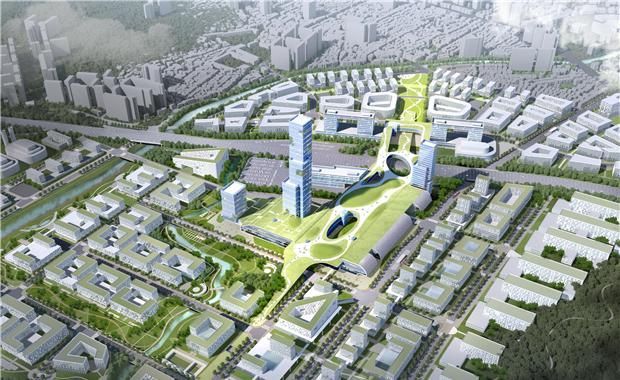 Hanam Gyosan District Best Work Specialized Zone Bird's-eye View (Photo by Ministry of Land, Infrastructure and Transport)
The winning design for the Gyosan district sets eco-friendliness, transportation friendliness, child-rearing environment, jobs and self-sufficiency, and diverse residential environments as the development directions.
The area is broadly divided into a self-sufficient central living zone and a residential central living zone, further subdivided into 12 small pedestrian-centered living zones.
To connect the north and south of the self-sufficient central living zone, which is divided by the Jungbu Expressway, the area is designated as a specialized zone. An artificial urban plateau will be installed to connect the divided living zones, and based on this, a future-type mixed-use site combining commercial, business, residential, and cultural functions is planned.
The underground floor of the specialized zone will house advanced transportation and logistics functions such as BRT, underground roads, and shared parking lots, while the ground floor will form a natural network including Deokpungcheon Stream and parks. The upper floors will feature an artificial deck park that overcomes road disconnection and creates diverse urban landscapes including landmark buildings.
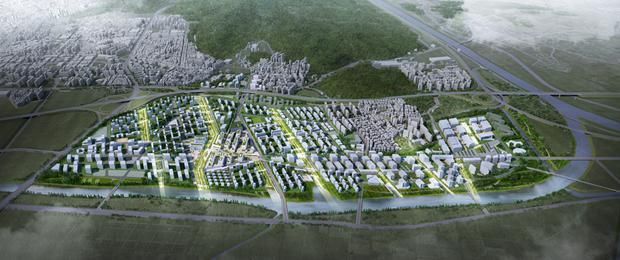 Perspective view of the best work in Incheon Gyeyang District (Photo by Ministry of Land, Infrastructure and Transport)
The winning design for the Gyeyang district proposes inclusion, connection, convergence, and sharing as urban development directions.
In Gyeyang New Town, a three-dimensional route is proposed to ensure smooth operation of the S-BRT connecting Gimpo Airport Station and Bucheon Sports Complex Station, and station plans are made so that S-BRT can be accessed within an 8-minute walk from residential complexes.
A green axis is established diagonally connecting Gyeyang Mountain on the west side of the district and Gulpo Stream running east-west on the east side, and complexes are arranged so that parks and green spaces can be accessed within 200m in all living zones.
The intersection of the north-south S-BRT line and the east-west green axis connecting Gyeyang Mountain and Gulpo Stream is designated as a specialized zone, which will be developed into an advanced industrial cluster combining a complex transfer center, corporate and commercial sites, and a startup campus.
The top winning designs for each district can be viewed from the 1st of next month through the online exhibition hall of the competition winners.
The winning companies will be granted the right to perform the three-dimensional urban spatial planning service and the position of Master Planner in the field of urban design.
Currently, designation of 18 public housing districts capable of supplying 200,000 homes out of the "3 million housing plan in the metropolitan area" has been completed. The remaining districts supplying about 50,000 homes, such as Bucheon Daejang and Ansan Jangsang, are planned to be designated in the first half of this year.
For districts where basic urban concepts have been prepared, such as Namyangju Wangsuk, Hanam Gyosan, Incheon Gyeyang, and Gwacheon, the joint project implementers including local governments, LH, and local public corporations will prepare district plans within the year.
Kim Gyuchul, head of the Public Housing Promotion Team at the Ministry of Land, Infrastructure and Transport, said, "The 3rd generation new town basic concepts have been prepared, and the project is being activated," adding, "We plan to continuously communicate with original residents and prepare various measures to enable them to settle in the new towns as much as possible."
© The Asia Business Daily(www.asiae.co.kr). All rights reserved.



















