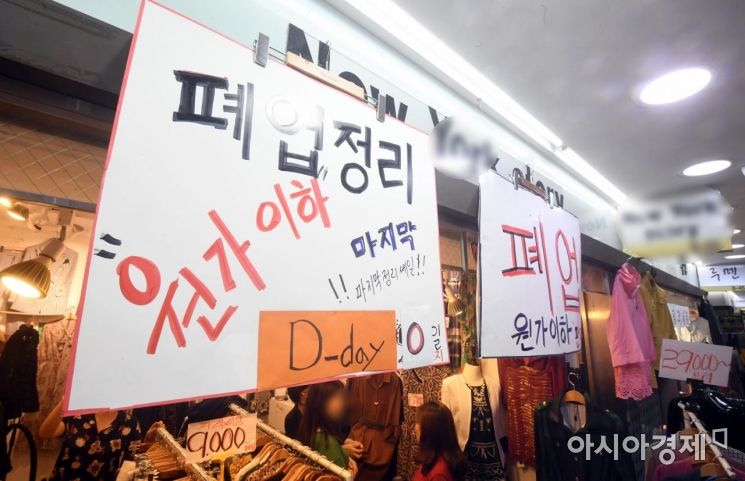
 The economic downturn for self-employed individuals continues as external uncertainties and rising oil prices combine as negative factors. On the 4th, a store in the underground shopping center near Gangnam Station in Seoul hung a notice announcing its closure and operated on its last day. Photo by Hyunmin Kim kimhyun81@
[Asia Economy Reporter Oh Hyung-gil] The government is promoting measures to alleviate the burden on self-employed individuals in response to the economic shock caused by the novel coronavirus infection (COVID-19). There has been a call to unify the reduction of National Health Insurance premiums based on income criteria for more effective response.
On the 29th, Lee Tae-yeol, a senior research fellow at the Korea Insurance Research Institute, pointed this out in a report titled "Discussion on Income and Household Burden of Self-Employed Households."
According to the report, the real income of self-employed households has stagnated for a long period since 2012. Furthermore, real disposable income has been decreasing since 2015, indicating generally poor income conditions.
The real income of urban self-employed households recorded an average monthly income of about 3,625,000 KRW in 2012 and has not shown a clear upward trend, remaining at about 3,753,000 KRW monthly last year.
Regarding real disposable income, it recorded 3,047,000 KRW in 2015 and has been declining, falling to around 3,000,000 KRW last year.
The report analyzed, "The long-term income stagnation of self-employed households is driven by a decrease in business income, which is the main source of income," and "Overall, the decrease in business income has been supplemented by earned income and transfer income."
It further diagnosed that the decrease in real disposable income of self-employed households occurred because non-consumption expenditures such as taxes, quasi-taxes, and interest expenses increased significantly despite stagnant income.
The report stated, "Since non-consumption expenditures of self-employed households have increased enough to reduce real purchasing power, it is necessary to pay attention to the related collection system such as taxes and quasi-taxes," and explained, "In the case of quasi-taxes paid by self-employed households, there is a structural characteristic where the payment burden can persist or increase even if income decreases."
It added, "Since it seems difficult to improve the income conditions of self-employed households in the short term, reducing household burdens through improvements in the tax or quasi-tax system would be a more effective alternative."
Currently, the government is implementing proactive crisis management policies such as reducing value-added tax for small individual business owners and significantly easing quasi-tax burdens for a certain period.
For individual business owners with annual sales of 80 million KRW or less, value-added tax payments were reduced to the level of simplified taxpayers until the end of 2021. In the case of National Health Insurance, premiums for the bottom 20% income bracket were reduced by 50% for three months.
Research fellow Lee said, "If improvements are made to unify National Health Insurance premiums based on income criteria, side effects where quasi-tax burdens increase regardless of income can be minimized," and added, "If efforts to overcome the temporary economic shock of self-employed individuals and structural burden issues of self-employed households are improved, crisis recovery can be achieved more effectively."
© The Asia Business Daily(www.asiae.co.kr). All rights reserved.

















