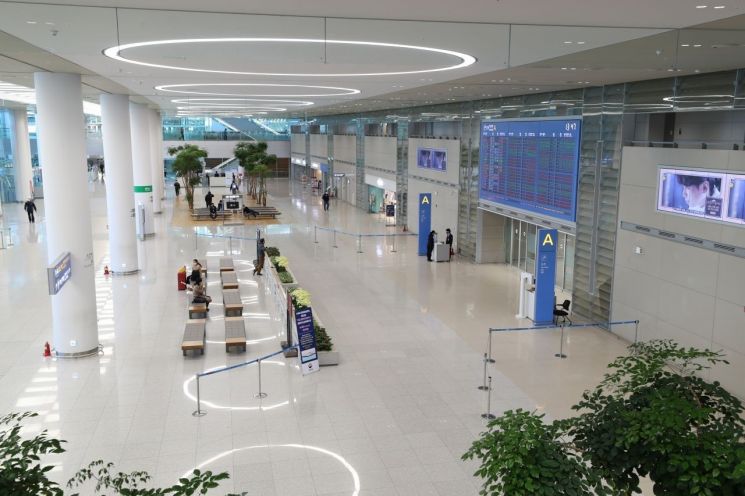
[Asia Economy Reporter Yu Je-hoon] The 'emergency system' triggered by the novel coronavirus infection (COVID-19) in the aviation industry is spreading to the two major airport corporations. Both corporations are partially returning executive salaries to overcome the crisis and are closely monitoring the potential long-term impacts of the situation.
According to the industry on the 28th, Incheon International Airport Corporation and Korea Airports Corporation recently entered an 'emergency system' by partially returning executive salaries. These two corporations are responsible for operating 15 airports nationwide.
Incheon Airport Corporation officially announced the start of an emergency management system as of the 26th and decided to return 30% of the salaries of executives, including the president, for the next four months. Korea Airports Corporation had earlier announced a salary return plan starting from the 25th, including a 30% return of the president's salary and 20% for executives and subsidiary presidents.
The two major corporations initiated the emergency system, led by executive salary returns, due to the sharp decline in air travel demand following the spread of COVID-19. In fact, since the first confirmed COVID-19 case on January 20, passenger transport records at both airports have plummeted. In the case of Incheon Airport, the fourth week of February saw a 51% decrease compared to the previous year, and the third week of March recorded a staggering 91% decrease compared to the previous year.
Ultimately, on the 24th, the number of passengers using Incheon Airport dropped to only 9,316, breaking the 10,000 mark. This is the worst performance in about 20 years since Incheon Airport opened in 2001. An aviation industry official said, "For now, the number of passengers is somewhat maintained due to many overseas Koreans returning worldwide amid the COVID-19 pandemic," adding, "Once this wave ends, the number of passengers at Incheon Airport will decrease further."
Accordingly, Incheon Airport has prepared an emergency operation plan based on passenger demand. If the daily passenger count is between 7,000 and 12,000, basic facilities such as immigration halls, shuttle trains, check-in counters, and runways will be operated on a reduced scale. If the daily passenger count drops to between 3,000 and 7,000, some commercial facilities and boarding terminals will be suspended, entering a quasi-shutdown state. If the daily passenger count falls below 3,000, services will be maintained at a minimum level.
Incheon Airport Corporation sees a high possibility of turning into a net loss if this situation continues. Accordingly, the corporation plans to raise a total of 975.1 billion KRW this year through bond issuance. A representative from Incheon Airport said, "If this trend continues, the annual passenger volume this year could decrease by about 70% compared to the previous year, putting the break-even point at risk."
Korea Airports Corporation, which seems relatively more stable due to the maintenance of domestic flights, is also facing difficulties. Korea Airports Corporation, which is enduring losses at most airports except for four major ones?Gimpo, Jeju, Gimhae, and Daegu?would face significant damage if these major airports also turn to losses.
Meanwhile, demands for support from airlines, ground handling companies, and commercial facilities related to airports are intensifying. An industry official said, "Both corporations are suffering a double burden of direct damage from the decrease in passenger demand and supporting national airlines."
© The Asia Business Daily(www.asiae.co.kr). All rights reserved.

















