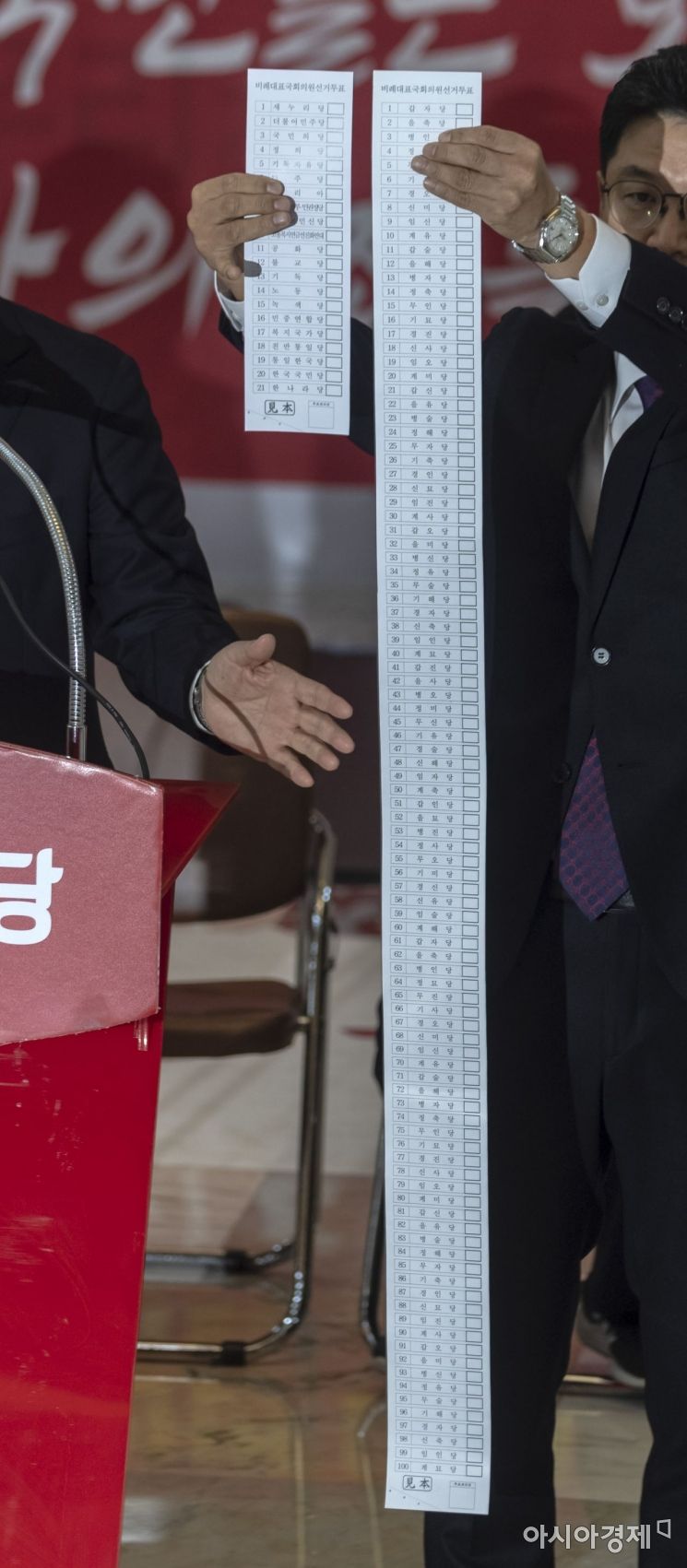
 Hwang Kyo-ahn, leader of the Liberty Korea Party, is showing a comparison between the proportional representation ballot based on the parties currently registered with the Central Election Commission and the ballot with the mixed-member proportional representation system applied at the Supreme Council meeting held in the Rotunda Hall in front of the National Assembly plenary session hall on the 23rd. Photo by Yoon Dong-joo doso7@
[Asia Economy Reporter Lee Ji-eun] With a total of 41 parties participating in the April 15 general election, the ballot paper is expected to reach nearly 50 cm in length. This is the longest ballot paper since the introduction of the party-list dual vote system in the 17th general election, and it confirms the warning by Hwang Kyo-ahn, leader of the Future United Party, who predicted that the ballot paper could exceed 1 meter due to the proliferation of proportional representation satellite parties.
The Central Election Commission announced on the 28th through a press release that out of the 51 registered parties, 41 will participate in both the constituency and proportional representation elections.
Although 38 parties initially expressed their intention to participate due to the introduction of the semi-linked proportional representation system, the number of parties confirmed to participate in the proportional representation election is 35, resulting in a ballot paper length of approximately 48.1 cm. This length includes the voting boxes, dividing lines, and top and bottom margins, making it nearly 15 cm longer than the 33.5 cm ballot paper used in the 20th general election. The Election Commission decided that when the number of parties exceeds 23, the height of the voting boxes will be maintained, but the dividing lines will be reduced from 0.3 cm to 0.2 cm, and the top and bottom margins will be reduced from 6.5 cm to 6.3 cm. This ballot paper length exceeds the 34.9 cm limit that can be processed by the ballot sorting machine, making manual counting inevitable.
The reason for the record length of the ballot paper lies in the semi-linked proportional representation system, which allows parties to gain seats if they surpass just 3% of the vote share. This has led to the proliferation of satellite parties and minor parties aiming for proportional representation seats.
Hwang’s prediction about the possibility of a "1-meter ballot paper" due to the semi-linked proportional representation system has come true. In his opening remarks at the National Assembly Rotunda Hall last December, Hwang warned, "You will realize how absurd the semi-linked proportional representation system is when you receive the ballot paper on April 15 next year. There are forecasts that the number of parties could exceed 100, and if all 100 parties are included, the ballot paper length would be 1.3 meters," highlighting the system’s drawbacks.
Although the scenario of over 100 registered parties did not occur as he warned, the ballot paper has become so long that it cannot be processed by the sorting machine, revealing the flaws of the semi-linked proportional representation system. The Future United Party, which warned about the system’s drawbacks, also contributed to the problem by leading the creation of satellite proportional representation parties.
Meanwhile, the ballot numbers assigned based on the number of seats are as follows: the Democratic Party of Korea received number 1, the Future United Party number 2, and the Minsheng Party number 3, with the Future Korea Party, Together Citizens’ Party, and Justice Party receiving numbers 4 to 6 respectively. On the party-list ballot paper for proportional representation, the Minsheng Party, assigned number 3, is listed first, followed by the Future Korea Party, Together Citizens’ Party, and Justice Party. This is because the Democratic Party and the Future United Party, assigned numbers 1 and 2, did not field proportional representation candidates. Numbers 7 to 10 are assigned to the Our Republican Party, Minjung Party, Korea Economic Party, and People’s Party based on seat count and previous election vote shares. The People’s Party (number 10), Pro-Park Shin Party (number 11), and Open Democratic Party (number 12) had the same number of seats, so their numbers were determined by drawing lots.
© The Asia Business Daily(www.asiae.co.kr). All rights reserved.

















