[Asia Economy Reporter Su-yeon Woo] Due to the impact of the novel coronavirus infection (COVID-19), the operating rate of Hyundai Kia Motors' overseas factories has dropped to the 10% range, making a production cliff overseas a reality. All factories overseas, except for those in Korea, China, and Mexico, have entered a 'shutdown,' making production disruptions at overseas factories inevitable.
According to the automotive industry on the 28th, most of Hyundai Kia Motors' overseas factories in the United States, Czech Republic, India, Brazil, Russia, Turkey, excluding Korea, China, and Mexico, have temporarily suspended operations.
In the United States, Hyundai Motor's Alabama plant halted operations from the 18th due to an employee's COVID-19 infection, and Kia Motors' Georgia plant will also temporarily stop operations for two weeks starting from the 30th. Hyundai Motor's Chennai plant in India has stopped production from the 23rd until the end of this month, and the S?o Paulo plant in Brazil will also halt production for nine days from the 23rd in accordance with government policy.
In Europe, Hyundai Motor's Czech plant and Kia Motors' Slovakia plant have been closed since the 23rd, and Hyundai Motor's Turkey plant also began closure early from the 27th to prevent the spread of COVID-19. In Russia, Hyundai Motor's Saint Petersburg plant will stop operations for five days from the 30th until the 3rd of next month.
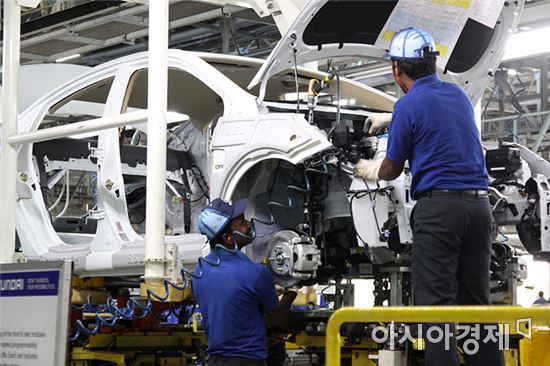 Hyundai Motor India Chennai Plant
Due to the successive shutdowns of overseas factories, Hyundai Kia Motors' overseas factory operating rate has fallen to the 10% range. According to the Korea Automobile Manufacturers Association, Hyundai Kia Motors has an annual overseas factory production capacity of up to 5 million units, but due to COVID-19, the current actual production is known to be only about 600,000 units.
The pandemic of COVID-19 is making the 'production cliff' a reality for automakers with production bases in overseas markets. The decrease in overseas production and demand of domestic automakers directly leads to difficulties for domestic suppliers.
According to a survey conducted by the Korea Automobile Manufacturers Association on the 19th and 20th targeting 75 domestic automakers and suppliers, over 90% of companies cited 'sales decline due to demand contraction (91.5%)' as the biggest difficulty. This was followed by difficulties in financing (36.6%), shortage of quarantine supplies (32.4%), instability in overseas factory operations (11.3%), uncertainty in overseas market demand (9.9%), and restrictions on overseas business trips and lack of government financial support (5.6%).
A representative from supplier A who participated in the survey said, "Due to the shutdown of the customer's local factory, the supply volume has decreased by more than 50% compared to last year," adding, "Financial institutions are urging early repayment of principal, making it difficult to secure operating funds."
Another representative from supplier B also said, "As the domestic economy contracts, sales are rapidly decreasing, but perhaps due to concerns that companies are becoming insolvent, financial institutions are accelerating moves such as loan recovery," and added, "Moreover, raw material suppliers are requesting cash transactions or collateral, so financing is the biggest problem."
© The Asia Business Daily(www.asiae.co.kr). All rights reserved.
















