Telegram 'Baksa Bang' Suspect Jo Joo-bin Obtained Victims' Personal Information Through Social Service Worker Collaboration for 'Blackmail'
Victims Report Personal Data Leaks Not Only in Public Institutions but Also on University Campuses
Experts Call for Expanded Support for Victims Suffering from 'Doxxing'
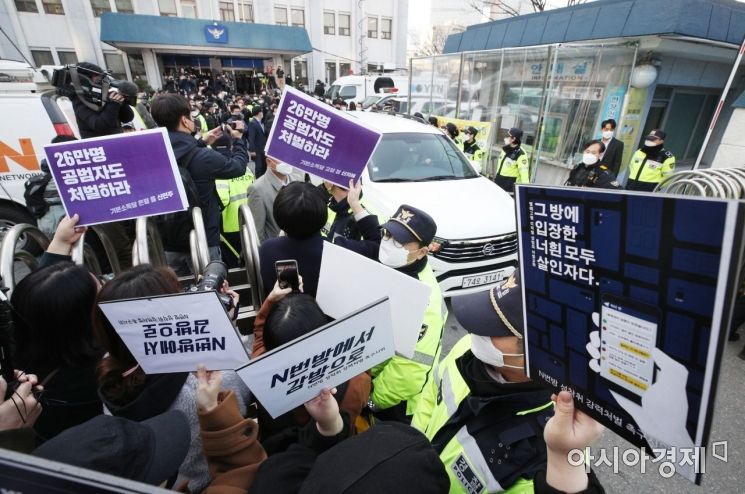 On the 25th, as the vehicle carrying Jo Joo-bin (25), the operator of the 'Doctor's Room' who is accused of producing and distributing sexual exploitation materials of women including minors on the internet messenger Telegram, left the Jongno Police Station in Seoul and headed to the prosecution detention center, citizens held a picket protest demanding severe punishment for Jo Joo-bin. Photo by Moon Ho-nam munonam@
[Asia Economy Reporters Suwan Kim and Intern Yeonju Kim] "It's terrifying that if someone sets their mind to it, they can find out even my family's personal information," "Is it even possible that anyone can easily access my personal data?"
The 'Doctor's Room' suspect Jo Joo-bin (25, in custody) and his accomplices, who threatened women to produce sexual exploitation materials and sold them on Telegram for money, obtained personal information through social service agents and used it as a tool for intimidation. If victims refused to comply with orders to film sadistic videos, they were threatened with revealing their personal information to family or acquaintances.
The problem lies in the fact that sensitive personal information such as names, ages, addresses, and resident registration numbers can be easily used for crimes like the 'Nth Room' case if those handling the data so desire.
Not only public institutions such as district offices where social service agents work but also recently in university campuses, there have been claims that administrative staff obtained students' personal information and engaged in conversations.
As a result, fears are growing about when and where personal information might be used as a tool for crime. For now, the government has decided to prepare comprehensive measures to strengthen management and supervision of social service agents working at district offices and community centers. Experts also pointed out that it is urgent to change the personal information of women victims whose data has been leaked.
◆ 'Doctor's Room' suspect Jo Joo-bin and accomplices recruited social service agents to extract victims' personal information
Social service agent A said in an interview with CBS's 'Kim Hyun-jung's News Show' on the 26th, "Social service agents working at district offices or community centers can access personal information if they set their minds to it while performing administrative support tasks," adding, "Basic information such as resident registration numbers, phone numbers, and addresses can be accessed, and even family members' personal information can be found out."
According to work regulations, when assigned to areas where there is a risk of corruption or complaints such as handling money or personal information, social service agents must work jointly with the responsible staff. However, A claims that this is often not properly followed in practice.
A pointed out, "There is a program that is not supposed to be used in principle, but social service agents handling complaints have separate IDs and passwords," adding, "There are no records of who accessed it and when, which is very dangerous."
◆ High risk of personal information exposure even on university campuses... My data accessible to anyone, including alma mater and income bracket
This is not just a problem in public institutions. It has been revealed that general students such as national work-study students and teaching assistants who handle administrative tasks at universities can easily obtain students' personal information.
An anonymous post on a university community exposed the widespread disclosure of personal information on campus. The writer said, "A classmate working as an undergraduate teaching assistant mentioned another classmate's grades and TOEIC scores while gossiping," and questioned, "Is it acceptable that a mere student, not even faculty staff, can check students' personal information?"
They also said, "They even mentioned another student's income bracket," expressing frustration, "How can any action be taken when there is no sense of responsibility for leaking personal information?"
B (28), who worked as a teaching assistant at a university for a year, said, "For administrative tasks such as instructor appointments and student scholarships, personal information-related documents are often exchanged via the school's shared email," adding, "The documents include names, resident registration numbers, addresses, as well as grades and alma mater."
B pointed out, "Since there are cases where family registers are submitted, if management is negligent, virtually all personal information could be exposed," and criticized, "I had thought about the possibility of misuse, and now what was bound to happen has happened."
Given this situation, women have come to carry the fear that they could always be targets of crime.
C (24), a university student, said, "I was horrified by the methods perpetrators involved in the Nth Room case used to find out victims' personal information," adding, "If the crime was committed by social service agents working at community centers, I think I could become a victim at any time."
C said, "Just thinking that I could be the one being threatened is terrifying," and pointed out, "How could anyone refuse the perpetrators' demands when they have personal information about your family and use it to threaten you?"
D (26), an office worker, said, "I'm scared that someone with ill intentions might enter my social network service (SNS) and dig up information. So I switched everything to private," adding, "Since the identities of Nth Room users have not yet been disclosed, I think we need to be cautious."
Experts emphasized the need for trustworthy, government-wide support for victims whose personal information was exposed in the Nth Room case.
Bae Bok-joo, Chairperson of the Justice Party's Minority Human Rights Special Committee (former head of the National Sexual Violence Counseling Center Council), said, "Victims of personal information exposure need legal assistance. To prevent further damage, practical support such as resident registration number changes, video deletion support, and psychological counseling must be provided," adding, "The process of changing identity information like resident registration numbers should be simplified, and strict confidentiality must be guaranteed."
Bae emphasized, "Above all, a strong message is needed to assure victims that they can trust the support system and disclose their victimization."
Additionally, the Ministry of the Interior and Safety (MOIS) announced on the 29th that it will prepare comprehensive measures to prevent recurrence of personal information leaks by social service agents. MOIS plans to educate public officials and social service agents to comply with the 'Social Service Agent Duty Management Regulations.'
They will conduct on-site inspections and take strict action if violations of the 'Act on Handling of Complaints' and duty management regulations are found.
Furthermore, comprehensive measures including strengthened management and supervision will be prepared to prevent recurrence of personal information leaks by social service agents.
*If you experience difficulties such as illegal filming or distribution of photos or videos, threats using such materials, or sexual harassment in cyberspace, you can receive support from the Women's Emergency Hotline 1366 or the Digital Sexual Crime Victim Support Center (02-735-8994).
© The Asia Business Daily(www.asiae.co.kr). All rights reserved.


















