Government Injects 1 Trillion Won Liquidity Emergency Fund
Operating Profit of 307 Billion Won
Net Loss After Deducting Interest on Borrowings
Coal, Nuclear Power, and Other Core Businesses in Decline
Ongoing Profitability Deterioration Causes
Accelerating Restructuring Including Fixed Cost Reduction
 On the 27th, the Doosan Tower building in Dongdaemun-gu, Seoul, is visible as the government decided to inject 1 trillion won into Doosan Heavy Industries, which is experiencing financial difficulties, through the Korea Development Bank and the Export-Import Bank of Korea. Photo by Jinhyung Kang aymsdream@
[Asia Economy Reporters Jeongsoo Lim, Gimin Lee] Doosan Heavy Industries & Construction, which received an emergency capital injection of 1 trillion KRW from the Korea Development Bank and the Export-Import Bank of Korea, plans to focus on preparing self-help measures for business normalization.
According to Doosan Heavy Industries & Construction and banking sources on the 27th, the company signed a loan agreement worth 1 trillion KRW with the Korea Development Bank and the Export-Import Bank of Korea on the same day. Doosan Corporation, the major shareholder of Doosan Heavy Industries & Construction, provided collateral worth a total of 1 trillion KRW, including common shares of Doosan Heavy Industries & Construction it holds, Doosan Tower, and treasury shares of Doosan Heavy Industries & Construction.
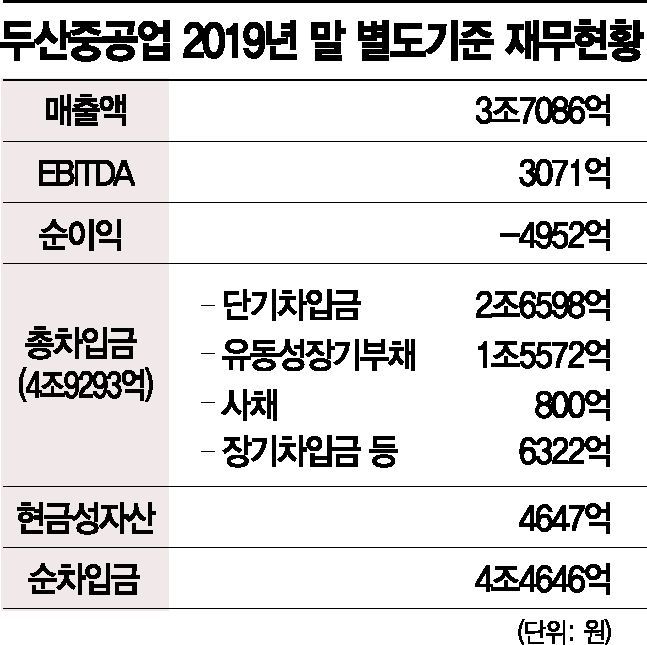
◆The immediate crisis is averted, but uncertainty remains= Despite the 1 trillion KRW emergency capital injection from the policy banks, Doosan Heavy Industries & Construction’s situation remains difficult. As of the end of last year, on a separate basis, the company’s borrowings amounted to approximately 4.93 trillion KRW. The problem is that most of these borrowings are short-term debts that must be repaid within one year. At the end of last year, short-term borrowings were 2.66 trillion KRW, and current portion of long-term debt was 1.56 trillion KRW. Roughly 4.2 trillion KRW must be repaid or refinanced within the year.
The company’s ability to repay its borrowings on its own has also significantly deteriorated. Doosan Heavy Industries & Construction’s annual EBITDA (Earnings Before Interest, Taxes, Depreciation, and Amortization) is 307 billion KRW, which, after deducting interest on borrowings, results in a net loss. Last year, the company posted a net loss of 533.8 billion KRW. It is evaluated that the company’s earnings are barely sufficient to cover interest payments on borrowings. Due to credit rating deterioration, issuing corporate bonds is virtually impossible. The financial market has tightened due to the COVID-19 pandemic, making it difficult even to secure ultra-short-term funds such as commercial paper (CP) and electronic short-term bonds. While the 1 trillion KRW support from the Korea Development Bank and the Export-Import Bank can temporarily ease the urgent situation, the market assesses that resolving short-term borrowings will be difficult without additional self-help measures.
The worsening situation of Doosan Heavy Industries & Construction is attributed to the global market downturn in its core businesses such as coal and nuclear power generation, and profitability deterioration due to changes in government power supply policies. In particular, six new nuclear reactors, including Shin Hanul Units 3 and 4, which were included in the 7th Basic Plan for Electricity Supply and Demand, and three coal-fired power plants worth 3 trillion KRW were excluded from the 8th plan due to the current government’s nuclear phase-out and eco-friendly power generation policies, resulting in the disappearance of orders worth about 10 trillion KRW. Consequently, Doosan Heavy Industries & Construction, which had annual sales exceeding 7.7 trillion KRW on a separate basis in 2012, saw its sales drop to the 3 trillion KRW range last year. Analysts say that normal business operations alone were insufficient to cover financial costs.
◆Focusing on self-help measures... speeding up restructuring= Doosan Heavy Industries & Construction is concentrating on preparing self-help measures. It plans to accelerate workforce restructuring to reduce fixed costs. Since the end of last month, it has been accepting voluntary retirement applications from about 2,600 employees aged 45 and above (born in 1975 or earlier). Currently, about 650 employees have applied for voluntary retirement, and procedures such as executive interviews are being finalized. The company also believes that temporary layoffs for some employees are necessary. Doosan Heavy Industries & Construction has offered to pay 70% of wages to employees subject to temporary layoffs, but the labor union has rejected this, making negotiations difficult. Last year, the company reduced its workforce by 20% and implemented rotational layoffs for 2,600 employees. At that time, about 300 employees were transferred to affiliates such as Doosan Infracore and Doosan Bobcat. Additionally, at the end of last year, to improve financial structure, Doosan Corporation injected capital by contributing approximately 2.382 billion KRW worth of 2.94 million shares of Doosan Mecatec Co., Ltd. in kind.
Furthermore, while continuing sales activities in overseas markets such as the Middle East and Southeast Asia, the company is diversifying its business into areas such as domestic gas turbine production, wind power, hydrogen, and nuclear power plant dismantling. Doosan Heavy Industries & Construction is expected to secure orders worth about 2 trillion KRW this year for coal-fired power plants and seawater desalination projects in the Middle East and Southeast Asia. It is also steadily negotiating with Korea Hydro & Nuclear Power and Korea Electric Power Corporation regarding nuclear power plant dismantling and gas turbine development, accelerating related technology development. Korea Electric Power Corporation announced that it has commercialized a gas turbine starting device jointly developed with its four power generation subsidiaries?Jungbu, Seobu, Nambu, and Dongseo Power?and Doosan Heavy Industries & Construction.
However, since it is expected to take time for Doosan Heavy Industries & Construction to normalize its management, there are also calls for the government to continue its nuclear power plant construction plans for the time being. On the 24th of this month, the Doosan Heavy Industries & Construction labor union and the Changwon Chamber of Commerce and Industry issued an appeal titled "Please protect local jobs and livelihoods. We earnestly urge the resumption of construction of Shin Hanul Units 3 and 4," stating, "The value of products produced has turned entirely into costs due to the suspension of construction of Shin Hanul Units 3 and 4 nuclear reactors, and the once-bustling workplace atmosphere is now filled with employees’ sighs," appealing to the government.
Meanwhile, it is reported that within Doosan, including Chairman Park Jeong-won of Doosan Group and the management team, there is consideration of donating personal assets to support business normalization.
© The Asia Business Daily(www.asiae.co.kr). All rights reserved.


















