Reflecting Expectations for Economic Stimulus
Public Pension Funds Have Room for Stock Inclusion; Short Covering Also Influences
Optimism on Volatility Increase Is Not Easy
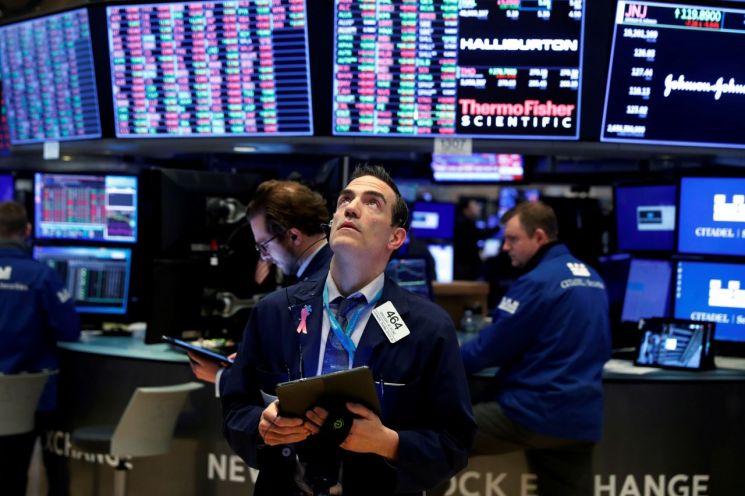
[Asia Economy New York=Correspondent Baek Jong-min] After experiencing a major plunge for more than two weeks, the U.S. stock market entered a strong bull market this week. This was driven by expectations for the implementation of an economic stimulus bill despite a surge in U.S. unemployment numbers. However, with a high likelihood of a recession in the second quarter and voices calling for additional stimulus measures depending on the situation, volatility remains significant.
On the 26th (local time) in the New York stock market, the Dow Jones Industrial Average surged 6.38% (1,351.62 points) to close at 22,552.17, the S&P 500 rose 6.24% (154.51 points) to 2,630.07, and the Nasdaq Composite increased 5.60% (413.24 points) to 7,797.54.
In particular, the Dow and S&P 500 each rose for three consecutive days, leading to assessments that they have effectively entered a bull market. The Dow has risen 21% over the past three days. A rise of more than 20% from the low point classifies the market as a bull market, while a drop of more than 20% from the high point is classified as a bear market. The Wall Street Journal (WSJ) reported that "the Dow Jones has technically entered a bull market."
The market attributed the rise in the New York stock market that day to expectations for economic stimulus measures. Before the market opened, the U.S. announced that new weekly unemployment claims reached a staggering 3.28 million, the highest ever recorded. The previous record was 695,000 during the second oil shock in 1982.
However, the expectation that a stimulus package of up to $2.2 trillion had passed the Senate the day before and would pass the House on the 27th was even greater. Jeffrey Kleintop, Chief Global Investment Strategist at Charles Schwab, said, "Investors expect the House to pass the stimulus bill."
On the same day, key officials tried to calm the market through communication. Jerome Powell, Chair of the U.S. Federal Reserve (Fed), unusually appeared on broadcast and said, "It seems the U.S. economy has entered a recession," but also stated, "The Fed’s ammunition is not lacking." This was interpreted as indicating the possibility of additional intervention if market turmoil occurs.
Steven Mnuchin, U.S. Treasury Secretary, emphasized, "I talk with Chair Powell up to 30 times a day to coordinate the government’s response to this situation," and said, "We have approved all of the Fed’s requests for bond-buying facilities."
With the stock price rise, the market interpreted that the liquidity crunch might have been overcome for the time being. The dollar index, which shows the value of the dollar against major currencies, fell 1.50% from the previous day to 99.480. The dollar index had surged to 103.605 on the 19th due to cash preference. The U.S. 10-year Treasury yield also rose slightly from the previous trading day to 0.814%. The Chicago Board Options Exchange (CBOE) Volatility Index (VIX), known as the "fear index," closed down 4.61% at 61.00 compared to the previous trading day.
JPMorgan predicted that "major institutional investors such as pension funds, having recently reduced their bond allocations, will engage in rebalancing by purchasing stocks," and estimated that $800 billion to $900 billion could flow into the stock market by next month.
However, given the high market volatility, it is still too early to be reassured. Bank of America (BoA) assessed, "Although the Fed’s aggressive actions have calmed the market, the COVID-19 crisis is ongoing and economic activities are halted in many places, so the possibility of further market turmoil remains."
© The Asia Business Daily(www.asiae.co.kr). All rights reserved.

















