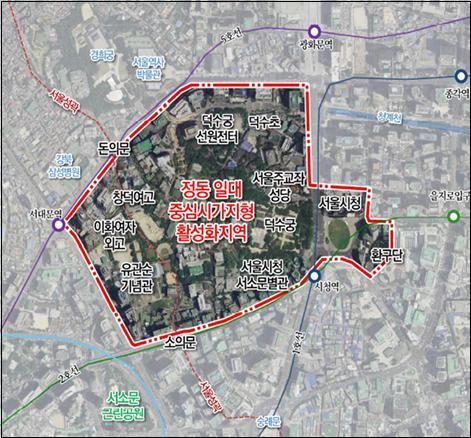
[Asia Economy Reporter Donghyun Choi] The urban regeneration project in the Jeongdong area, known as a living museum in the heart of Seoul, is set to be fully launched.
On the 26th, Seoul City held the 2nd Urban Regeneration Committee meeting and announced on the 27th that it had approved the revised Seoul Jung-gu Jeongdong Area Urban Regeneration Activation Plan.
Jeongdong is the original space of the Korean Empire era, centered around Deoksugung Palace, the imperial palace of the Korean Empire, and was the hub of modernization in Korea, where Western culture such as modern religion, education, and medical care was introduced, and where diplomatic missions of world powers operated. It is often called a living history textbook and museum in the city center. Over the past 100 years, the urban organization, including the street network and land parcels, has been well preserved, and as a center of modern and contemporary culture, it houses numerous cultural assets and architectural heritage, holding significant historical and cultural value. However, during the Japanese colonial period, the original historical forms of the old Deoksugung palace grounds and Hanyang Fortress were damaged, and now the area is mainly remembered only for the Deoksugung Stone Wall Road, indicating a need for recognition and revitalization of its identity.
Seoul City plans to promote the 'Jeongdong Historical Regeneration Activation' to restore Jeongdong's historicity and identity and make it a representative historical and cultural landmark of Seoul through active preservation and utilization of historical and cultural assets, and the establishment of a network based on cooperation among local stakeholders. Since Jeongdong was designated as a Seoul-type Stage 2 Urban Regeneration Activation Area in 2017, Seoul has been exploring various activation measures including building local consensus, establishing cooperation foundations, and expert consultations.
The urban regeneration of the Jeongdong area will be promoted as a historical regeneration model based on historicity that citizens can empathize with, called 'historical and locational value regeneration.' Seoul City has prepared three main strategies: establishing a historical walking network, creating regeneration activation hubs, and cultivating historical landmarks, and plans to implement unit regeneration projects to realize these strategies. In particular, the Jeongdong area historical regeneration project is expected to have high feasibility and regional ripple effects as it is being carried out in a cooperative relationship with local stakeholders through an early-established regeneration platform involving institutions and organizations in the region for project discovery, planning, and implementation.
A Seoul City official said, "The Jeongdong Area Urban Regeneration Activation Plan is scheduled to be officially announced later this month," and added, "Based on the local council, each project will proceed step-by-step in earnest, enhancing the unique historical and locational value of the Jeongdong area."
© The Asia Business Daily(www.asiae.co.kr). All rights reserved.

















