"Lost Emotional Expressions While Working"
Office Workers Complain of 'Burnout' Syndrome
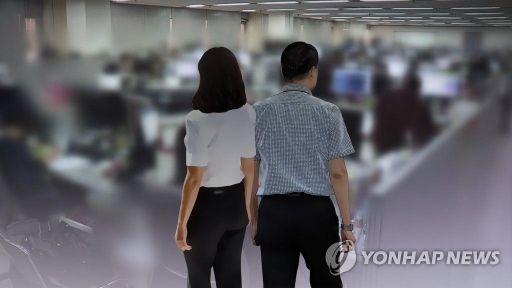
[Asia Economy Reporters Kay Kim and Seulgi Kim (Intern)] "Since starting work, I have lost my emotions and facial expressions. I rarely smile now and even have a gloomy look. I am also experiencing symptoms similar to depression."
Office worker A said, "My personality changed after starting work." He added, "I used to be lively and easily laugh at trivial things. I return to my true self on weekends, but anxiety and frustration start creeping in from Sunday night."
Recently, the number of people in their 20s and 30s reporting personality changes or feelings of depression due to work life has been increasing. They confessed to feeling depressed because of stress from work, an uncertain future, and dissatisfaction with their company.
A survey conducted by job portal JobKorea on 547 office workers about "company depression" revealed that 8 out of 10 workers have experienced so-called "company depression."
Among company types, large corporation employees reported the highest experience of company depression at 87.5%, with junior and assistant manager levels?typical ranks for people in their 20s and 30s?accounting for 81.0% and 85.6%, respectively.
The most cited cause of "company depression" was "an uncertain vision for my future." This was followed by △uncertain vision for the company (37.6%) △excessive workload (20.6%) △lack of salary or raise despite performance (14.0%) △relationship with supervisors (13.6%) △unclear position within the organization (12.3%), among others.
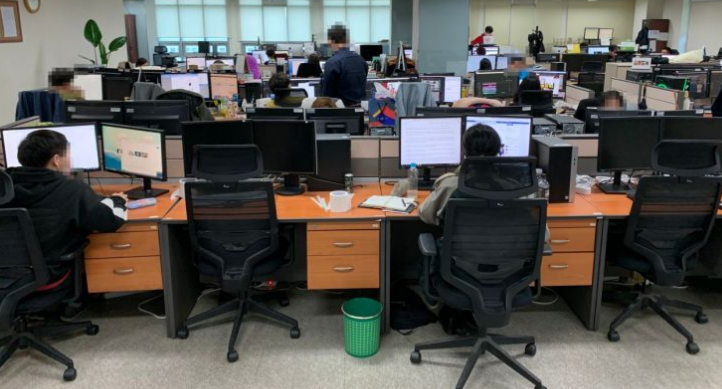 An office of a company located in Seoul. Employees are focused on their work. Photo by Seulgi Kim, intern reporter sabiduriakim@asiae.co.kr
B (26), who has been working for just over a year, said, "I was never a gentle person, but after joining the company, stress seems to have made my personality more irritable."
B added, "Now, I curse as soon as I open my mouth, and positive thoughts rarely come to mind. Being pushed around like this, I can't calm down even on weekends and sometimes unintentionally get angry at my parents. They say quitting will help, but I can't just quit without a plan."
C (25) also said, "When I was a student, people said I was outgoing, and I found it easy to make friends and express my opinions in groups."
C continued, "But after starting work, I felt like I was part of a group where my words and thoughts didn't get through. Since then, I have become more reserved and eventually developed this as part of my personality."
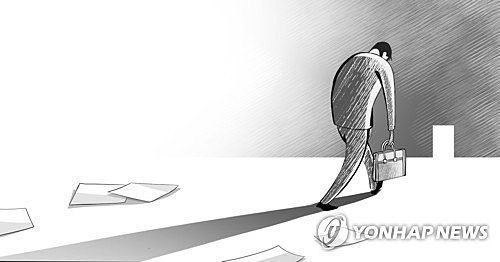
Experts point to "burn-out syndrome" as one reason why the younger generation experiences depression related to work. They explained that 7 out of 10 office workers suffer from this syndrome.
Burn-out syndrome refers to a state of physical and mental exhaustion that causes psychological distance from work and an increase in cynical feelings about job tasks.
A survey by JobKorea last year of 492 office workers about their experience with burn-out syndrome found that 95.1% had experienced it during their work life.
Among junior and assistant manager level workers, mostly in their 20s and 30s, 98.0% reported experiencing burn-out syndrome, followed by 94.9% of junior staff.
The 11th International Classification of Diseases (ICD-11), adopted at last year’s World Health Organization (WHO) General Assembly, defines burn-out syndrome as "a syndrome resulting from chronic workplace stress that has not been successfully managed."
Yoonjung Kim, counseling director at the Marriage and Family Relations Research Institute, appeared on YTN Radio's "Your Prime Today" and explained, "70% of office workers suffer from burn-out syndrome."
Kim said, "South Korea has the longest working hours among OECD countries. Long working hours mean there is very little time to rest or play."
She added, "Stress can have positive aspects, motivating people to perform and work harder, but if it is not properly relieved through rest or leisure, it accumulates in the body. When suffering from burn-out syndrome, you don't want to answer calls from work and feel like running away somewhere."
© The Asia Business Daily(www.asiae.co.kr). All rights reserved.



















