Measures Unseen Even During the Foreign Exchange and Financial Crises
Unlimited Liquidity Supply to Financial Institutions

[Asia Economy Reporter Eunbyeol Kim] The Bank of Korea (BOK) has finally pulled out the 'unlimited money printing' card. In order to mitigate the real and financial shocks caused by the novel coronavirus disease (COVID-19), the BOK decided to utilize its note-issuing power to inject money. Although the funds are supplied indirectly through financial institutions, the fact that liquidity is supplied regularly every week without limits can be regarded as quantitative easing.
This is the first time in history that the BOK has decided to supply unlimited liquidity, a measure never taken even during past foreign exchange or financial crises. The background for the BOK's use of its note-issuing power includes the U.S. Federal Reserve's (Fed) declaration of 'unlimited quantitative easing' and the limitations of support that commercial banks and policy financial institutions can provide.
◆Unlimited Purchase of Financial Institutions' RP... "First Ever Quantitative Easing"= On the morning of the 26th, the BOK held a Monetary Policy Board meeting and approved amendments to the 'Bank of Korea's Open Market Operation Regulations and Financial Institution Loan Regulations,' focusing on unlimited purchases of repurchase agreements (RP) and the expansion of eligible institutions and securities for open market operations. Typically, the BOK conducted RP purchases as needed through resolutions by the Monetary Policy Board, but from now on, it will open the RP purchase window weekly and supply unlimited funds to financial institutions in need of liquidity. The interest rate ceiling is set at 0.85%, which is the base rate (annual 0.75%) plus 0.1 percentage points. The bidding method will allocate the entire amount without limit. The bidding rate will be announced separately each time.
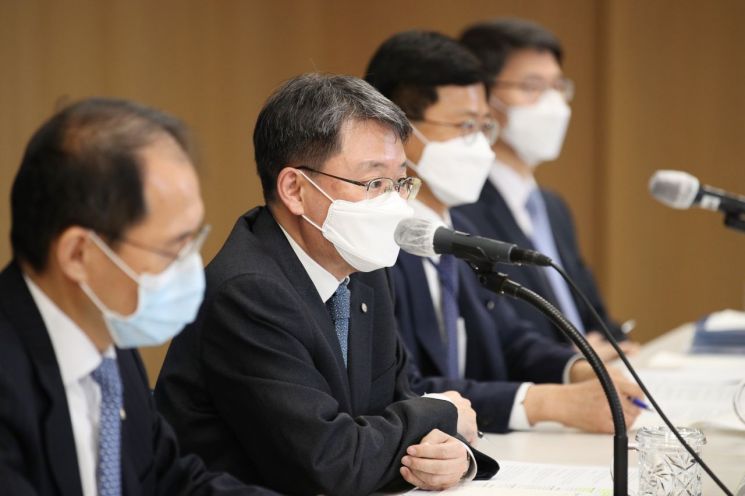
BOK Deputy Governor Yoon Myeon-sik stated regarding the BOK's measure, "It is not far off to consider this quantitative easing." Quantitative easing refers to the method used by major advanced countries' central banks to supply money after lowering policy rates to zero (0) and having no room to reduce rates further. It mainly involves purchasing government bonds or mortgage-backed securities (MBS) in specific amounts or periods to induce a sustained large drop in long-term interest rates. Deputy Governor Yoon added, "In that sense, the liquidity support system announced today by the BOK, which supplies funds in full according to market demand, differs somewhat in nature from the quantitative easing of other advanced central banks. However, if one asks whether supplying the full demand according to market needs is de facto quantitative easing, it cannot be denied, and it is not far off to see it that way."
Deputy Governor Yoon also said, "We will decide whether to extend the measures after July based on market conditions and bidding results."
◆Financial Sector Can Borrow More Easily from BOK... Cooperation with Government Measures= The BOK will also expand the eligible institutions for borrowing through open market operations. The BOK added 11 securities companies to the eligible institutions, increasing the number of non-bank institutions eligible for RP transactions from the current 5 to 16. Under the previous system, securities companies that found it difficult to borrow from the BOK can now borrow funds. Eligible securities have also been expanded to include 8 special bonds issued by public institutions. Bonds issued by Korea Electric Power Corporation, Korea Expressway Corporation, Korea Gas Corporation, Korea Land and Housing Corporation, Korea Railroad Corporation, Korea Rail Network Authority, Korea Water Resources Corporation, and Small and Medium Business Corporation have been added. The expansion of eligible securities that can be used as collateral when borrowing means there are more ways to borrow funds.
The BOK's measures have also strengthened the government's 'Livelihood and Financial Stability Package Program' worth over 100 trillion won. To create a support program exceeding 100 trillion won, financial institutions' investments are essential, but many financial institutions were reluctant to support due to concerns about profitability deterioration amid the COVID-19 crisis and low interest rate environment. Deputy Governor Yoon said, "These stabilization measures will contribute to financial market stability and further facilitate the smooth supply of liquidity necessary for the government's livelihood and financial stability package." Although the expanded RP purchase target size is estimated at 70 trillion won, he added that it is still too early to judge how much money can be supplied through this measure.
An official from the Ministry of Economy and Finance also evaluated, "If the central bank actively plays a role by implementing policy responses never done even during the foreign exchange crisis, it is expected to greatly help stabilize the financial market," adding, "The effect of policy cooperation will increase further."
◆How Much Liquidity Will Flow into the Real Economy Remains a Future Task= However, it remains to be seen how private financial institutions will evaluate the conditions and volume of RP purchases presented by the BOK. Future challenges include how banks that receive unlimited liquidity will efficiently channel funds to the field, and how much they can alleviate market instability. There are also calls to induce commercial banks to align the funds they receive with government policies to support the real economy.
Deputy Governor Yoon explained, "The bonds currently under stress in the bond market are not government bonds but other bonds," and added, "While the simple purchase of government bonds is not excluded, the introduction of full RP purchases that meet market demand is the purpose."
The expanded RP purchase size through this measure is estimated at about 70 trillion won.
The BOK believes that the credit risk associated with unlimited liquidity supply is not significant. Deputy Governor Yoon said, "Since it is limited to bonds that have received the highest 'Triple A' rating from domestic credit rating agencies and have government loss compensation clauses, we think credit risk has been minimized," adding, "There is no significant separate risk or cost."
There were also claims in the market that the BOK should directly purchase corporate bonds and commercial papers (CP) without going through bond stabilization funds. However, the BOK's position is that it would be difficult if there are no eligible securities to collateralize the bonds to be purchased. Deputy Governor Yoon said, "If the government guarantees securities, I think it would be easier for the Monetary Policy Board to decide on purchases," but added, "Government guarantees for corporate bonds require the consent of the National Assembly, and whether a national consensus can be formed on that matter is a separate issue."
As the BOK has effectively implemented quantitative easing, attention is also focused on whether it will lower the base interest rate in the future. Deputy Governor Yoon said, "There was no discussion related to the base rate at today's meeting," and added, "The base rate decision will be discussed at the regular Monetary Policy Board meeting scheduled for April 9."
© The Asia Business Daily(www.asiae.co.kr). All rights reserved.


















