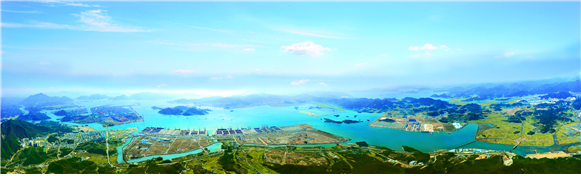
[Asia Economy Honam Reporting Headquarters Reporter Lee Hyung-kwon] The Gwangyang Bay Area Free Economic Zone Authority (Commissioner Kim Gap-seop, hereinafter Gwangyang Economic Authority) announced on the 25th that since its establishment in 2004, it has attracted 372 companies and investments worth 20.5312 trillion KRW over 16 years, contributing to regional economic revitalization and job creation.
Since its opening, it has focused on attracting logistics companies to develop Gwangyang Port as a logistics hub in Northeast Asia, attracting investments to strengthen the competitiveness of existing core industries, improving residential conditions, and developing tourism.
Yulchon Industrial Complex, created by reclaiming sea surface since 1994, had been stagnant due to the cancellation of Hyundai Motor's agency development contract, but through active investment attraction activities, 84% of the complex has been sold.
Yulchon Industrial Complex houses excellent companies such as Hyundai Steel, POSCO Chemical, and Samwoo Heavy Industries, providing quality jobs to the local community and playing a pivotal role in regional industrial development.
Shindae Rear Complex, developed as a hinterland complex of the Gwangyang Bay Area, has sold 10,700 households across 9 complexes to date, rapidly emerging as a prestigious residential complex. Following the Shindae district, the Gwangyang Economic Authority is also promoting the development of the Seonwol High Park complex with 3,000 households.
Se-pung Industrial Complex succeeded in attracting foreign-invested company Gwangyang Aluminum and is focusing its capabilities on generating hinterland cargo volume for Gwangyang Port through designation as a Gwangyang Port hinterland complex.
This year, it secured 2.1 billion KRW in national funds for the designation of Gwangyang Port hinterland complex and was designated as a special support area for small and medium enterprises.
The Gwangyang Economic Authority plans to seize the two goals of job creation and cargo volume supply by utilizing these opportunities.
If Se-pung Industrial Complex is designated as a Gwangyang Port hinterland complex, it is expected to contribute to investment activation by reducing the initial burden on entrepreneurs through low rent and customs suspension, thereby lowering initial investment costs.
In particular, to develop the Gyeongdo district as a new marine leisure tourism hub in Northeast Asia, rapid administrative support for development plan and implementation plan changes and follow-up measures after passing the preliminary feasibility study for the Gyeongdo access road are being accelerated.
The project operator, Mirae Asset Consortium, plans to invest more than 1 trillion KRW by 2029 to create world-class marine leisure facilities such as a 6-star hotel, marine cable car, and water park.
Commissioner Kim Gap-seop said, “For 16 years since its establishment, the Gwangyang Economic Authority has devoted all its capabilities to injecting economic vitality into the Gwangyang Bay Area. Although there are difficulties in attracting companies due to the global economic downturn caused by COVID-19, we are doing our best to attract investments to achieve this year’s goal of 1 trillion KRW.”
He added, “We will create future new growth engines for the Gwangyang Bay Area through the advancement of existing core industries such as steel and petrochemicals and the agglomeration of new industries suitable for the 4th industrial era.”
© The Asia Business Daily(www.asiae.co.kr). All rights reserved.

















