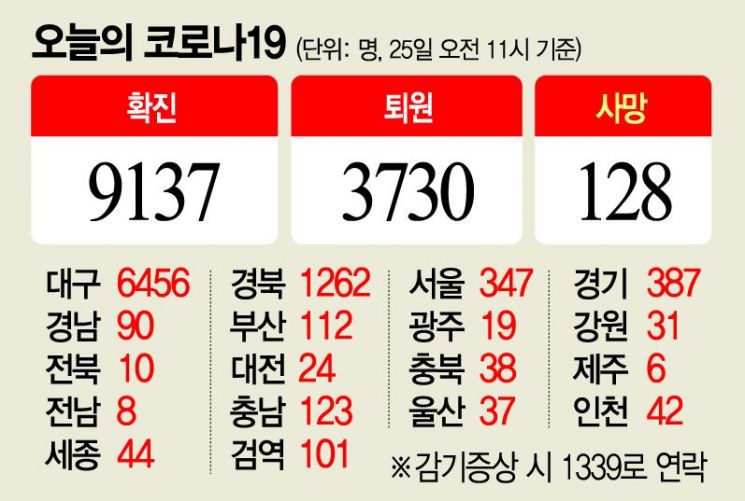
[Asia Economy reporters Choi Dae-yeol, Kim Heung-soon, Jo Hyun-ui] The number of new confirmed cases of the novel coronavirus infection (COVID-19) in South Korea has returned to triple digits after four days. According to the Central Disease Control Headquarters for COVID-19, as of midnight on the 25th, the number of new cases increased by 100 from the previous day, totaling 9,137. The increase was influenced by 34 additional imported cases from Europe and the United States, where confirmed cases are surging. In response to the sharp rise in imported cases, the government decided to implement diagnostic testing focused on symptomatic individuals and transfer to residential treatment centers for arrivals from North America, mainly the United States, following measures for arrivals from Europe. A major overhaul of the domestic quarantine system is expected. The health authorities are preparing countermeasures focusing on arrivals showing COVID-19 symptoms such as fever or cough, but confirmed cases have also emerged among asymptomatic domestic arrivals, who constitute the majority. This has revealed gaps in the system allowing these cases to enter the community unprotected, making urgent measures necessary.
Imported Cases Surpass Daegu
Sharp Increase to 90 in Three Days
55 from Europe, 31 from the Americas
On this day, the number of new imported cases ranked first nationwide, exceeding the 14 cases reported in Daegu, the local government with the highest number of confirmed cases. The numbers have been increasing daily, changing the leading digit from 13 on the 23rd, to 20 on the 24th. These figures reflect only cases identified through airport quarantine; including those confirmed by local governments, the number of imported cases has risen from 13 to 90 over the past three days. Among these 90 cases, 55 are from Europe and 31 from the Americas, including the United States.
Based on this, the Central Disaster and Safety Countermeasures Headquarters for COVID-19 announced that from midnight on the 27th, enhanced quarantine measures will be applied to arrivals from the United States. Diagnostic testing will focus on symptomatic individuals, with consideration given to conducting universal testing later. Domestic citizens and long-term foreign residents will enter 14-day self-quarantine and undergo testing if symptoms develop. Short-term foreign visitors who cannot self-quarantine will be tested at the airport (facility) and allowed entry if negative.
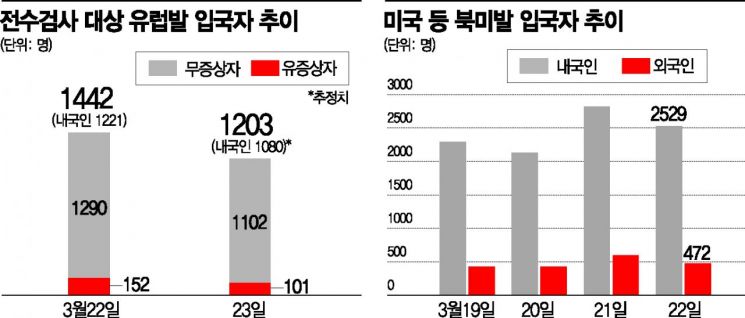
If universal diagnostic testing for arrivals from the United States is implemented, the number of tests for imported cases will increase more than threefold compared to now. On the first day of implementing measures for arrivals from Europe, 1,442 people (1,221 domestic citizens) entered, and on the 23rd, 1,203 people (1,080 domestic citizens, estimated) arrived. Approximately 3,000 arrivals from North America, including the United States, will be added. The number of arrivals from North America was 2,719 on the 19th, 2,546 on the 20th, 3,414 on the 21st, and 3,001 on the 22nd, with domestic citizens accounting for about 85%.
Self-Quarantine for U.S. Arrivals, Universal Testing Under Consideration
Asymptomatic Domestic Citizens Sent Home... Concerns Over Transmission During Transit
As of 2 p.m. on the 24th, the government and health authorities decided that asymptomatic domestic citizens arriving from Europe will be sent to their residences or destinations for self-quarantine without diagnostic testing and will be required to undergo testing at the local health center within three days. Previously, all symptomatic arrivals from Europe waited at airport quarantine facilities for testing, while asymptomatic arrivals were moved to temporary isolation facilities, tested, and sent home if negative.
However, with 1,200 to 1,400 arrivals from Europe daily, the time required for testing and result confirmation became lengthy, and concerns about cluster infections arose due to contact between symptomatic and asymptomatic individuals, prompting a change in policy. Approximately 1,200 isolation rooms previously used for asymptomatic individuals are now being secured to accommodate symptomatic arrivals from the United States. However, concerns arose from the first day of implementation. Asymptomatic domestic citizens arriving from Europe moved to their destinations without additional measures.
An official from Incheon Airport Quarantine Office stated, "Asymptomatic domestic citizens were only given self-quarantine guidelines and allowed to pass through the quarantine office as is." If these individuals used public transportation or had contact with family or acquaintances in the community, positive results from tests conducted within three days could lead to secondary and tertiary transmissions, causing additional cases. Kwon Jun-wook, Deputy Director of the Central Disease Control Headquarters, said, "Since positive cases may emerge among asymptomatic individuals, we will make every effort to prevent any community transmission or damage caused by this."
© The Asia Business Daily(www.asiae.co.kr). All rights reserved.


















