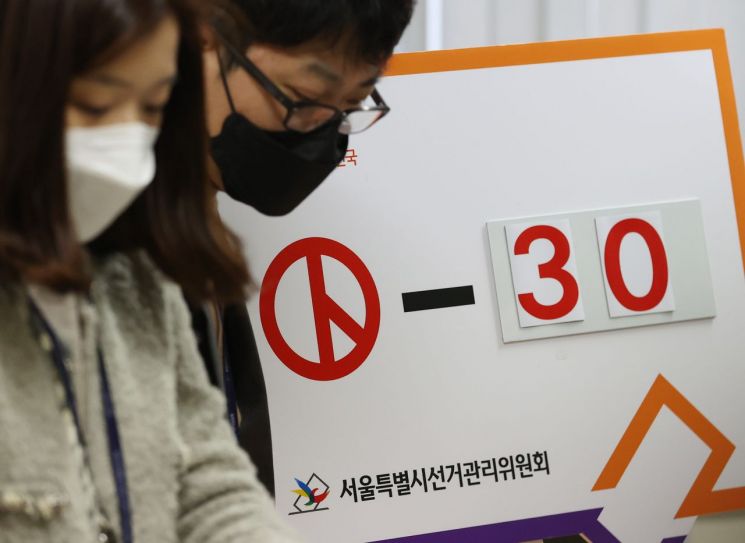
[Asia Economy Reporter Park Cheol-eung] The National Election Commission is conducting a voter awareness survey to gauge the intention to vote, and plans to devise extraordinary measures if the results show significantly low figures. Given that the election is being held amid the unprecedented novel coronavirus disease (COVID-19) crisis, there are concerns about historically low voter turnout. The Election Commission initially aimed to operate separate polling stations exclusively for quarantined individuals as a primary countermeasure, but currently, health authorities maintain that even travel to polling stations is not permitted.
On the 25th, an Election Commission official stated, "We are currently conducting a voter awareness survey through Gallup Korea, and the results are expected to be released around early next month. In past general election surveys, turnout intention was estimated at around 60-70%, but if it comes out much lower, we will need to find extraordinary measures again. Depending on the results, we will consult with political circles and health authorities," he said.
In addition to disinfection of polling stations, the Election Commission announced special operational guidelines on the 19th, including mandatory mask-wearing for voters, temperature checks, and maintaining at least 1 meter distance between lines. Nevertheless, it is generally expected that voter turnout will inevitably decline due to anxiety.
Measures such as mask distribution or extending early voting periods were also discussed but failed to materialize due to budget and supply issues, as well as difficulties in amending laws. The Election Commission considers operating separate polling stations exclusively for voters self-quarantined due to COVID-19 infection as the most effective measure, but this requires exceptional relaxation of movement restrictions.
An Election Commission official said, "There are about 5,400 people self-quarantined due to infection, and if these individuals vote separately, it would greatly alleviate voters' anxiety," adding, "We have continuously consulted with health authorities, but they have expressed reluctance, saying that relaxing movement restrictions even for voting purposes is difficult. Nonetheless, if the voter intention survey results come out significantly low, we will discuss it once again."
Looking at historical general election turnout rates, it rose continuously from 46.1% in 2008, 54.2% in 2012, to 58% in 2016, but this time it is expected to take a direct hit due to COVID-19. In fact, the abstention rate in the first round of France's local elections held on the 15th was 56%, 20 percentage points higher than the 2014 local elections. The schedules for local elections in the UK and the Democratic presidential primaries in the US were also postponed.
This general election is even more concerning due to fierce controversy over 'tricks' related to proportional representation-only parties, in addition to COVID-19. The impact on voter turnout by generation is also a matter of interest.
Hong Hyung-sik, director of Hangil Research, said, "Voter turnout will vary depending on how much the number of confirmed cases decreases by election day," adding, "The turnout of the relatively more vulnerable elderly may decrease, but those dissatisfied with the government's response may actually vote more actively."
© The Asia Business Daily(www.asiae.co.kr). All rights reserved.

















