[Asia Economy Reporter Kim Bo-kyung] From now on, annual leave accrued during the first year of employment will automatically expire if not used within one year from the date of joining. Additionally, a system to promote the use of annual leave will be established for workers with less than one year of service and those with an attendance rate below 80% over one year.
On the 24th, the government deliberated and approved five employment-related bills under the Ministry of Employment and Labor, including the Labor Standards Act, Industrial Safety and Health Act, and the Korea Employment and Labor Education Institute Act, at the Cabinet meeting.
According to the amended law, up to 11 days of annual leave accrued in the first year of employment will naturally expire if not used within one year from the date of joining. Therefore, annual leave accrued in the first year must be fully used within one year, and in the second year, only up to 15 days of annual leave accrued that year can be used. Previously, employees could combine the first and second years’ annual leave to use up to 26 days at once.
This legal amendment is expected to reduce the burden on employers who previously had to pay up to 26 days of annual leave allowance when an employee resigned shortly after completing one year of service.
The use promotion system will also apply to annual leave for workers with less than one year of service and those with an attendance rate below 80% in the previous year among employees with more than one year of service.
The use promotion system exempts employers from the obligation to compensate monetarily for unused annual leave that expires when employees do not use their leave despite the employer’s efforts to encourage its use. Until now, this system was only applied to employees with an attendance rate of 80% or higher over one year.
An official from the Ministry of Employment and Labor stated, "The annual leave system has been designed to operate in line with the purpose of the legal amendment, which is to strengthen the right to rest for new employees rather than serve as a means of wage compensation," adding, "It will apply to annual leave accrued after the law’s enforcement date."
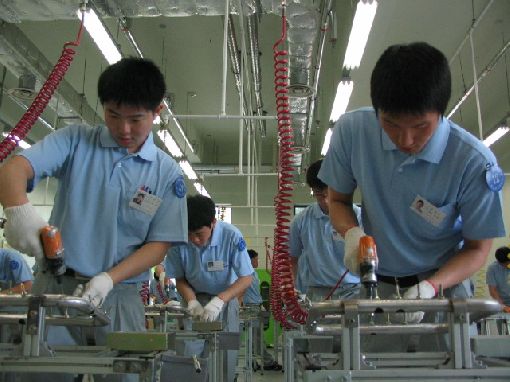 Trainees enrolled in the Renault Samsung vocational training program are receiving practical training.
The amended Industrial Safety and Health Act imposes obligations on employers to implement safety and health measures for on-site trainees. Employers of companies where on-site trainees participate must provide protective equipment and take safety and health measures such as fall prevention. Violations of these obligations can be supervised and punished. The law will take effect six months after its promulgation.
In addition, the law prohibits not only lending but also borrowing and brokering the lending of certificates and registration cards of industrial safety instructors and industrial health instructors. Penalties for violations have been newly established, which is expected to ensure strict management of instructor qualifications.
The Act on the Development of Workers' Vocational Competency, which prohibits rebates from vocational training institutions, was also approved at the Cabinet meeting. Training institutions are banned from providing rebates such as gift certificates to employers to secure vocational training contracts. If rebates are given or received, the training institution will face cancellation of course recognition and future recognition restrictions. Employers will face restrictions on government support and loans for training costs. Those involved may be subject to imprisonment of up to three years or fines up to 30 million KRW.
Furthermore, in cases of fraudulent receipt of training fees, joint liability for the return or additional collection of the fraudulently received amount will be imposed not only on the training institution that directly received the support but also on employers and trainees who bear substantial responsibility for the fraud. If fraudulent training occurs more than a certain number of times, the training institution’s name, representative’s name, and violations will be publicly disclosed.
The act also prohibits lending, borrowing, or brokering the lending of training teacher certificates, with violations punishable by imprisonment of up to one year or fines up to 10 million KRW.
Additionally, through amendments to the Skilled Technology Promotion Act, obligations to make efforts to pass on skilled techniques have been imposed on Korea’s Master Craftsmen, and legal grounds for the selection and support of Skilled Koreans have been established. A law was also enacted to separate the 'Employment and Labor Training Institute,' an affiliate of Korea University of Technology and Education, into an independent corporation named the 'Korea Employment and Labor Education Institute.'
© The Asia Business Daily(www.asiae.co.kr). All rights reserved.

















