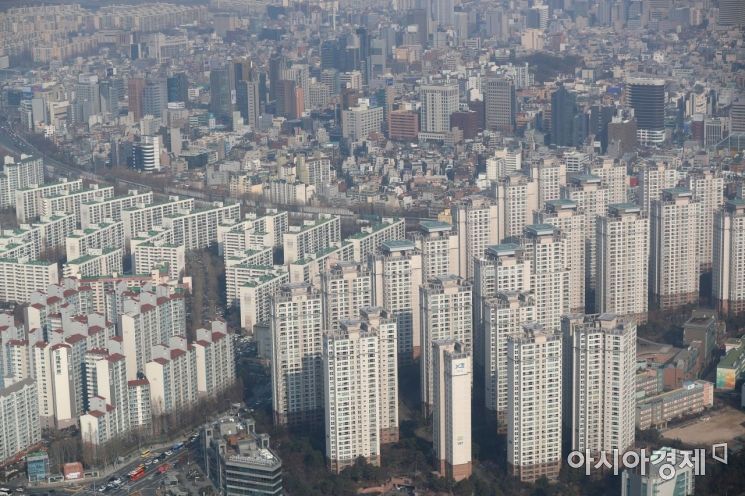
[Asia Economy Reporter Kim Yuri] On the 24th, the Seoul Metropolitan Government announced that it has conducted administrative guidance for approximately 2,200 apartment complexes (15,900 buildings, 1.3 million households) with 300 or more households to create apartments safe from the novel coronavirus infection (COVID-19).
The 2,200 apartment complexes subject to administrative guidance include apartments in Seoul with 300 or more households, apartments with elevators and 150 or more households, and apartments with central heating or district heating systems with 150 or more households, all of which are mandatory management targets under the Apartment Housing Management Act.
The city recommended that residents' representative meetings refrain from face-to-face meetings, which have the potential for droplet transmission, as much as possible, and instead conduct non-face-to-face meetings via messengers or written resolutions. It also advised that when electing block representatives or officers of the residents' representative meetings, decisions should be made through electronic voting instead of on-site or visit voting.
Seoul stated that it sent official letters containing these guidelines to the targeted apartments and conducted administrative guidance based on the Ministry of Land, Infrastructure and Transport’s legal interpretation. On the 13th, Seoul received a legal interpretation from the Ministry stating, "In situations where a first-class infectious disease is spreading, written meetings can be temporarily conducted under the supervision and guidance of local governments," and based on this, administrative guidance was initiated.
The city plans to apply these recommendations temporarily until the COVID-19 crisis alert level is downgraded to 'caution,' proactively responding to block the possibility of COVID-19 transmission among apartment residents and prevent its spread.
In cases where holding residents' representative meetings is unavoidable, such as for construction service contracts or safety inspections, non-face-to-face meetings are recommended. The method can be chosen according to the apartment complex’s situation, including SNS, messengers, or phone calls. Written resolutions are conducted by having the residents' representative meeting chairperson or management office manager visit block representatives who participated in the non-face-to-face meeting to obtain signatures, minimizing contact. Previously, under the Apartment Housing Management Act, block representatives had to participate directly in the meetings and make decisions on the spot after the meeting.
However, even when holding non-face-to-face meetings, the city plans to maintain transparency by adhering to existing residents' representative meeting procedures such as announcing the meeting, discussing agenda items through non-face-to-face methods, and preparing and disclosing meeting minutes.
Voting will temporarily be conducted only through electronic voting (via text messages, apps, etc.) instead of the previous combined method of on-site and electronic voting to prevent residents from crowding at polling stations during specific times such as after work. Previously, according to the Seoul Metropolitan Government’s Apartment Housing Management Regulations, block representatives and residents' representative meetings were generally elected through both electronic voting and on-site voting with polling stations. To increase voter turnout, election management committees sometimes selectively conducted visit voting by visiting each household to collect ballots. Seoul made electronic voting mandatory within apartments through amendments to the management regulations in February last year.
Additionally, Seoul has conducted administrative guidance to place hand sanitizers in elevators to prevent infections among residents and completed distribution of a total of 75,000 hand sanitizers through district offices to complexes that had difficulty securing them after conducting demand surveys. Furthermore, the city is responding to prevent the spread of infectious diseases within apartments by recommending restrictions on the use of communal facilities such as exercise facilities, community centers, and reading rooms, and postponing legally mandated training for housing managers.
Ryu Hoon, head of the Seoul Housing and Architecture Headquarters, said, "Since most members of the residents' representative meetings and election management committees are elderly people vulnerable to COVID-19, proactive measures that block resident gatherings and reduce the possibility of droplet transmission through non-face-to-face methods can be effective," adding, "We expect residents’ participation so that these proactive measures within apartments can play a role in preventing the spread of COVID-19."
© The Asia Business Daily(www.asiae.co.kr). All rights reserved.

















