Interview with Jeong Yang-ho, President of Korea Institute for Advancement of Technology
Second Year of Term, Aiming to Prevent SME Bankruptcies
Responsible from Quality Assurance to Profit Generation
Connecting Planning with Large Corporations as Demanders
Implementing Over 50% Convergence Projects During Term
Full Effort on Innovative Technology Development 'Alchemist'
Introduced 'Untact Evaluation System' Amid COVID-19
Establishing System Semiconductor Hub in China
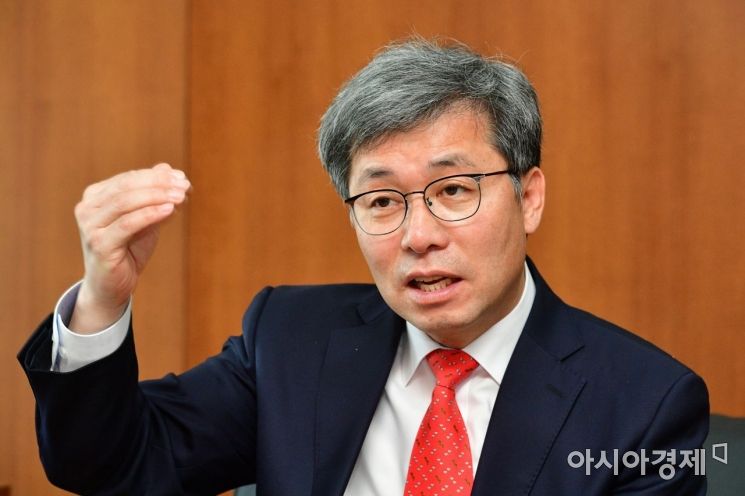 Jung Yang-ho, President of the Korea Institute for Advancement of Technology. / Photo by Yoon Dong-joo doso7@
[Interview = Asia Economy Chief Economic Reporter Kang Hee-jong, Organized by Reporter Moon Chae-seok] "Our job is to show the public that the Ministry of Trade, Industry and Energy's research and development (R&D) is not 'R&D for the sake of R&D' but R&D that leads to commercialization."
Jung Yang-ho, who has been the head of the Korea Evaluation Institute of Industrial Technology (KEIT), a quasi-governmental organization, for one year, expressed this ambition in an interview with Asia Economy on the 20th, stating that he will achieve definite results this year in the "R&D Commercialization Relay." He emphasized that, in addition to fulfilling the fundamental role of discovering so-called "profitable" R&D projects, KEIT will assist in the overall process including technology quality assurance, financing, and initial public offerings (IPO) to prevent promising small and medium-sized enterprises (SMEs) from going bankrupt. The R&D Commercialization Relay is a support project by the Ministry of Science and ICT, where foundational technologies developed are taken over by the Ministry of Trade, Industry and Energy to achieve practical commercialization. Along with this, through memorandums of understanding (MOUs) between KEIT and related organizations (such as the Public Procurement Service and Korea Credit Guarantee Fund), a support system is established to ensure that R&D-supported projects can proceed to commercialization. Jung also conveyed his intention to actively discover convergent R&D planning projects in sectors like future vehicles and the hydrogen economy by managing a government budget of 2 trillion won.
◆Responsible for Quality Assurance, Financial Support, and IPO = Reflecting on his first year in office, Jung diagnosed that KEIT has not properly played the role of sowing the seeds that lead "innovative growth." His goal for the second year is to help SMEs and others undertaking R&D projects avoid bankruptcy. He announced that this year he will produce visible results across the entire process of "R&D technology evaluation - quality improvement - financing - market development - financial support - IPO." He has emphasized to his staff that they must be "facilitators who assist project execution, not just project managers." His principle is to go beyond the passive role of simply reviewing submitted projects and deciding pass or fail, and to provide thorough "after-service" until the companies that submitted projects succeed in commercialization and make proper profits.
In January, Jung confirmed at CES 2020 in Las Vegas, USA, that Silicon Valley has a well-established management system that provides funding from the idea stage through to market commercialization. Due to Japan's export restrictions, large corporations, which are the demand side for R&D projects, find it difficult to rely solely on cheap foreign components and materials. Therefore, pairing them with domestic SMEs with high technological capabilities is important, and KEIT intends to play this role. Large corporations are reluctant to invest 30 to 40 billion won per production line even if the SME's R&D item is excellent, but KEIT plans to attract investment by conducting product quality reliability evaluations. They are also considering ways to allow large corporations to participate in the research process even if they do not provide research funding.
Jung said, "There has been serious concern about how SMEs can secure markets and commercialize even if they conduct R&D, so we will facilitate matching between demand-side large corporations and SMEs from the planning stage." He added, "Since the R&D conducted by the Ministry of Trade, Industry and Energy is 'R&D for commercialization,' even after R&D is completed, we are working with the Public Procurement Service, Korea Credit Guarantee Fund, Asset Management Corporation, and others to resolve corporate difficulties related to quality improvement, financing, and market development."
◆More than 50% of Projects to be Convergent during Term = Jung said he promised Minister Sung Yun-mo of the Ministry of Trade, Industry and Energy that more than 50% of the projects conducted during his three-year term will be convergent planning projects. To maximize R&D capabilities in growth sectors such as future vehicles and the hydrogen economy, KEIT has established an R&D Strategy Planning Group. This year, the government plans to spend 24 trillion won, the Ministry of Trade, Industry and Energy 4 trillion won, and KEIT 2 trillion won on R&D budgets, focusing intensively on fostering high value-added businesses. Korea's total R&D investment, including private sector, is expected to reach about 100 trillion won, with 75 trillion won from the private sector and 25 trillion won from the government. The key issue is how to harmonize these. Under the keywords "openness, speed, convergence," collaboration between ministries and between government and private sectors is essential, especially close cooperation in future vehicles and hydrogen economy sectors.
Having convergent content in projects does not mean demanding only stable R&D. Rather, to lead R&D more proactively than advanced countries, KEIT will focus its capabilities on carrying out the "Alchemist Project," which challenges industrial problems. This project supports the development of disruptive and innovative technologies with potential, breaking away from the conventional R&D framework that guarantees success. The Ministry of Trade, Industry and Energy plans to support this with 11.8 billion won this year. Jung said, "For example, R&D to solve fine dust and COVID-19 requires a complex input of big data, bio, and medical devices, and KEIT's role is to create a framework that connects each technology for new purposes." He added, "Although alchemists did not turn iron into gold, the process led to the development of sulfuric and nitric acid. Similarly, creating new added value during the pursuit of specific goals should become a new paradigm."
Jung cautiously mentioned that KEIT should integrate with the Korea Energy Technology Evaluation Institute (KETEP) to strengthen convergence between industry and energy, especially in the hydrogen industry. On the 13th of last month, the Ministry of Trade, Industry and Energy proposed a partial amendment to the Energy Act. Jung expects that although it is difficult for the bill to pass during the 20th National Assembly session, it will be discussed again in the 21st session. He said, "The keyword of the 4th Industrial Revolution is 'convergence.' For example, making tanks and materials necessary for safely transporting hydrogen is the role of industry." He added, "If governance between institutions is integrated and operated, there will be more synergy effects." He continued, "It is regrettable that integration could not be achieved within the 20th session due to the National Assembly situation, but it is a part we must pursue according to the demands of the times. The government will propose it again for discussion in the 21st session."
◆Introduction of Untact Evaluation... Additional Base Office in China = Jung introduced an online electronic evaluation system for industrial technology R&D this month in response to COVID-19. The system was first applied to ongoing projects in materials, parts, and equipment that urgently need budget support in the first half of the year, and to projects with no competition in the selection process of executing institutions. Generally, KEIT finishes accepting new projects by the end of February, but this year, due to COVID-19 disruptions, the application period was extended by about two weeks in consultation with the Ministry of Trade, Industry and Energy. This was in response to requests from applicants who could not conduct necessary consultations due to COVID-19 and asked for an extension.
KEIT plans to create an online system for planning, evaluation, management, and project systems centered on the Industrial Technology Knowledge Information Group. Through this, they intend to share information with the Ministry of Science and ICT and plan new projects. Jung explained, "Just as antibodies form when a virus invades the body, COVID-19 has penetrated the R&D system and created a digital antibody called the 'untact system.'" He added, "In the past, we invested capabilities to catch up with technologies lagging behind advanced countries, but now 'knowwhat'?identifying what to develop so that other countries cannot follow?is important. Therefore, a system to evaluate that process was needed, and COVID-19 accelerated the establishment of the online evaluation system."
Jung is also paying attention to establishing overseas bases for system semiconductors. He plans to set up a base in China, the world's largest market for system semiconductors. Since 2012, KEIT has supported technology exchange and collaboration between domestic fabless companies and Chinese demand companies through the Korea-China System IC Cooperation Research Institute, a platform for entering the Chinese market. Jung said, "It is difficult for SMEs alone to overcome the wall of 'gwan-si' (personal connections), so government-related institutions' recommendations are necessary in reality." He added, "We are considering establishing an additional base office in China, the world's largest market, within this year."
© The Asia Business Daily(www.asiae.co.kr). All rights reserved.
![User Who Sold Erroneously Deposited Bitcoins to Repay Debt and Fund Entertainment... What Did the Supreme Court Decide in 2021? [Legal Issue Check]](https://cwcontent.asiae.co.kr/asiaresize/183/2026020910431234020_1770601391.png)

















