"Unemployment Benefits Over Unpaid Leave" ... February Payments Reach Record High
Unemployment Benefits Briefing Packed with Masked Visitors
Experts Warn "Prolonged Crisis Could Cause IMF or Financial Crisis-Level Employment Disaster"
Companies Demand "Flexible Operation of Employment Retention Subsidies" as Urgent Measure
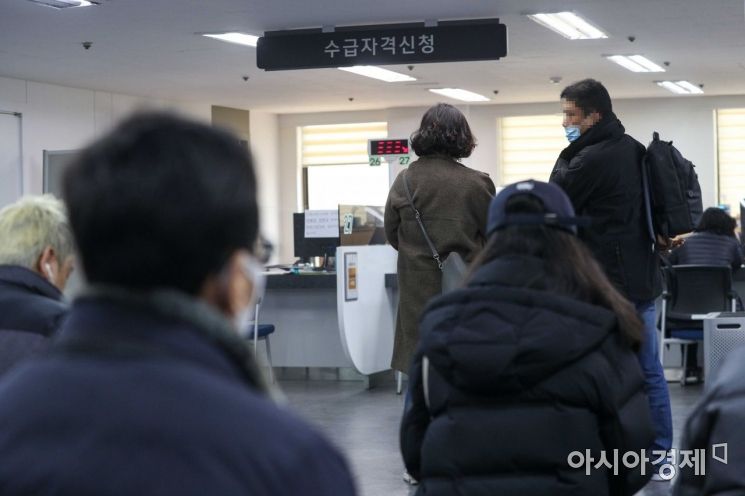
[Asia Economy Reporters Kim Bo-kyung, Moon Chae-seok, Lee Jung-yoon, Jung Hyun-jin] On the 18th, the 4th floor of the Seoul Employment Welfare Plus Center was crowded with business owners attending training for employment retention subsidies, while the 3rd floor was bustling with job seekers applying for unemployment benefits.
On that day, Mr. Lee (53), who came to the center to apply for unemployment benefits, had a dark and tense expression. He had been working as a cleaner at a hotel in Myeongdong for three years. As the hotel, which attracted tourists mainly from China and other Asian countries, saw a sharp decline in sales due to the novel coronavirus disease (COVID-19), he voluntarily submitted his resignation. He thought it better to receive unemployment benefits and live off them than to endure not getting paid as the situation prolonged. Mr. Lee said, "I plan to receive unemployment benefits for about 5 to 6 months and rest while looking for reemployment opportunities."
Mr. Lee (63) and his spouse, who worked as daily laborers at a construction site, lost their jobs simultaneously and have been receiving unemployment benefits for three months. They must continue job-seeking activities to receive benefits for several more months. He said, "They say I have to prove job-seeking activities to receive unemployment benefits, but because of COVID-19, I don't know if companies will hire anyone," adding, "I'm not good at using the internet, so I can't even bring myself to find job ads and submit resumes."
The government recommended refraining from visiting employment centers to prevent the spread of COVID-19 and expanded online training, but the center was crowded with citizens seeking unemployment benefits that day. The hand sanitizer placed at the entrance of the center ran out within an hour. Visitors repeatedly pumped the sanitizer, but it barely came out. A center official explained, "Since the COVID-19 outbreak, the number of unemployment benefit applicants has increased by about 20%. One out of every ten applicants is directly affected by COVID-19, such as those in the travel and accommodation industries."
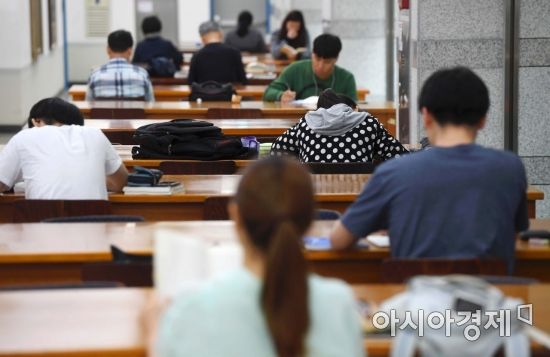 Asia Economy DB=Photo by Honam Moon munonam@
◆Is an Employment Crisis Surpassing the IMF Foreign Exchange Crisis and Financial Crisis Coming?= If this trend continues, the amount paid for unemployment benefits this month may again break the record high. According to the 'February Labor Market Trends' released by the Ministry of Employment and Labor, the amount paid for unemployment benefits (job-seeking benefits) last month was 781.9 billion won, an increase of 169 billion won (32.0%) compared to the same month last year. This surpassed the previous record high of 758.9 billion won recorded in July last year. The number of new job-seeking benefit applicants last month was 107,000, an increase of 27,000 (33.8%) compared to the same month last year.
Experts warned that an employment crisis surpassing the International Monetary Fund (IMF) foreign exchange crisis and the financial crisis is approaching. Professor Kwon Hyuk of Pusan National University said, "If the COVID-19 situation prolongs, it seems unavoidable to face an employment crisis such as restructuring."
Professor Kwon advised, "The government should not only provide employment retention subsidies but also take the lead in minimizing mass unemployment through agreements on pain-sharing between labor and management," adding, "It is necessary to strengthen investment in human resources such as vocational training in preparation for unemployment and prepare for economic recovery." He further added, "It is necessary to re-examine social safety nets such as employment insurance and actively provide government-level reemployment mediation and support in response to industrial structural changes."
Professor Kim Dong-won of Korea University predicted, "The impact of COVID-19 is more severe than expected and may become more serious than the IMF economic crisis," forecasting, "It could lead to mass unemployment and an employment crisis." Professor Kim said, "The government should reduce taxes and help companies regain vitality," adding, "If the direction changes to large-scale tax increases by expanding welfare, companies may face more difficulties."
The International Labour Organization (ILO) predicted on the 18th (local time) that if governments worldwide do not take protective measures for workers in response to COVID-19, up to 25 million jobs could disappear globally. According to the scenario, the number of unemployed due to COVID-19 could reach between 5.3 million and 24.7 million, potentially exceeding the 22 million unemployed during the 2008-2009 global financial crisis.
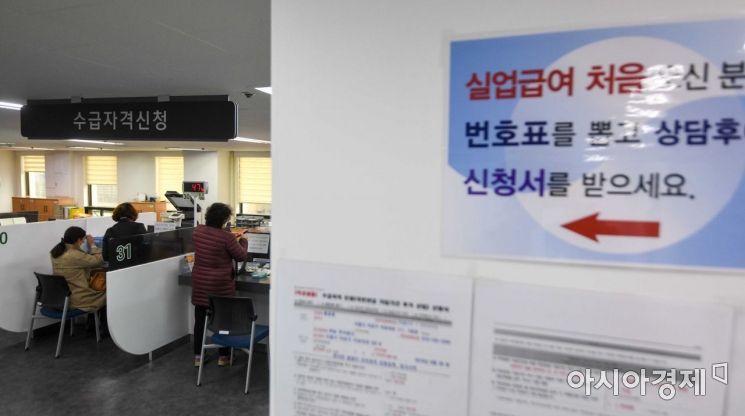 On the 19th, citizens visiting the Seoul Western Employment and Labor Office in Mapo-gu, Seoul, are receiving consultations for unemployment benefit applications. Photo by Jinhyung Kang aymsdream@
◆"Urgent Drastic Measures Needed to Prevent Mass Unemployment"= Companies demanded the government operate the employment retention subsidy system flexibly. Seo Seung-won, Executive Vice President of the Korea Federation of Small and Medium Business, said, "The daily subsidy is fixed at a maximum of 66,000 won, so the burden on companies is still large," adding, "There are many requests to raise the daily subsidy limit."
He continued, "There were also demands from the field to temporarily relax the conditions that require at least one month of leave or more than 20% reduction in working hours," he said. There were also voices hoping for cash support. Hwang In-hwan, director of the Seoul Automobile Maintenance Cooperative, said, "Even with government subsidies, small businesses are more likely to choose layoffs over paid leave," adding, "I hope they provide tangible help, such as supporting 200,000 to 300,000 won per person monthly."
Small businesses struggling to survive day by day were most concerned about the prolonged COVID-19 situation. If financial difficulties continue, they will inevitably reduce personnel to lessen labor costs. The first targets are non-regular workers such as contract and part-time employees. Shin, who runs a small language academy in Jongno, said, "In Europe, like France, where 'stay-at-home orders' have been issued, study abroad schedules are being postponed," lamenting, "Inquiries have almost stopped, and sales are close to zero." He said, "Small businesses like ours will likely cut part-time workers first to reduce costs."
Won, who runs a computer academy, said, "Overall, classes were postponed or delayed for two weeks," adding, "It means there was no revenue for two weeks." He said, "If COVID-19 continues, the biggest issue will be whether part-time instructors, who contract monthly, will be re-contracted."
© The Asia Business Daily(www.asiae.co.kr). All rights reserved.
![User Who Sold Erroneously Deposited Bitcoins to Repay Debt and Fund Entertainment... What Did the Supreme Court Decide in 2021? [Legal Issue Check]](https://cwcontent.asiae.co.kr/asiaresize/183/2026020910431234020_1770601391.png)
















