Duty-Free Industry Hit Hard by COVID-19
Only About 3 Areas Including East and West Passenger Wings and Boarding Wing
Sharp Decline in Passenger Numbers... A Natural Outcome
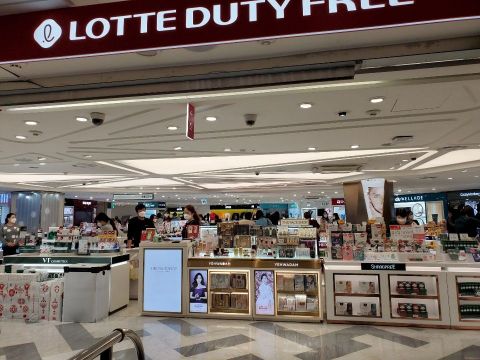
[Asia Economy Reporter Cha Min-young] As international travelers sharply declined due to the novel coronavirus infection (COVID-19), the duty-free industry is downsizing the duty-free product delivery counters at Incheon International Airport. With sales at downtown duty-free shops and online duty-free shops plummeting, the need to streamline the operation of delivery counters for duty-free goods has also increased.
According to the duty-free industry on the 18th, Shinsegae Duty Free will consolidate the delivery counters within Terminal 1 (T1) of Incheon International Airport starting from midnight departures on the 20th. The existing delivery counter at Gate 11 on the east side of the passenger terminal will be merged with the west side counter, and the east side counter will be operated exclusively for Asiana Airlines. The delivery counters in front of Gates 122 and 115 in the boarding area will also be unified as boarding area delivery counters.
Shilla Duty Free ceased operations of two delivery counters at the east side and second east side gates of the T1 passenger terminal as of the 9th, and stopped operating the boarding area delivery counter as of the 16th. Currently, goods can only be picked up at the delivery counter near Gate 29 on the west side. Lotte Duty Free combined three delivery counters near the boarding and passenger terminals within T1 as of the 4th, and now goods can only be picked up at the B delivery counter near Gate 26 on the east side.
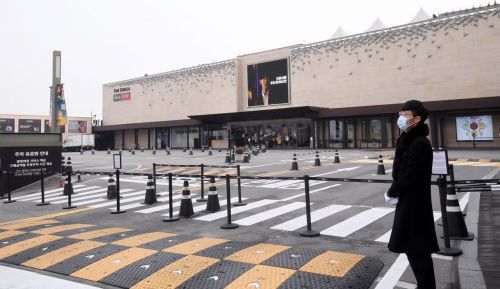 An interim closure notice has been installed at the entrance of Shilla Duty Free Seoul Branch, which began temporary closure from the 2nd following the confirmation of a visit by the 12th confirmed case of the novel coronavirus infection. Photo by Kim Hyun-min kimhyun81@
Downtown duty-free shops and online duty-free shops had been on a growth trajectory, fueled by the purchasing power of Chinese tourists and the so-called 'convenipremium' trend (a blend of convenience and premium). In particular, downtown duty-free shops were regarded as a 'shopping mecca' where customers could leisurely shop for luxury goods, contributing to Korea's tourism premium. According to the office of Kim Jung-woo, a member of the Democratic Party, annual sales at downtown duty-free shops in 2019 were about 21 trillion won, an increase of approximately 6 trillion won from the previous year (15 trillion won). Online duty-free shops recorded annual sales of 7.6 trillion won last year, showing sales growth of over 3 trillion won compared to the previous year.
As demand for duty-free goods increased, the proportion of delivery counters also grew. Duty-free product delivery counters are dedicated spaces near the departure area within bonded zones, set up separately to hand over goods to consumers of downtown and online duty-free shops. In 2014, there were only three counters totaling 1,297.72㎡ across T1 and the boarding area, but by 2017, including T1, the boarding area, and Terminal 2 (T2) of Incheon International Airport, the total area expanded to 3,272.92㎡ with seven counters. This scale was maintained as of July 2019. Accordingly, plans were in place to introduce arrival area delivery counters by July this year. Arrival area delivery counters would allow Korean nationals returning from abroad to pick up goods purchased from online duty-free shops at the airport upon their return.
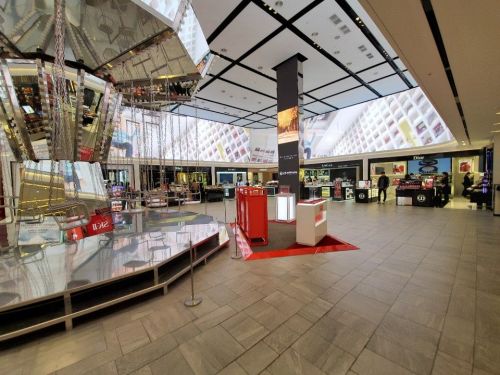
However, this year, the atmosphere in the duty-free industry has cooled sharply due to the impact of COVID-19. With over 100 countries banning entry of Koreans, international flights have also decreased. According to Incheon International Airport Corporation, from March 1 to 15, the total number of passengers using Incheon Airport was 417,009, which is only 14.5% of the 2,828,047 passengers during the same period last year. The average daily number of passengers was just 27,800.
The duty-free industry shortened operating hours of downtown duty-free shops by 2 to 3 hours. While the primary purpose is to prevent COVID-19 transmission among customers and staff, the economic burden caused by prolonged closures is also considered a contributing factor. Shinsegae Duty Free is operating three downtown duty-free stores in Seoul?Myeongdong, Gangnam, and Busan?from 11 a.m. to 6 p.m. Lotte Duty Free shortened business hours at Myeongdong Main Store, World Tower, COEX, Busan, and Jeju stores to 9:30 a.m. to 5:30 p.m. starting from the 12th. Shilla Duty Free changed the Seoul store's operating hours to 9 a.m. to 6 p.m. from the 7th of last month. Some have also shortened online duty-free order hours.
A duty-free industry official said, "As the number of passengers using Incheon Airport has sharply decreased, the volume of duty-free goods to be delivered has also decreased, leading to consolidated operation of delivery counters. There was a time when delivery counters were so popular that 'delivery counter chaos' occurred every vacation season, but now both downtown duty-free shops and online sales are sluggish."
© The Asia Business Daily(www.asiae.co.kr). All rights reserved.



















