Samjong KPMG Publishes Report on 'Finding Solutions for the Domestic Courier Industry'
[Asia Economy Reporter Minji Lee] While the average operating profit margin of domestic courier companies sharply declined from 8.6% in 2014 to 0.5% in 2018, there is a claim that courier logistics companies need to find growth breakthroughs by adopting digital technologies.
According to the report "Finding Solutions for the Domestic Courier Industry" published by Samjong KPMG on the 16th, the domestic courier market has grown in size thanks to the activation of the online distribution market. However, due to intensified competition caused by the entry of online and offline distributors and lifestyle industry companies, the market has fallen into a slump of poor profitability, such as a decline in the average courier unit price.
The average unit price in the domestic courier market has continuously declined from 2,534 KRW in 2011 to 2,229 KRW in 2018 without a single price increase. The report analyzed that the domestic courier industry has effectively entered a chicken game since 2016.
In particular, domestic distribution companies are strengthening direct delivery and enhancing 'Fulfillment' services, which were previously considered part of the logistics industry, thereby breaking down existing barriers between industries. The report emphasized that with the entry of players from other industries into the logistics market, further price competition is impossible, and domestic courier market companies must establish survival strategies to restore profitability.
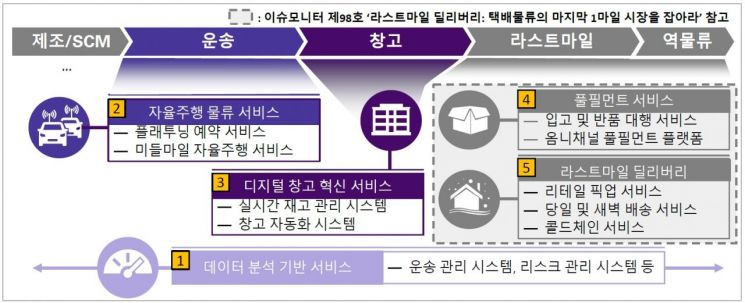
The global courier logistics industry is enhancing competitiveness through digital-based on-demand logistics and sustainable logistics as customer needs rapidly diversify. The report explained that the introduction of various digital technologies such as the Internet of Things, autonomous driving, robotics and automation, and machine learning into logistics is causing positive effects such as new business creation, improved customer satisfaction, and increased profitability.
Key technological elements leading the digital transformation of courier logistics include △5G networks (improving operational efficiency through network slicing) △robotics (improving logistics warehouse operations via cyber-physical systems) △telematics (developing new services related to road transportation) △Internet of Things (strengthening courier logistics competitiveness using big data from objects).
The report explained that service competitiveness can be enhanced through delivery optimization, digital twins, and asset lightening by developing data analysis-based services. It also predicted that with the introduction of autonomous driving technology, the industry will evolve into crowdsourcing logistics and micro logistics platform companies, and that the adoption of digital technologies across the entire logistics value chain will enable the creation of new services related to automatic control, visioning, and voice recognition.
Bong Chansik, Operation Consulting Leader at Samjong KPMG, said, "While traditional logistics focused on delivery services for consignors, future logistics should aim for integrated logistics that satisfy the needs of all stakeholders including consumers, carriers, and producers of goods," adding, "To achieve this, competitiveness can be strengthened through alliances with ICT solution companies such as virtual reality technology firms and data analysis startups that can realize digital logistics."
© The Asia Business Daily(www.asiae.co.kr). All rights reserved.

















