No Risk of Reporting When Visiting Medical Institutions
Ministry of Foreign Affairs to Distribute Staff at Consular Call Center
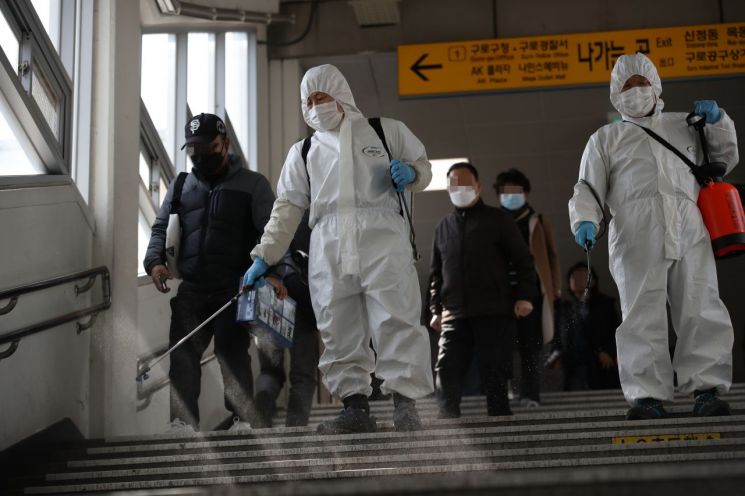 On the 13th, officials are conducting disinfection work related to the novel coronavirus disease (COVID-19) at Guro Station in Seoul.
 The government will cover the full cost of treatment if undocumented foreign residents in the country become infected with the novel coronavirus disease (COVID-19). Additionally, to prevent these individuals from avoiding medical institutions due to concerns about their immigration status, measures have been taken to ensure that they will not be reported as undocumented residents even if they undergo COVID-19 testing.
On the 13th, a senior official from the Ministry of Foreign Affairs stated, "Undocumented foreign residents are a group that requires focused attention regarding COVID-19," and announced that a diplomatic note containing these details was distributed in writing to foreign diplomatic missions in Korea after consultation with the Ministry of Justice.
The official explained, "Undocumented residents may fear being reported or forcibly deported if they visit medical institutions, which could result in them not receiving opportunities for COVID-19 testing or treatment." This raises concerns that symptomatic individuals might hide in the shadows, falling into a blind spot for treatment, and that the virus could spread covertly through them.
He added, "Originally, when an undocumented resident visited a medical institution, the institution was required to notify the Ministry of Justice of the visit. However, the system has been changed so that medical institutions no longer need to report such visits to the authorities."
The official emphasized, "The intention is to allow undocumented residents to receive treatment without fear of being reported," and stated, "Just like legally residing foreigners, the government will cover the full cost of treatment if undocumented residents become infected with COVID-19."
Following a large outbreak of COVID-19 cases at the Guro call center and increased awareness about call centers, the Ministry of Foreign Affairs also prepared countermeasures.
The Ministry operates a consular call center on the 12th floor of the Korea Chamber of Commerce and Industry building in Seoul, with a total of 84 staff members, including 78 counselors. All consular call center staff were tested, and fortunately, no COVID-19 symptoms were detected.
The official said, "To reduce the risk of infection, we plan to open a temporary counseling office in Gwacheon starting March 18," and added, "About 20 of the 78 staff members will be separated from the main call center to work there." Preparations are underway to immediately disperse personnel in case an infection occurs at the main center.
Furthermore, in accordance with guidelines from the Ministry of Personnel Management, the Ministry of Foreign Affairs plans to encourage employees who are not involved in COVID-19 response tasks to work from home starting next week.
As of this morning, a total of 2,355 nationals are quarantined worldwide, with the majority in China (1,902) and Vietnam (386). So far, 3,264 individuals have been released from quarantine.
The rapid response teams dispatched to Hanoi, Ho Chi Minh City, and Da Nang to assist quarantined nationals in Vietnam returned home today.
On the same day, the Ministry of Foreign Affairs invited the diplomatic corps in Korea to observe the quarantine procedures at Incheon International Airport (Terminal 1). This on-site visit was intended to allow the diplomatic corps to directly experience Korea's entry and exit quarantine system in response to COVID-19.
The event, organized in cooperation with the Korea Centers for Disease Control and Prevention, the National Incheon Airport Quarantine Station, and Incheon International Airport Corporation, was attended by diplomatic missions from over 40 countries.
Together with Kim Geon, Deputy Minister of Foreign Affairs, the diplomatic corps listened to explanations from the President of Incheon International Airport Corporation regarding departure quarantine procedures, then moved to the arrival hall to hear a special entry procedure briefing from the Director of the National Incheon Airport Quarantine Station. They observed the fever screening process at the departure hall, then moved to the arrival hall to observe the health status questionnaire collection process and the special entry procedures on site.
The Ministry of Foreign Affairs reported, "The diplomatic corps showed great interest in Korea's proactive departure quarantine and efficient entry quarantine system utilizing advanced IT technology," and added, "They particularly inquired about the management of infectious disease inflow through departure fever screening, health status questionnaire completion, and self-diagnosis apps."
© The Asia Business Daily(www.asiae.co.kr). All rights reserved.
![User Who Sold Erroneously Deposited Bitcoins to Repay Debt and Fund Entertainment... What Did the Supreme Court Decide in 2021? [Legal Issue Check]](https://cwcontent.asiae.co.kr/asiaresize/183/2026020910431234020_1770601391.png)















