Gimpo and Incheon International Airports See Empty Waiting Seats as Only Construction Workers Move Around
"Is the Government Only Taking a Hard Line Against Japan?" Criticism Met with "Restrained Response"
Despite Foreign Ministry's Full Effort, Entry Restrictions Remain in 106 Countries
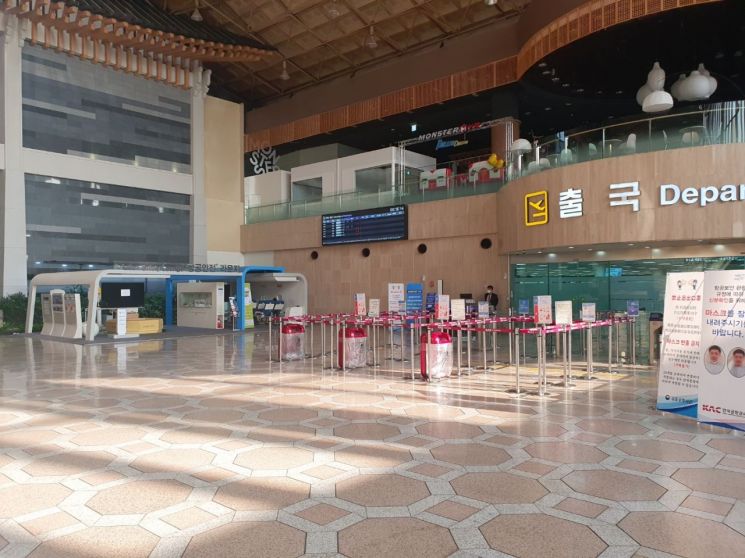
[Asia Economy Reporters Lim Cheol-young and Yoo Je-hoon] At 9 a.m. on the 9th, the first day Korea and Japan raised the threshold of their borders citing COVID-19 prevention measures, an eerie silence prevailed at the international terminal of Gimpo International Airport in Gangseo-gu, Seoul. It was difficult to find travelers anywhere except for airport corporation and resident agency staff at the first-floor arrivals hall, second-floor ticket counters, third-floor departures hall, and fourth-floor ancillary facilities. Only Chinese passengers waiting to board the two remaining daily flights to Shanghai (Hongqiao) were sitting in the sparsely occupied waiting seats, pulling their suitcases.
The situation airside was even more severe. The airside, usually bustling with foreign airline passengers, had almost no passengers except for airport staff. A representative of a duty-free shop said, "I understand that only two international flights are operating today," and pointed to a cafe that had ceased operations, adding, "It was open until yesterday, but given today's situation, it seems they have closed."
The situation at Incheon International Airport was no different. As countries tightened entry controls on travelers from Korea, the total number of users at Terminal 2 plummeted to the 10,000s per day last week. Korean Air, a mainstay of Terminal 2, also suspended all flights to Japan except for Incheon-Narita and Kansai routes starting today. For the KE001 flight (A330-300) departing at 5:20 p.m. to Narita, only 206 out of 272 seats have been reserved. The airline explained that even this is uncertain due to the entry restrictions that began today.
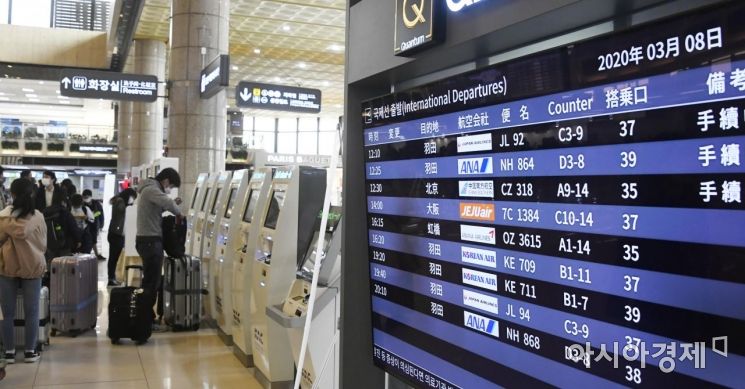 On the 8th, ahead of Japan's implementation of entry restrictions on Korea, the international departure hall at Gimpo Airport in Seoul was crowded with Japanese residents and international students who had been staying in Korea, rushing to depart. Photo by Dongju Yoon doso7@
◆Strong Response by Korea to Japan's Sudden Measures= The Korean government’s COVID-19 related entry restrictions against Japan, effective from midnight on the 9th, consist of four major parts. The government clearly stated that it would escalate its response depending on the inconvenience and damage experienced by Korean nationals due to Japan’s unilateral tightening of entry restrictions, emphasizing that it has taken a "measured response." However, no specific deadline was set for the 'reciprocal measures.'
Travel for tourism purposes has become virtually impossible. The Korean government first suspended the visa waiver for Japan and also suspended the validity of already issued visas. This corresponds to suspending the visa-free entry system to Korea, which was equivalent to Japan’s suspension of single and multiple-entry visas. Additionally, Cho Se-young, First Vice Minister of Foreign Affairs, stated that beyond suspending the visa waiver, "health verification procedures will be included in the visa issuance process, and health certificates may be requested depending on future changes," leaving room for further tightening.
Special entry procedures, previously applied to foreigners entering from China, are now also applied to foreigners arriving from Japan, and the travel advisory for all regions of Japan has been raised to level 2. This is a reciprocal measure following Japan’s request for 14-day quarantine at designated locations for entrants from Korea and its upgrade of infection risk information on Korea. The Ministry of Foreign Affairs also indicated that it could take stronger measures considering the spread of infectious diseases in Japan.
Regarding reciprocal measures for Japan’s restrictions on airports for takeoff and landing, the government plans to monitor the situation and take action accordingly. The airports have already been specified as Incheon, Gimpo, Gimhae, and Jeju airports. Vice Minister Cho explained, "Regarding requests to suspend ship and passenger transport, we will consider the potential inconvenience to Korean residents in Japan upon their return and take reciprocal measures later," adding, "Among the many Korea-Japan routes, the airports will be selected from Incheon, Gimpo, Gimhae, and Jeju."
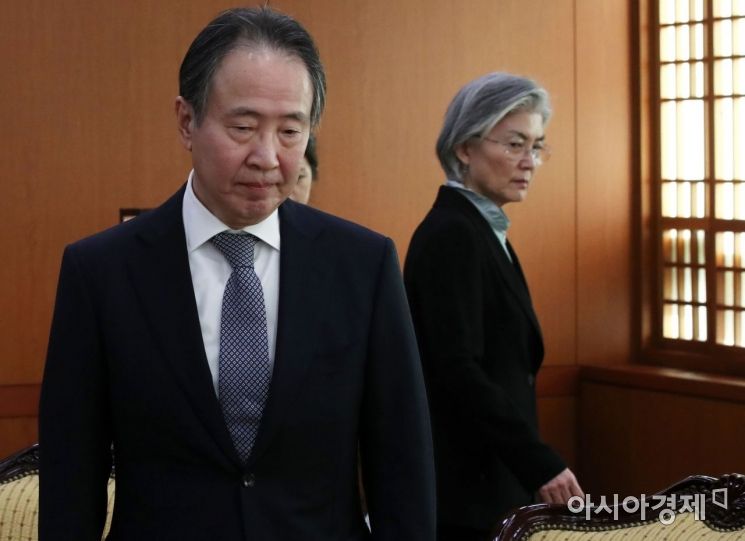 Japan has decided to strengthen entry restrictions on travelers arriving from Korea starting from the 9th to prevent the spread of COVID-19. On the 6th, Foreign Minister Kang Kyung-wha headed to her seat for a meeting after summoning Koji Domita, the Japanese Ambassador to Korea, to the Ministry of Foreign Affairs building in Jongno-gu, Seoul. Photo by Moon Honam munonam@
◆Is Korea Only Taking a Hard Line Against Japan?= Some have criticized Korea’s strong reciprocal measures against Japan as being "harsh only on Japan." In response, the Blue House and the Ministry of Foreign Affairs have repeatedly stated since last weekend that the response is "measured."
The Korean government emphasizes that Japan’s entry restrictions are driven more by political motives than by disease prevention. It argues that Japan has positioned Korea as an adversary to overcome crises such as the Tokyo Olympics uncertainty due to COVID-19 prevention failures and the postponement of Chinese President Xi Jinping’s visit to Japan.
Kang Min-seok, spokesperson for the Blue House, noted, "It is noteworthy that Japanese media evaluate Japan’s use of Korea as a political tool to avoid its own failure in disease prevention." Foreign Minister Kang Kyung-wha pointed out that considering Korea’s measures and disease prevention capabilities, Japan’s actions are "unscientific and unfriendly, raising suspicions about their motives." Minister Kang also criticized Japan’s COVID-19 response, saying, "We are watching with concern Japan’s opaque and passive disease prevention measures."
◆Despite the Ministry of Foreign Affairs’ Full Effort, 106 Countries Restrict Entry= Despite the Ministry of Foreign Affairs and related authorities’ full efforts, including responses to Japan’s strong measures, the number of countries restricting entry from Korea has steadily increased to 106 as of 9 a.m. on the 9th. The Caribbean island nations of Grenada and Barbados were newly added. Grenada imposes a 14-day quarantine on foreigners who have visited Korea, China, Italy, Iran, etc., within 14 days before entry.
Some countries are strengthening entry restrictions. Saudi Arabia, which had allowed limited entry for holders of other visas such as employment, business, commercial, and family visits after government persuasion, announced a ban on all foreigners who have visited or transited Korea, Japan, Italy, or Azerbaijan within 14 days before entry. Oman also strengthened its measures from quarantine to entry ban.
There are 44 countries that have completely banned entry or allow entry only after a certain period. Including China, 15 countries impose quarantine measures, and 47 countries have relatively lower-level measures such as suspension of arrival visa issuance and self-quarantine.
© The Asia Business Daily(www.asiae.co.kr). All rights reserved.



















