Detailed Disclosure of Confirmed Patients' Movements Raises Privacy Concerns
Some Criticize Patients' Movements... Human Rights Commission Complaints Filed
KCDC: "Public Interest Takes Priority... Will Make Improvements"
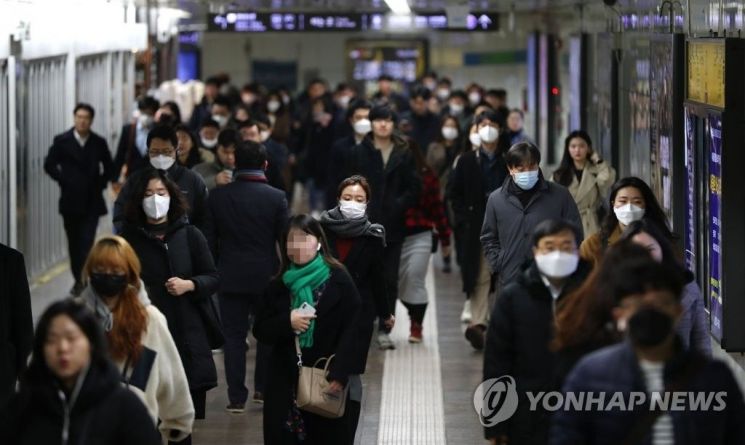
[Asia Economy Reporter Han Seung-gon, Intern Reporter Lim Joo-hyung] The disclosure of movement paths of confirmed cases of the novel coronavirus infection (COVID-19) has become controversial. The paths are disclosed in excessive detail, raising concerns about the invasion of the confirmed patients' privacy, while some netizens are sending baseless criticism based on the disclosed paths. The government has stated that it will make improvements from the perspective of information provision.
The rapid response team and immediate response team dispatched from the Korea Disease Control and Prevention Agency (KDCA), along with local government personnel, are conducting the investigations together. They investigate comprehensively based on the patient's memory, credit card usage records, and closed-circuit television (CCTV) footage.
The disclosure of confirmed patients' movement paths is conducted according to relevant laws (Infectious Disease Control and Prevention Act), revealing the patient's travel routes, means of transportation, medical institutions visited, and contact status.
The problem lies in the fact that excessively detailed disclosure of movement paths can lead to invasion of the confirmed patients' privacy.
In particular, one confirmed patient suffered baseless accusations of infidelity because, although his wife and children tested negative, only his sister-in-law tested positive.
Similarly, the case of employee A at Samsung Electronics' Gumi plant, who was confirmed positive on the 22nd of last month, is also notable. At that time, Jang Se-yong, mayor of Gumi City, disclosed A's surname, gender, the name of the apartment where he resides, and also revealed that his boyfriend is a member of Shincheonji Church of Jesus, the Temple of the Tabernacle of the Testimony (Shincheonji) in a post on Facebook.
As a result, A complained of mental distress due to some malicious comments. Two days after the disclosure of his movement information, on the 24th, he posted on his social network service (SNS) account, pleading, "Please do not spread my personal information," and said, "I am suffering a lot from malicious comments. I did not get infected intentionally."
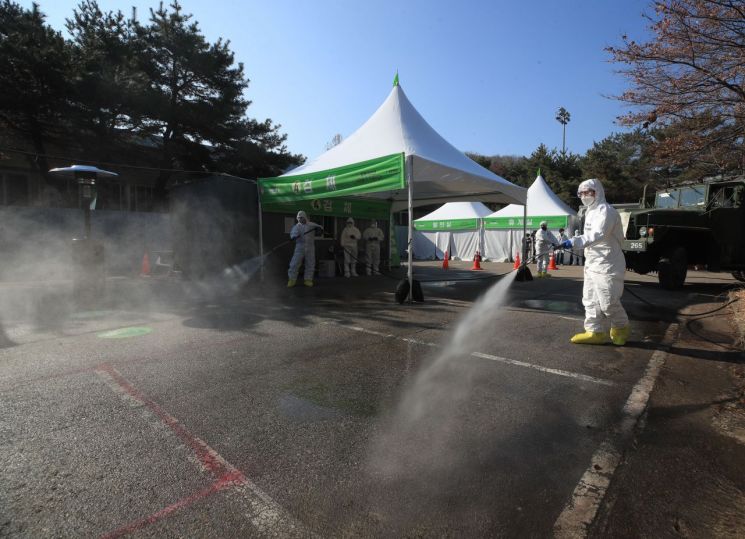 On the morning of the 5th, amid concerns over the spread of the novel coronavirus infection (COVID-19), the Road Building Disinfection Team of the Special Mission Unit of the Republic of Korea Army Chemical, Biological, Radiological, and Nuclear Defense Command is conducting disinfection work at the 'Drive-Through' screening clinic set up on the site of the former Fire Academy in Seocho-gu, Seoul. / Photo by Yonhap News
In some online communities, posts have appeared that speculate on or ridicule the identity of confirmed patients based on their movement information, and official documents containing the confirmed patients' personal information have also been uploaded.
Given this situation, it is known that some confirmed patients have filed complaints with the National Human Rights Commission, claiming damages such as invasion of privacy during the disclosure process.
Concerns about excessive exposure of confirmed patients' personal information have also been raised in the political sphere. Lee Jun-seok, Supreme Council Member of the United Future Party, recently posted on his Facebook, stating, "There are deep concerns about the current method of disclosing confirmed patients' movement paths," and argued, "Only information necessary for infection prevention should be disclosed, but the fact that how much information about confirmed patients is 'exposed' seems to be regarded as a measure of local government administrative capability is itself worrisome."
He further pointed out, "Do we need to know which company the confirmed patient works for, or the exact minute they left their home? Is it necessary for us to know the confirmed patient's age and gender?" and questioned, "Why should the confirmed patient's movement paths be disclosed on the internet and deliberately made a subject of analysis?"
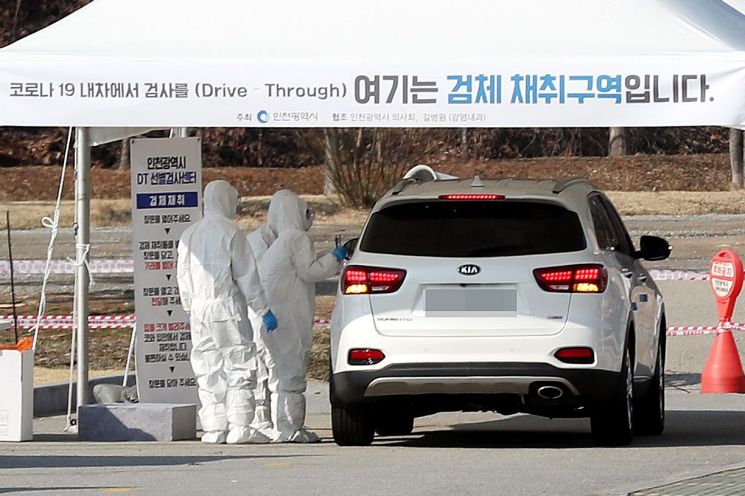 On the morning of the 2nd, a citizen is being tested at the 'Drive Thru COVID-19 Screening Clinic' set up in the parking lot of Seonhak Gymnasium in Yeonsu-gu, Incheon. This clinic is characterized by allowing individuals to undergo COVID-19 specimen testing while remaining inside their vehicles.
 [Image source=Yonhap News]
The quarantine authorities maintain that public interest is emphasized over individual rights during the quarantine process.
Jung Eun-kyung, head of the Central Disease Control Headquarters, said at a briefing held at the KDCA in Osong, Chungbuk on the 6th, "If the infectivity is high, quickly finding additional patients, diagnosing, and taking measures can reduce major damage," and added, "From this perspective, there is an aspect where (human rights) are overlooked compared to other public interests."
Director Jung emphasized the need to always maintain an "appropriate balance." He said, "Discrimination and prejudice also become obstacles to quarantine," and added, "Infectious diseases do not disappear by being concealed or hidden; rather, they spread. We will improve so that confirmed patients can receive proper treatment and provide information."
Regarding the criticism that each local government has different standards for disclosing confirmed patients' movement information, he explained, "It is true that there have been slight differences in standards," and said, "We will create detailed standards, recommend them to local governments, and clarify why and in what cases movement paths should be disclosed through education."
He emphasized, "The purpose of disclosing (confirmed patients') movement paths is for quarantine to identify other potential exposures that have not yet been found," and added, "We will manage it to the maximum extent to prevent unnecessary disclosure of movement paths or human rights violations."
© The Asia Business Daily(www.asiae.co.kr). All rights reserved.



















