Concerns Over Side Effects Such as Real Estate Concentration Phenomenon
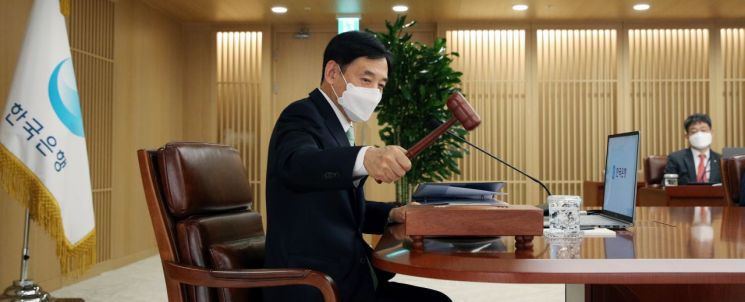
[Asia Economy Reporter Eunbyeol Kim] Due to the impact of the novel coronavirus infection (COVID-19) crisis, South Korea is increasingly likely to enter an ultra-low interest rate era. As the United States Federal Reserve (Fed) and countries worldwide are mobilizing fiscal and monetary policies, it has become inevitable for South Korea to lower its benchmark interest rate.
According to market experts on the 8th, the Bank of Korea (BOK) is highly likely to cut the benchmark interest rate by 0.25 percentage points soon. If the rate is lowered this time, the benchmark rate will be 1.00%, and the BOK will be treading "uncharted territory."
The biggest reason for the increased possibility of a rate cut by the BOK is the global coordinated monetary easing policy atmosphere. On the 3rd, right after the Group of Seven (G7) finance ministers and central bank governors announced that they would "mobilize all policy tools," the U.S. Fed made a surprise 0.5 percentage point cut in the benchmark interest rate (from 1.50?1.75% to 1.00?1.25%). The Fed is also expected to cut rates again at the Federal Open Market Committee (FOMC) meeting scheduled for the 17th?18th (local time). Experts anticipate that the U.S. will lower the benchmark interest rate to near zero (0?0.25%) within this year.
The European Central Bank (ECB) and the Bank of Japan (BOJ), which are already operating zero interest rates, have either taken or are preparing additional liquidity supply measures. Accordingly, the BOK has no choice but to follow suit.
Another reason cited for the BOK's need to lower rates is to create a synergy effect in line with the government, which has prepared an additional supplementary budget of 11.7 trillion won.
However, the BOK still worries about the side effects of a rate cut. Unlike the U.S., a key currency country, South Korea has limited ammunition in terms of monetary policy capacity, so there is public opinion that rate cuts should be made cautiously. Rapid capital outflows cannot be ignored.
Moreover, the lower the interest rate and the more money is released, the more likely it is to flow into real estate rather than productive sectors, which also makes the BOK hesitate to decide on a rate cut. The real estate market issue was a major factor that blocked the Monetary Policy Committee's rate cut decision in February. If the benchmark interest rate falls to 1.00% per annum, debates over how much further cuts can be made, i.e., the "effective lower bound," are expected to surface.
There is also skepticism about whether the epidemic crisis can be resolved through rate cuts. The logic is whether the economy, which did not respond even during a prolonged low-interest-rate period, will be stimulated by further rate reductions.
Professor Inho Lee of Seoul National University’s Department of Economics said, "I do not think the economy will be significantly affected by lowering interest rates further in the current low-rate environment," adding, "At this point, quantitative support that ensures financial authorities do not block funding to affected industries is most important."
© The Asia Business Daily(www.asiae.co.kr). All rights reserved.

















