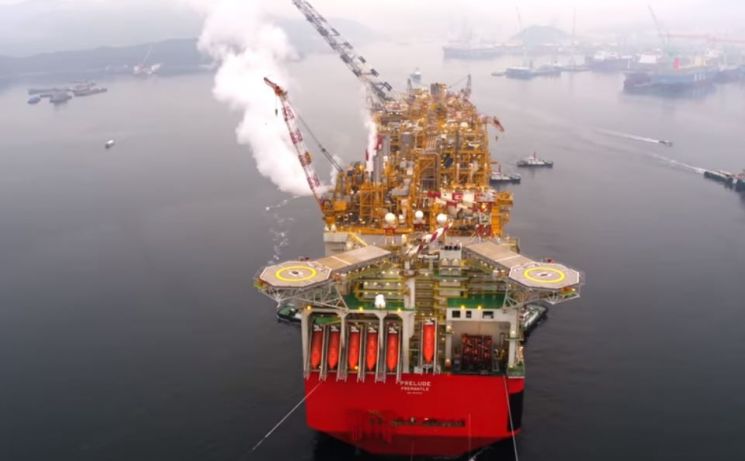
 The 'world's largest ship' Prelude FLNG built by Samsung Heavy Industries. (Source: Shell official YouTube channel)
[Asia Economy Reporter Hwang Yoon-joo] "It’s not a ship. It’s an oil-producing island."
Although it looks like a ship, it is actually called an 'energy plant' (FPSO) that does not navigate by itself but floats on the sea. FPSOs stay in one place for 20 to 30 years, producing and offloading crude oil from the seabed. Even when moving to an oil field after construction, FPSOs do not sail on their own but are towed by tugboats. Therefore, the industry classifies them as plants rather than ships.
Facilities with the same purpose but producing gas instead of crude oil are called LNG-FPSO (FLNG). The Korean shipbuilding industry is one of the countries that monopolizes FLNG orders worldwide. In particular, since 2010, Samsung Heavy Industries has secured orders for 3 out of the 4 ultra-large FLNGs ordered globally. The remaining one was ordered by Daewoo Shipbuilding & Marine Engineering.
Currently, Samsung Heavy Industries’ Geoje Shipyard is actively constructing the 'Mozambique Coral Sul FLNG.' It is an ultra-large offshore facility with a length of 439 meters, width of 65 meters, height of 38.5 meters, and a self-weight of 210,000 tons. Its size is equivalent to four standard football fields (length 105 meters, width 68 meters) placed side by side.
The construction cost borne by Samsung Heavy Industries alone amounts to 2.8534 trillion KRW (approximately 2.5 billion USD). Unusually, all the steel plates used in this massive plant were supplied by a single steel company. This is an exceptional case. Shipbuilders usually diversify suppliers of steel materials for large projects to reduce costs and ensure supply stability. However, Samsung Heavy Industries ordered all the steel plates for this project exclusively from POSCO.
The reason POSCO monopolized the steel plate supply for this project was due to a special collaboration proposal called the 'Alliance TFT.' This TFT (Task Force Team) was formed with the purpose of regularly exchanging information between the project-related departments of both companies to reduce costs and improve productivity.
One of the critical issues in offshore projects is 'shortening the construction schedule.' The shorter the construction period, the more the shipbuilder’s costs are reduced. To shorten delivery times, it is essential for the shipbuilder to receive key materials like steel plates quickly.
During the Prelude project, known as the 'world’s largest ship' constructed by Samsung Heavy Industries, POSCO supplied steel grades that normally take five months in just three months. Generally, when ordering offshore steel plates, the customer prepares an order sheet and sends it to POSCO, which then plans steel production sequentially according to the order.
POSCO and Samsung Heavy Industries boldly overturned this routine. Before issuing a formal order sheet, Samsung Heavy Industries first sent POSCO the specifications and sizes of the required steel. Based on this data, POSCO’s design, marketing, and production departments collaborated to simulate the most efficient production schedule within the shortest possible time.
Starting with the order sheet created this way, the order-design-production-shipment process was activated, allowing Samsung Heavy Industries to receive ultra-high-strength offshore structural steel two months earlier than before. POSCO also significantly improved product productivity. Without altering either company’s design or production methods, this collaboration met Samsung Heavy Industries’ needs and resulted in a win-win outcome. It was a smart partnership.
The collaboration skills also shone in the Coral project. Initially, Samsung Heavy Industries considered using 3.5% nickel steel for the outer walls of the LNG storage tanks, which is suitable for cryogenic conditions. However, 3.5% nickel steel posed challenges for the shipbuilder due to raw material supply volatility, price, and long production times. A new solution was needed.
POSCO proposed replacing the existing nickel steel with a general carbon steel grade developed for cryogenic use. This was a rather challenging attempt that required persuading the shipowner and changing the design. Ultimately, thanks to the close collaboration between the two companies, the proposal was accepted. Samsung Heavy Industries succeeded in reducing both costs and delivery times, achieving two goals at once.
POSCO was able to mass-produce this cryogenic steel not only at its Pohang Steelworks but also at its Gwangyang Steelworks. Most importantly, it was significant in developing new demand for the company’s WTP (World Top Premium) product, the cryogenic steel.
© The Asia Business Daily(www.asiae.co.kr). All rights reserved.

















