Central Disaster and Safety Countermeasures Headquarters Consults with National University Hospitals and Other Tertiary Hospitals
Focus on Treating Severe Patients Following COVID-19 'Damage Minimization Strategy'
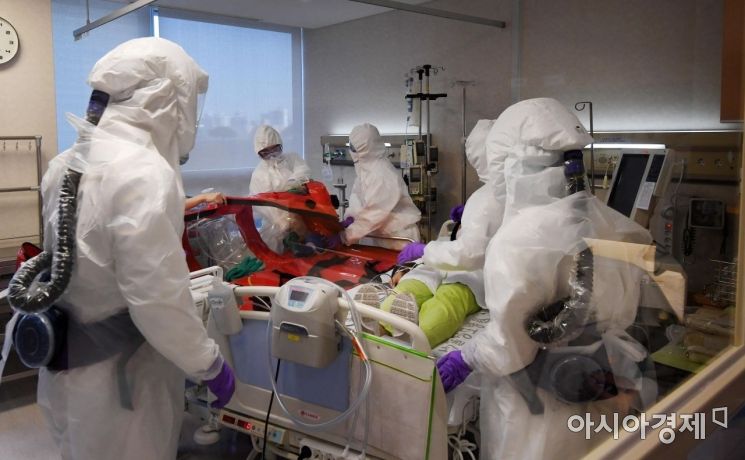 On the 5th, medical staff are conducting patient treatment simulation exercises in the COVID-19 patient ward set up at Seoul St. Mary's Hospital in Seocho-gu, Seoul. Seoul St. Mary's Hospital has prepared a total of 30 beds in one ward for COVID-19 patients and suspected cases, and will start admitting COVID-19 patients from this day. Photo by Hyunmin Kim kimhyun81@
[Asia Economy Reporter Choi Dae-yeol] National university hospitals, including Seoul National University Hospital, have decided to secure additional beds for treating patients infected with the novel coronavirus (COVID-19). It is necessary to quickly identify and hospitalize severe patients for treatment, but in regions like Daegu and Gyeongbuk where the number of patients surged rapidly within a short period, there are still many patients who cannot be admitted in time due to a shortage of beds.
According to the Central Disaster and Safety Countermeasures Headquarters on the 6th, Seoul National University Hospital is expanding 40 beds, and Kyungpook National University Hospital and Chungbuk National University Hospital are each expanding about 30 beds for severe COVID-19 patients. Including the beds being expanded by other national university hospitals, a total of about 250 beds are expected to be added within this month.
Kim Kang-lip, the 1st General Coordinator of the Disaster and Safety Headquarters, said at a briefing that "Securing beds for treating severe confirmed patients, centered on tertiary general hospitals equipped with treatment capabilities for severe patients, is a very important task to minimize additional damage under the current situation," and added, "We will secure about 250 beds as quickly as possible, including adding 77 beds this week."
Seoul National University Hospital plans to relocate the faculty research building to another building and convert the vacated building into patient rooms. They are also considering converting the general intensive care unit into a negative pressure intensive care unit to make an entire ward a negative pressure isolation ward. In addition, Kim said they are in discussions with about 80 tertiary general hospitals and similarly sized general hospitals regarding these measures.
This measure comes as the shortage of beds in regions like Daegu and Gyeongbuk, where patients surged rapidly within a short period, has increased the number of people unable to be admitted promptly even after confirmation. According to Daegu City, as of this date, out of 4,693 confirmed patients in the region, 1,760 are hospitalized, and 638 with mild symptoms are admitted to residential treatment centers. Excluding the deceased and recovered, more than 2,000 people are still waiting at home without hospitalization.
The government emphasized that in addition to designating more residential treatment centers, they will increase dedicated hospitals for patients with relatively severe symptoms to ensure the smooth operation of the medical delivery system. Kim said, "The Korean Hospital Association and the Association of Small and Medium Hospitals have expressed active cooperation to systematically deploy medical staff to residential treatment centers and manage them effectively, and we will provide systematic support to medical personnel going forward."
© The Asia Business Daily(www.asiae.co.kr). All rights reserved.

















