[Asia Economy Reporter Seulgina Jo] KT's long-cherished project, the 'internet bank,' ultimately failed to pass the final hurdle in the National Assembly. The amendment to the "Special Act on the Establishment and Operation of Internet-Only Banks (Internet Bank Act)," which aimed to relax the qualification requirements for major shareholders of internet banks, was rejected in the plenary session, blocking KT's path to becoming the major shareholder of K-Bank. This is a bad sign for the Koo Hyun-mo administration at KT, which sought to accelerate its?(?)telecom strategy by becoming a major shareholder in the banking industry.
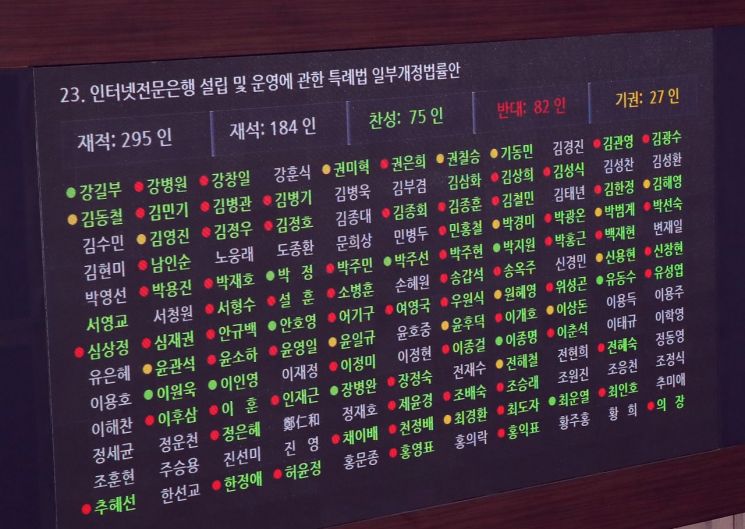
On the afternoon of the 5th, the National Assembly held a plenary session and submitted the amendment to the Internet Bank Act, but it was rejected with 75 votes in favor, 82 against, and 27 abstentions out of 184 members present. It is very unusual for the amendment to the Internet Bank Act to be rejected in the plenary session. It is analyzed that the opposition debate by Representative Chae Eui-bae, who had claimed that the Internet Bank Act was a "special privilege only for KT," had a significant impact. Just before the plenary session, Representative Chae, who led the opposition debate, raised his voice in criticism again that day, calling it a "violation of basic principles" and "giving special privileges to KT."
The amendment mainly deletes the clause that disqualifies major shareholders of internet banks who have a history of violating the Fair Trade Act (with fines or higher penalties) from approval to hold shares exceeding the limit. This deleted clause was considered KT's Achilles' heel. Although the amendment to the Internet Bank Act repeatedly failed to pass the Judiciary Committee due to the 'KT special privilege controversy,' it passed the committee the day before, raising expectations of a green light.
The Koo Hyun-mo administration at KT, which is about to officially launch, appears to be in a difficult position. Many new industries related to K-Bank, which had been on hold, were expected to accelerate with the passage of the bill. If the Internet Bank Act had passed, KT would have increased its stake in K-Bank (currently 10%) to 34%, and combined with its existing 69.54% stake in BC Card, its position as a financial ICT (Information and Communication Technology) operator would have been further solidified.
For this reason, KT had already begun preparing mid- to long-term business plans based on the passage of the Internet Bank Act. If KT became the major shareholder in the banking industry, it would be the only group among the three major telecom companies to have subsidiaries in payment, banking, and telecommunications. It would have been a turning point to accelerate?telecom, the biggest challenge in the telecommunications industry.
However, failing to pass the final hurdle means that KT's goal of financial + IT innovation is also collapsing. K-Bank, which had been unable to conduct loan operations for 11 months due to a lack of capital, now faces inevitable setbacks in its plan to welcome KT as the largest shareholder and proceed with large-scale capital expansion. KT only stated a general position, saying it "will strive to normalize K-Bank's management."
The ICT industry, which had been on edge awaiting the bill's passage, also expressed disappointment. Companies such as Naver, Nexon, Interpark, and Wemakeprice also have histories of violating the Fair Trade Act. With the rejection of the amendment to the Internet Bank Act, Kakao Bank must undergo Fair Trade Act reviews every six months, which is pointed out as a risk that destabilizes its status as a major shareholder.
© The Asia Business Daily(www.asiae.co.kr). All rights reserved.
![Clutching a Stolen Dior Bag, Saying "I Hate Being Poor but Real"... The Grotesque Con of a "Human Knockoff" [Slate]](https://cwcontent.asiae.co.kr/asiaresize/183/2026021902243444107_1771435474.jpg)
















