Decrease in Clothing Purchases Due to Warm Winter
Delivery Days May Also Decrease Due to Seol Holiday... Average Daily Transaction Amount Increases
COVID-19 Impact Partially Reflected in Mask Transactions and Others
[Asia Economy Reporter Kim Hyunjung] In January of this year, online shopping transaction volume decreased by 2.3% compared to the previous month. The main reason was a decline in clothing sales due to warm weather. Since the survey period was before the full-scale spread of the novel coronavirus infection (COVID-19), the related impact was reflected only in certain items such as hand sanitizers and masks.
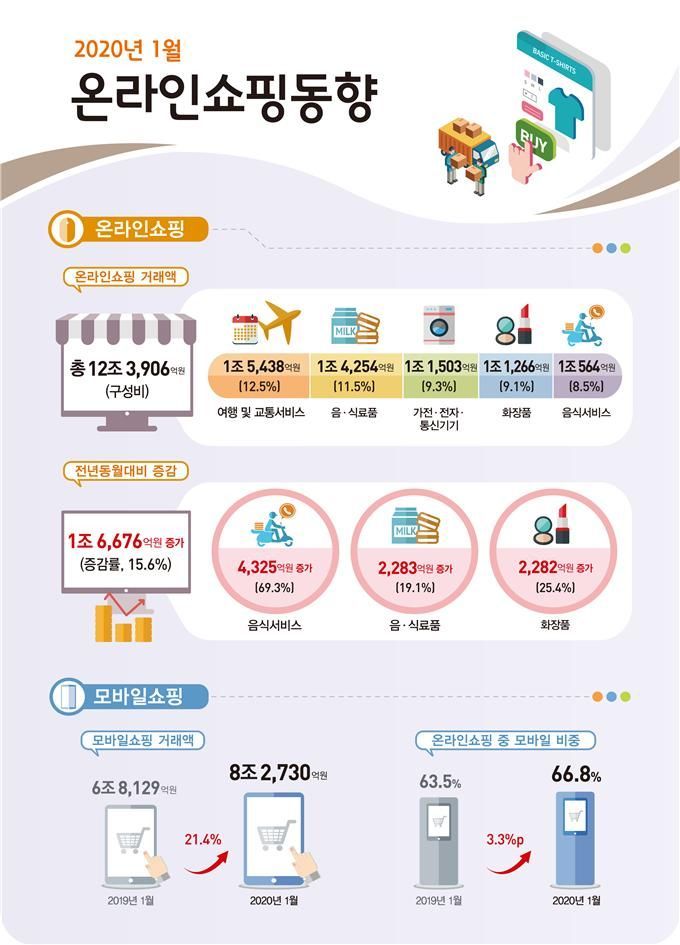
According to the "January 2020 Online Shopping Trends" released by Statistics Korea on the 4th, the total online shopping transaction amount in January this year was 12.3906 trillion KRW, down 292 billion KRW (2.3%) from the previous month. This marks the second consecutive month of decline following December (-169.5 billion KRW).
By product category, online shopping transaction amounts decreased compared to the same month last year in clothing (-3.5%) and computers and peripherals (-1.5%), while increasing in food services (69.3%), cosmetics (25.4%), and food and groceries (19.1%). Statistics Korea reports that the diversification of food services and the preference for ready-to-eat meals and delivery services have led to significant changes in consumer behavior.
Compared to the previous month, increases were seen in others (65.8%) and food and groceries (17.6%), but mainly due to the warm winter, clothing (-26.6%) saw a large decrease, along with children and infant products (-23.2%) and home appliances, electronics, and telecommunications devices (-7.5%).
The Lunar New Year holiday in January, which resulted in only 23 delivery days, also had an impact. When considering average daily transaction amounts, January (501.6 billion KRW) actually increased by 4.1% compared to December (481.7 billion KRW).
The share of mobile shopping in total transaction volume was 66.8%, up 3.3 percentage points from 63.5% in the same month last year. On mobile, all product categories increased compared to the same month last year, including food services (73.2%), food and groceries (27.1%), and daily necessities (22.7%). Compared to the previous month, increases were seen in others (92.2%) and food and groceries (20.5%), but transactions declined in clothing (-23.4%), children and infant products (-21.7%), and sports and leisure goods (-20.8%).
Among detailed product categories in January, the proportion of mobile shopping transactions was highest in food services (94.1%), e-coupon services (89.1%), and bags (78.5%).
The impact of COVID-19 appeared limited. Although the first confirmed case occurred in January, the phenomenon of reducing outdoor activities began in earnest from February as the virus spread more widely.
Yang Donghee, head of the Service Industry Trends Division at Statistics Korea, explained, "Masks are reflected in the others category, where transaction volume surged 57% compared to the same month last year," adding, "This is the highest increase since March 2018, when demand rose 57.8% due to fine dust." Regarding future trends, he added, "It is currently difficult to make projections based on the figures."
© The Asia Business Daily(www.asiae.co.kr). All rights reserved.

















