Electoral District Delimitation Committee Submits Own Proposal to National Assembly
One Seat Each Merged in Seoul Nowon, Gyeonggi Ansan, Gangwon, and Jeonnam
Total 253 Constituencies... Moon Heesang Says "Insufficient Consideration for Rural and Mountainous Areas"
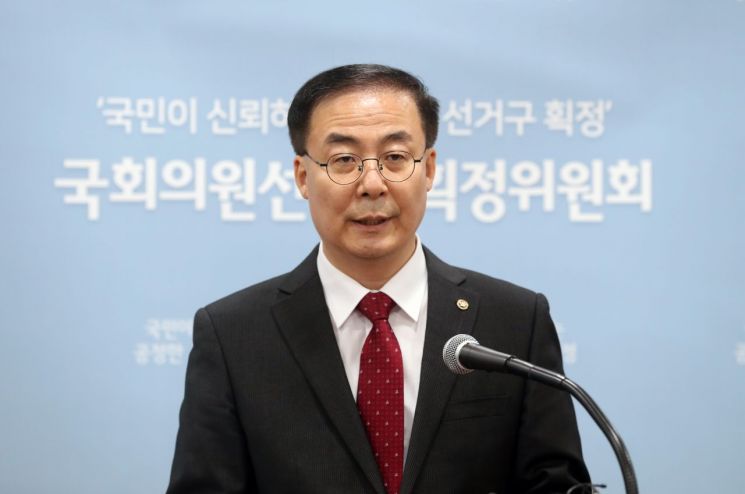
[Asia Economy Reporter Kim Hyemin] The electoral districts for the April general election have been finalized. One district each was added in Sejong, Hwaseong in Gyeonggi Province, Chuncheon in Gangwon Province, and Suncheon in Jeollanam-do, while one district each was reduced in Nowon, Seoul, Ansan in Gyeonggi Province, Gangwon, and Jeollanam-do, adjusting the total to 253 electoral districts.
The Electoral District Delimitation Committee under the National Election Commission created its own delimitation plan and submitted it to the National Assembly on the 3rd. The committee acted independently after the ruling and opposition parties failed to reach an agreement on the delimitation criteria.
The number of constituency seats was fixed at 253 following the passage of the revised election law centered on the mixed-member proportional representation system. The committee set the population lower limit for merging and splitting districts at 136,565 and the upper limit at 273,129, based on the standard population as of the end of January 2019, which is 15 months prior to the election date, to determine population deviations.
Accordingly, electoral districts exceeding the upper population limit were split, and those falling below the lower limit were merged or abolished.
There are a total of four split districts: ▲ Sejong Special Self-Governing City → Sejong Special Self-Governing City Gap and Eul ▲ Hwaseong City, Gyeonggi Province Gap, Eul, Byeong → Hwaseong City Gap, Eul, Byeong, Jeong ▲ Chuncheon City, Gangwon Province → Chuncheon City Gap and Eul ▲ Suncheon City, Jeollanam-do → Suncheon City Gap and Eul.
There are also four merged districts. Nowon-gu Gap, Eul, and Byeong in Seoul were merged into Nowon-gu Gap and Eul, and Ansan City’s Sangnok-gu Gap, Sangnok-gu Eul, Danwon-gu Gap, and Danwon-gu Eul in Gyeonggi Province were consolidated into Ansan City Gap, Eul, and Byeong. Gangwon Province and Jeollanam-do each reduced one district, resulting in mergers in other regions.
In Gangwon Province, five districts?▲ Gangneung City, Donghae City, Samcheok City, Taebaek City, Hoengseong County, Yeongwol County, Pyeongchang County, Jeongseon County, Sokcho City, Goseong County, Yangyang County, Hongcheon County, Cheorwon County, Hwacheon County, Yanggu County, and Inje County?were merged into four districts: ▲ Gangneung City and Yangyang County, Donghae City, Taebaek City, Samcheok City, Hongcheon County, Hoengseong County, Yeongwol County, Pyeongchang County, Jeongseon County, Sokcho City, Cheorwon County, Hwacheon County, Yanggu County, Inje County, and Goseong County. This merger created a massive electoral district encompassing six areas.
In Jeollanam-do, five districts?▲ Mokpo City, Naju City, Hwasun County, Gwangyang City, Gokseong County, Gurye County, Damyang County, Hampyeong County, Yeonggwang County, Jangseong County, Yeongam County, Muan County, and Sinan County?were reorganized into four districts: ▲ Mokpo City and Sinan County, Naju City, Hwasun County, Yeongam County, Gwangyang City, Damyang County, Gokseong County, Gurye County, Muan County, Hampyeong County, Yeonggwang County, and Jangseong County.
Additionally, one electoral district each was adjusted within the Incheon and North Gyeongsang regions, and boundaries within 11 districts’ autonomous districts, cities, and counties were modified. Due to the abolition of administrative districts, the names of Bucheon City’s Wonmi-gu Gap, Wonmi-gu Eul, Sosa-gu, and Ojeong-gu were changed to Gap, Eul, Byeong, and Jeong, respectively.
Accordingly, the number of districts by province and city is as follows: ▲ Seoul 48 ▲ Busan 18 ▲ Daegu 12 ▲ Incheon 13 ▲ Gwangju 8 ▲ Daejeon 7 ▲ Ulsan 6 ▲ Sejong 2 ▲ Gyeonggi Province 60 ▲ Gangwon Province 8 ▲ North Chungcheong Province 8 ▲ South Chungcheong Province 11 ▲ North Jeolla Province 13 ▲ South Gyeongsang Province 16 ▲ Jeju 3.
Chairman Kim Se-hwan said, "We did our best to prepare a reasonable delimitation plan, but we apologize to the public for submitting it nearly a year past the legal deadline," adding, "We repeatedly urged the National Assembly to finalize the number of districts by province and city, but as no consensus was reached, election management was also disrupted."
Regarding the delimitation plan, he said, "We aimed to minimize confusion in electoral districts," but added, "Although we tried to reflect the representation of rural and mountainous areas, some districts remain regrettable," and emphasized, "Measures should be established to prevent repeated delays in the future and to effectively reflect regional representation."
The National Assembly is expected to review the delimitation plan submitted by the committee and handle it in a plenary session. The floor leaders of the ruling and opposition parties have expressed their intention to respect the committee’s independently created plan as much as possible. However, National Assembly Speaker Moon Hee-sang reportedly said, "They say they tried to consider rural and mountainous areas, but grouping six counties together seems to contradict the law. It feels insufficient whether the discussions among negotiation groups have been adequately reflected," according to National Assembly spokesperson Han Min-su.
© The Asia Business Daily(www.asiae.co.kr). All rights reserved.
![Clutching a Stolen Dior Bag, Saying "I Hate Being Poor but Real"... The Grotesque Con of a "Human Knockoff" [Slate]](https://cwcontent.asiae.co.kr/asiaresize/183/2026021902243444107_1771435474.jpg)
















