Acquisition at 54.5 Billion Won... 15 Billion Won Lower Than Before
Lee Seok-ju: "Will Normalize Eastar by Maximizing Operational Efficiency" Choi Jong-gu: "Active Government Support Needed"
Concerns Over 'Winner's Curse' Remain
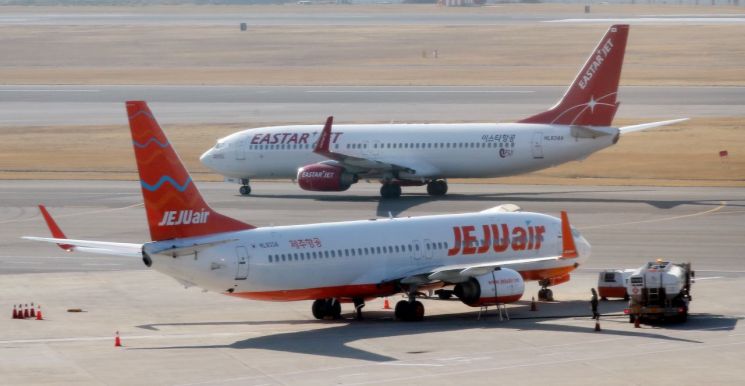
[Asia Economy Reporter Yoo Je-hoon] Jeju Air has finalized the acquisition of Eastar Jet after long consideration. This comes at a time when the entire airline industry is facing a crisis due to the impact of the novel coronavirus disease (COVID-19). While some voices express concerns about the winner's curse, both companies plan to realize 'economies of scale' through this integration to overcome the crisis caused by COVID-19.
Jeju Air announced on the 2nd that it has signed a stock purchase agreement (SPA) to acquire 4,971,000 shares (51.17%) of Eastar Holdings and Eastar Jet for approximately 54.5 billion KRW. This is about three months after signing a memorandum of understanding for management rights acquisition in December last year. Jeju Air plans to pay the remaining balance of about 43 billion KRW, excluding the performance bond of 11.5 billion KRW paid to Eastar Holdings at the time of the MOU signing, in full by April 29.
The acquisition price of 54.5 billion KRW is about 15 billion KRW lower than the 69.5 billion KRW initially discussed between Eastar Holdings and Jeju Air. This reflects a comprehensive consideration of various risks revealed during due diligence and the worsening business conditions due to COVID-19.
Lee Seok-joo, CEO of Jeju Air, stated, "Considering the current airline market situation due to COVID-19 issues, both companies have reached a price adjustment through concessions to ultimately contribute to the development of the airline industry," adding, "We will do our best to stabilize Eastar Jet’s management and improve profitability by maximizing operational efficiency."
This merger and acquisition (M&A) is attracting public attention as the first consolidation between companies in the same industry since the low-cost carrier (LCC) model emerged in Korea around 2005. The LCC industry, which has experienced rapid growth over 15 years, has faced ongoing calls for structural reform as oversupply in the short-haul market intensified following last year’s boycott of travel to Japan.
However, some in the industry raise concerns about the possibility of a winner's curse. This is due to oversupply on Southeast Asian routes following last year’s Japan travel boycott and the ongoing impact of major route suspensions caused by COVID-19 this year.
The situations of both companies are not entirely positive. Eastar Jet’s financial condition has deteriorated to the extent that it paid only 40% of employees’ wages in February. As of 2018, its debt ratio was 484.4%, and its capital erosion rate reached 47.9%.
Choi Jong-gu, CEO of Eastar Jet, also repeatedly called for government support for normalization. On the day of the announcement, CEO Choi said, "This decision is part of proactive private-sector efforts to overcome the COVID-19 crisis," emphasizing, "The airline industry should not be viewed separately from tourism, hotels, and self-employed sectors severely affected by COVID-19, but as an industry directly impacted that urgently needs active policy and financial support from the government."
Jeju Air holds cash reserves in the 300 billion KRW range as of the third quarter of last year, but concerns remain as it posted a loss of 32.9 billion KRW last year and is expected to incur losses in the hundreds of billions of KRW this year due to COVID-19. Additionally, concerns about future restructuring persist both inside and outside the two companies.
However, Jeju Air and Eastar Jet plan to pursue rapid normalization through economies of scale. They aim to reduce costs by realizing economies of scale, operate route networks flexibly, and secure price competitiveness. According to the Ministry of Land, Infrastructure and Transport’s Aircraft Traffic Information System (ATIS), the combined fleet of the two companies totals 68 aircraft (Jeju Air 45, Eastar Jet 23), surpassing T’way Air (28) and Jin Air (27), which rank second and third.
An industry insider said, "The greatest competitiveness of U.S. Southwest Airlines and Ireland’s Ryanair, which are considered the epitome of LCCs, is ultimately economies of scale and the resulting price competitiveness," adding, "If they can overcome the COVID-19 wave well, they will be able to establish a solid advantage over competing LCCs that remain small to medium-sized in the long term."
© The Asia Business Daily(www.asiae.co.kr). All rights reserved.

















