[Sejong=Asia Economy Reporter Joo Sang-don] The results of the '2019 National Marine Ecosystem Comprehensive Survey' revealed that the biodiversity of Korea's tidal flats is superior to that of the Wadden Sea tidal flats, designated as a UNESCO World Natural Heritage site.
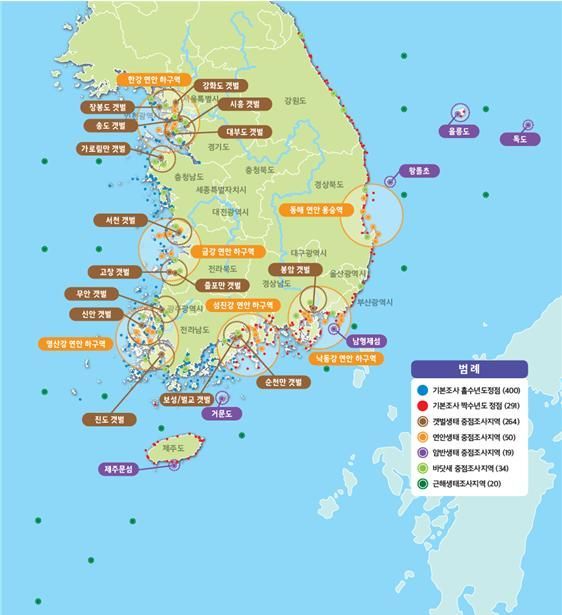
The Ministry of Oceans and Fisheries and the Korea Marine Environment Management Corporation announced on the 2nd that the comprehensive marine ecosystem survey conducted last year in the western and southwestern sea areas of the West Sea, where about 90% of Korea's tidal flats are located, confirmed that the total number of species inhabiting Korea's tidal flats reached 650. This figure is 1.6 times higher than that of the German Wadden Sea tidal flats, famous for world-class tidal flat conservation, which has a total of 400 species.
Additionally, the survey confirmed that the average particle size of the entire tidal flat sediment is about medium size between sand and clay (neutral silt), and there has been almost no change since 2015. Furthermore, three representative benthic animal groups of tidal flats?polychaetes, crustaceans, and mollusks?appeared in consistent proportions across the previous three surveys. This numerically confirms that the tidal flats in the western and southwestern seas of Korea maintain a stable ecosystem. The number of species appearing in the rocky ecosystem was 502, showing little change compared to 2015 (544 species) and 2017 (497 species).
The number of halophytic plant species and their distribution area, which inhabit saline environments like tidal flats, also significantly increased compared to previous surveys (2015 and 2017). This is analyzed to be due to the low rainfall in 2019, which created favorable conditions for the growth of Salicornia communities, and the expansion of Suaeda communities due to the dry climate, resulting in an increased area. The number of seaweed species also steadily increased, which the Ministry of Oceans and Fisheries attributes to the rise of red algae that prefer warmer seas.
Along with this, the survey identified the habitats and distribution status of a total of 33 marine protected species (7 tidal flat invertebrates, 6 seabirds, 18 rocky invertebrates, and 2 seaweed species). Notably, new coral habitats were discovered at Munseom Island in Jeju and Geomundo Island, which can be used as foundational data for future expansion of marine protected areas and management of marine protected species.
Lee Jae-young, Director of the Marine Ecology Division at the Ministry of Oceans and Fisheries, stated, "Creating a healthy sea begins with diagnosing the current state of the marine ecosystem," and added, "We will continue to conduct comprehensive surveys to accurately assess the marine ecosystem and systematically conserve and manage marine biodiversity."
© The Asia Business Daily(www.asiae.co.kr). All rights reserved.

















