Record Largest Deficit in 11 Years Last Year
Electricity Sales Revenue Down 903 Billion Won Year-on-Year
Cost Burden Due to Fine Dust and Greenhouse Gas Regulations
Uncertain Performance Recovery... Accelerating Tariff System Reform
[Asia Economy Reporter Kim Bo-kyung] Korea Electric Power Corporation (KEPCO) recorded its second-largest deficit ever, nearing 1.4 trillion won. This was due to a decrease in electricity sales revenue and a significant increase in operating costs caused by greenhouse gas regulations. The accumulation of KEPCO's deficits has intensified pressure for future electricity rate hikes.
On the 28th, KEPCO announced its provisional 2019 operating results (consolidated basis), reporting an operating loss of 1.3566 trillion won. This is the second-largest deficit in history since 2008 (2.7981 trillion won), when international oil prices surged. KEPCO posted operating losses for two consecutive years following 2018, with the deficit increasing by 1.1486 trillion won. Last year's sales amounted to 59.0928 trillion won, down 1.5348 trillion won from the previous year.
KEPCO stated that the main cause of the operating loss was a decline in electricity sales revenue. It explained that electricity sales revenue decreased by 903 billion won compared to the previous year due to reduced heatwaves and cold spells. Electricity sales volume was 520.5 million MWh, down 1.1% from the previous year.
Coal phase-out policies aimed at reducing fine dust and greenhouse gases also increased KEPCO's management burden. As the number of days with reduced or halted power plant operations increased, coal utilization rate dropped 4% from the previous year to 70.7%. The cost of greenhouse gas emission permits for power plants also surged from 53 billion won in 2018 to 709.5 billion won last year due to reduced free allocation.
Depreciation and maintenance costs related to facility investments increased by about 600 billion won compared to the previous year. Specifically, depreciation in the power generation sector increased by 200 billion won due to the completion of Shin-Kori Nuclear Unit 4, and depreciation in the transmission and distribution sector increased by 300 billion won due to new and expanded lines. Maintenance costs rose by 100 billion won due to strengthened safety inspections and preventive maintenance activities.
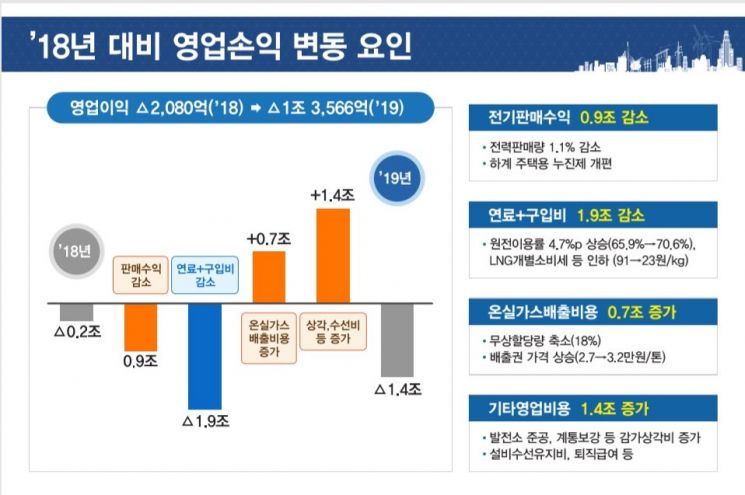
Costs related to nuclear power, including radioactive waste management and increased unit costs for nuclear decommissioning, led to an increase in restoration liabilities by 187.4 billion won, reaching 449.3 billion won. Additionally, labor costs rose by 200 billion won due to increased personnel, and retirement benefit expenses increased by 300 billion won. Although fuel costs decreased by 1.8 trillion won compared to the previous year due to falling international oil prices and higher nuclear utilization rates, this was insufficient to offset the deficit.
KEPCO maintains that its performance is unrelated to the nuclear phase-out policy. It explained that the nuclear utilization rate was 71.2% in 2017, when it posted an operating profit of 4.9 trillion won, and last year's nuclear utilization rate was similarly 70.6%.
KEPCO plans to reduce costs by around 1.6 trillion won through self-help efforts. However, due to the economic downturn caused by the COVID-19 pandemic, industrial electricity demand is decreasing, and pressure from exchange rate increases is expected to add further challenges, making recovery of this year's performance difficult. As the government maintains its coal phase-out and nuclear phase-out policy stance, KEPCO's power generation cost burden is expected to grow further.
Ultimately, there is speculation that KEPCO will accelerate the timing of reforming the electricity rate system to normalize management. On this day, KEPCO stated, "We will focus on rational institutional improvements to establish a sustainable rate system." Accepting the worst performance report, KEPCO once again expressed its determination to reform the electricity rate system.
KEPCO ended the special discounts scheduled to expire last year as planned and intends to submit electricity rate reform plans to the Ministry of Trade, Industry and Energy within the first half of this year. A KEPCO official said, "We are continuing to analyze surveys related to electricity usage and discuss plans for reforming the rate system." However, the official added, "Electricity rates must consider both public interest and profitability," and "We plan to continue consultations with the government on these aspects."
© The Asia Business Daily(www.asiae.co.kr). All rights reserved.