South Korea's Proposal to Prevent Unpaid Leave Crisis Met with De Facto Negative Response
Next Talks Delayed Despite Repeated South Korean Proposals
Negotiator Jeong Eun-bo: "Proposed Memorandum of Understanding to US Side... Expecting Acceptance"
US Side's Revised Proposal Considered "Meaningless"
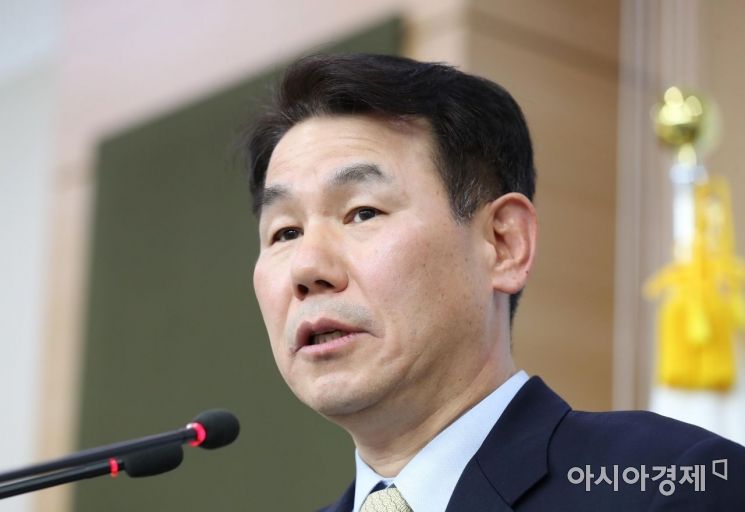 Jeong Eun-bo, the Special Representative for U.S.-Korea Defense Cost-Sharing Talks, is briefing on the U.S.-Korea defense cost-sharing negotiations at the Ministry of Foreign Affairs building in Jongno-gu, Seoul, on the 19th. Photo by Moon Ho-nam munonam@
[Asia Economy Reporter Lim Cheol-young] The U.S., which had demanded South Korea’s defense cost-sharing payment amounting to 5 trillion won?five times the previous amount?responded to the South Korean government’s proposal to prioritize resolving the labor cost issue of Korean workers employed by the U.S. Forces Korea (USFK) by stating that it would "significantly undermine a swift and comprehensive agreement."
The U.S. side, including the USFK Command, has continued to exert pressure by concretizing plans for the 'unpaid leave' of Korean workers at USFK, even in situations that could damage the ROK-U.S. alliance and joint defense posture. The U.S. has insisted on a 'comprehensive agreement' based on a substantial increase in defense cost-sharing payments.
The recent response also expressed a negative stance toward the South Korea’s proposal for a phased resolution of the 11th Special Measures Agreement (SMA) on defense cost-sharing. The South Korean government reportedly conveyed the proposal to prioritize resolving labor cost issues and continue negotiations after the sixth round of talks last month, as the USFK Command announced that it would implement unpaid leave for 9,000 Korean workers employed by USFK starting April 1.
Jeong Eun-bo, the ROK-U.S. defense cost-sharing negotiation representative, held an emergency briefing at the Ministry of Foreign Affairs building yesterday afternoon and said, "In preparation for possible delays in SMA negotiations, the government has already proposed to the U.S. side the signing of a memorandum of understanding prioritizing the payment of labor costs for Korean workers," adding, "We expect the U.S. to accept this proposal."
The U.S. side had not shown a progressive response to South Korea’s phased negotiation proposal but appeared to specify its position after Jeong’s official briefing. Following Jeong’s briefing, a spokesperson from the U.S. State Department said, "The proposal to conduct separate negotiations based on labor costs is mutually acceptable but would significantly undermine the swift conclusion of a comprehensive SMA."
Regarding the possibility of unpaid leave for Korean workers, the spokesperson added, "If the ROK and the U.S. conclude a fair SMA, it can be avoided," and "The U.S. remains committed to a fair defense cost-sharing and a mutually acceptable comprehensive negotiation."
Since September last year, six rounds of negotiations have taken place between South Korea and the U.S., but the outlook for the talks has become rather uncertain. There is speculation that the U.S. side’s insistence on a comprehensive agreement, leveraging the unpaid leave of Korean workers, and the South Korean government’s phased negotiation proposal may directly clash.
Representative Jeong stated, "We have held six rounds of negotiations and both countries have expanded their understanding considerably, but there remain differences that prevent reaching a final agreement," and criticized, "Our government finds it difficult to consider the U.S. side’s revised proposal as a meaningful offer." He also expressed regret over the delay of the next meeting despite repeated proposals from South Korea to meet for consultations.
However, a senior official familiar with the negotiations mentioned, "If it becomes inevitable for unpaid leave to be implemented, we expect the U.S. to agree to (South Korea’s) proposal." This reflects the judgment that the U.S. side will not maintain its existing position at the expense of strengthening and developing the ROK-U.S. alliance and the livelihood stability of workers.
Meanwhile, Jeong stated that if the U.S. accepts South Korea’s phased negotiation proposal, the government is prepared to seek parliamentary ratification twice. Jeong said, "The government is ready to proceed with the parliamentary ratification process twice if necessary to conclude an SMA without unpaid leave."
The defense cost-sharing paid by South Korea consists of wages for Korean workers employed by USFK, construction costs within U.S. bases, and logistics support expenses.
© The Asia Business Daily(www.asiae.co.kr). All rights reserved.

















