[Interview] Nurse Jo Mo's Nonstop Day in Daegu
Commuting to Health Center by Taxi... Testing 18 People Daily at Regional Screening Clinics
Shincheonji Believers Are Main Targets for Mobile Testing... Collecting Specimens Door-to-Door
'Level D' Full-Body Protection, Personal Smartphones with Infection Risk Strictly Prohibited
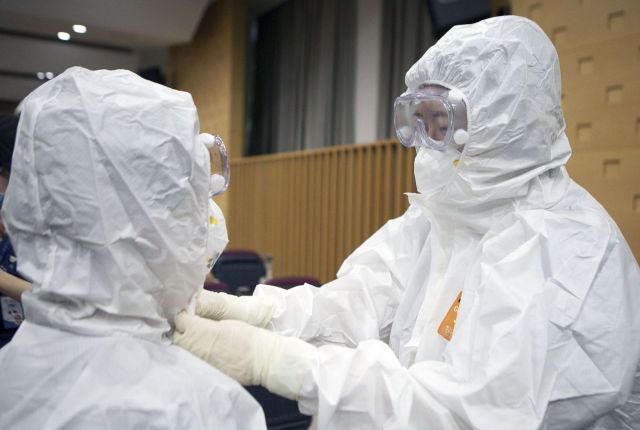 The photo is not directly related to the article. A medical staff member is wearing protective clothing to treat a patient with the novel coronavirus infection (COVID-19).
[Asia Economy Reporter Jeong Dong-hoon] "That's a death zone. Write your resignation letter immediately!" Leaving behind the anxious voices of my parents, I headed to Daegu. There was no time to delay when thinking of the Daegu citizens waiting for medical staff. It has been six days since I stood on the front lines of the novel coronavirus infection (COVID-19). When facing the incessant flow of people to be tested, there is no time to feel exhausted.
Jo Mo (31), a nurse affiliated with Hospital A in Gyeonggi Province, repeatedly requested in a phone interview with Asia Economy on the 28th, "Please do not reveal my real name." She said it was because she was just doing her duty. On the sixth day of her dispatch, Jo's day begins by gathering in the lobby of her accommodation at 8:40 a.m. After taking a taxi to the public health center, she disperses to screening clinics in various regions. Jo mainly handles epidemiological investigations and also collects specimens from COVID-19 symptomatic individuals. She said, "Recently, the schedule for specimen collection targeting Shincheonji Church of Jesus members has been so packed that there is no time to catch a breath."
When starting work, she wears protective gear at 'Level D' standard. Since recent test subjects are more likely to be patients than those who have visited before, she is more cautious than ever. Level D protective gear includes a full-body protective suit, goggles, medical mask, gloves, and shoe covers. Personal items such as smartphones cannot be brought into the screening clinic. They are separately stored wrapped in plastic wrap and zipper bags. This is to prevent virus infection through personal belongings.
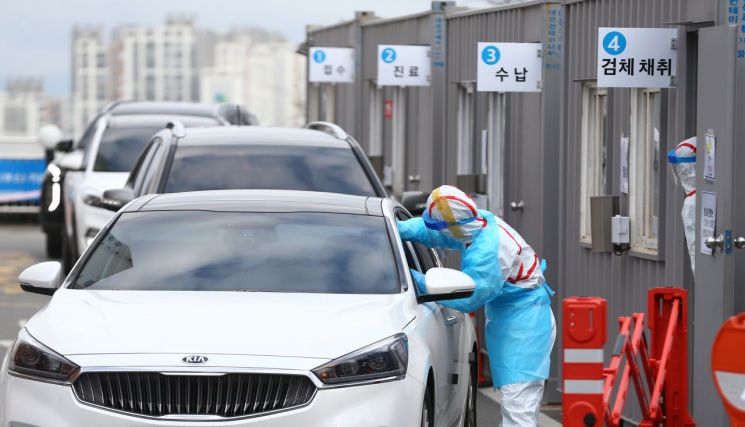 On the 27th, a medical staff member at the screening clinic of Yeungnam University Hospital in Daemyeong-dong, Nam-gu, Daegu City, is collecting specimens for testing of the novel coronavirus infection (COVID-19) from a citizen in a car.
 [Photo by Yonhap News]
◆ Up to 18 tests per day... Close contact unavoidable = A team of three?one doctor, one driver, and one nurse?conducts mobile specimen collection. The main mobile test subjects are patients with mobility difficulties and Shincheonji Church of Jesus members. They visit homes to check if anyone is present. This is when tension starts to build, thinking the subject might be a confirmed COVID-19 patient. Specimen collection is done by using a long swab to scrape inside the nose and throat to collect secretions. Another method is to have the person cough and spit out sputum. From these two collected specimens, only the virus genes are extracted and amplified to confirm infection.
Jo said, "Close contact with patients is unavoidable during specimen collection," and added, "Even after the test, the mobile specimen collection team cannot confirm whether the person being investigated is a confirmed patient." She bitterly recalled, "My mother, who told me to apply to nursing because 'it's easy to get a job,' has been saying she regrets it every time during infectious disease outbreaks, even though nearly ten years have passed." Even though they rush breathlessly, a team can only test about 18 people per day. Since the entire list of Shincheonji members was secured, the urgency increased. Except for some rest and waiting times, they spend more than five hours a day wearing Level D protective gear.
◆ Wearing equipment for 5 hours... Exhausted after work = One of the difficulties medical staff face is the discomfort caused by protective equipment. Jo said, "The N95 (protective mask) is made to fit the contours of the face, so wearing it for a long time causes pain from rubbing and leaves severe marks," adding, "Even wearing Level D protective gear for just 10 minutes causes sweating and discomfort, but living in it for 4 to 5 hours a day leaves me exhausted after work." Some medical staff attach hydrocolloid bandages (moisture-retentive bandages) they purchased themselves to the mask contact areas to prevent skin abrasions. However, even those are gradually running out.
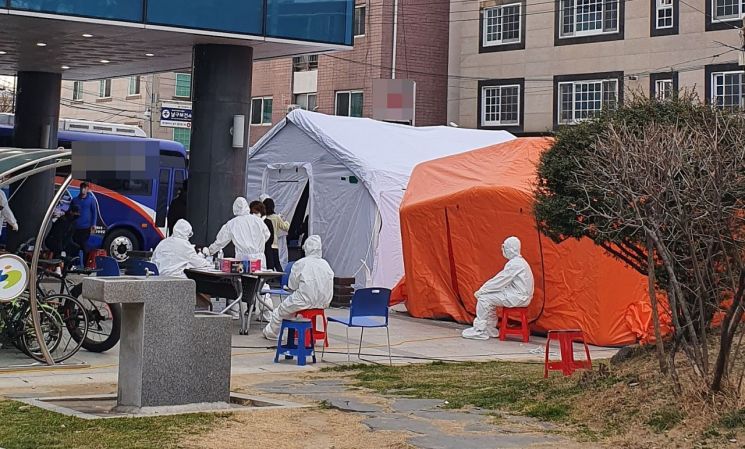 Due to concerns such as virus contamination, medical staff are not allowed to bring smartphones into the screening clinic. The photo shows Mr. Jo taking a distant picture of his fellow medical staff waiting near the screening clinic. Photo by Jo
Jo also expressed regret about the 'aseptic concept' among on-site officials. She pointed out, "There are cases where local government officials, such as those from public health centers, do not wear Level D protective gear while working at screening clinics," and "I even witnessed someone putting their foot into a medical waste box where protective gear was discarded without any protective equipment on." Such careless behavior can spread infectious diseases. She emphasized, "We will definitely win the war against COVID-19, but until then, we will not let our guard down and will do our best."
Meanwhile, on the same day, the government announced that it had provided more than 140,000 protective equipment items, including about 55,000 full-body protective suits and about 91,300 N95 masks, to prevent the spread of COVID-19 among medical staff in the Daegu and Gyeongbuk regions.
The government also plans to support medical personnel in these areas to work in a safe environment as much as possible. Kim Kang-lip, the first chief coordinator of the Central Disaster and Safety Countermeasures Headquarters and Vice Minister of Health and Welfare, said at a briefing, "We have provided full-body protective suits, N95 masks, and powered air-purifying respirators to prevent infection among medical staff in Daegu and Gyeongbuk," adding, "We plan to ensure that medical staff have sufficient protective equipment and can provide care in a safe environment."
© The Asia Business Daily(www.asiae.co.kr). All rights reserved.



















