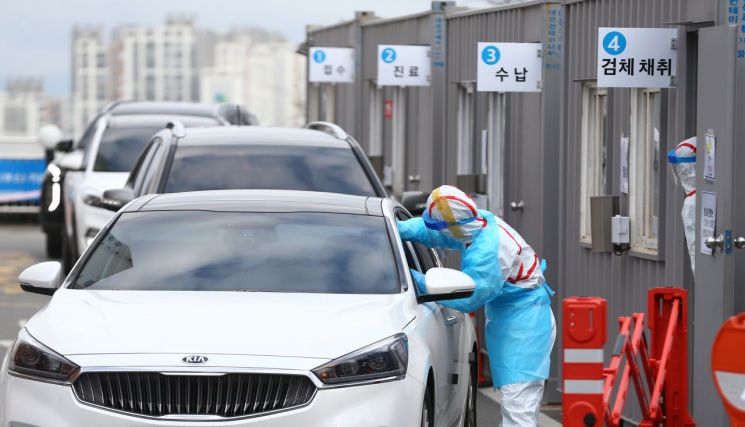
 On the 27th, citizens who came to get tested for COVID-19 at the screening clinic of Yeungnam University Hospital in Daemyeong-dong, Nam-gu, Daegu, are receiving medical examination from healthcare workers while remaining in their cars.
 [Image source=Yonhap News]
[Asia Economy Reporter Cho Hyun-ui] The 'drive-thru' method of COVID-19 testing (ordering fast food while in the car) introduced for the first time in Korea has achieved the 'two rabbits' of reducing the risk of cross-infection and increasing testing speed. Notably, this idea was proposed by the primary care physician of Korea's first confirmed COVID-19 patient, drawing attention.
According to the medical community on the 28th, the drive-thru testing method was first proposed by Jin-Yong Kim, an infectious disease specialist at Incheon Medical Center and the primary care physician of Korea's first COVID-19 patient. Two years ago, he devised a biological terrorism response method together with Jaegab Lee, an infectious disease professor at Hallym University Kangnam Sacred Heart Hospital, and Jung-Sik Eom, an infectious disease professor at Gachon University Gil Medical Center, which was adapted to the current situation and proposed.
◆"Applying the biological terrorism response method devised two years ago"=Professor Jaegab Lee said on KBS's YouTube channel the day before, "Drive-thru testing was one of the antidote distribution methods devised for large-scale patient outbreaks in a biological terrorism study conducted in 2018," adding, "After seeing the situation in Daegu, I told Professor Kim that a large-scale screening method was necessary, and he personally drew diagrams at 3 a.m. and created five documents (proposals)."
The testing method is simple. When a suspected patient or someone who wants to be tested arrives at the screening clinic by car, the entire process from registration, consultation, payment, to specimen collection can be done inside the vehicle. Since the person being tested does not need to get out of the car, the risk of infection to medical staff during the consultation process, such as temperature measurement, is reduced. Also, by not waiting for a long time in the same space with others who came for testing, the possibility of cross-infection is lowered.
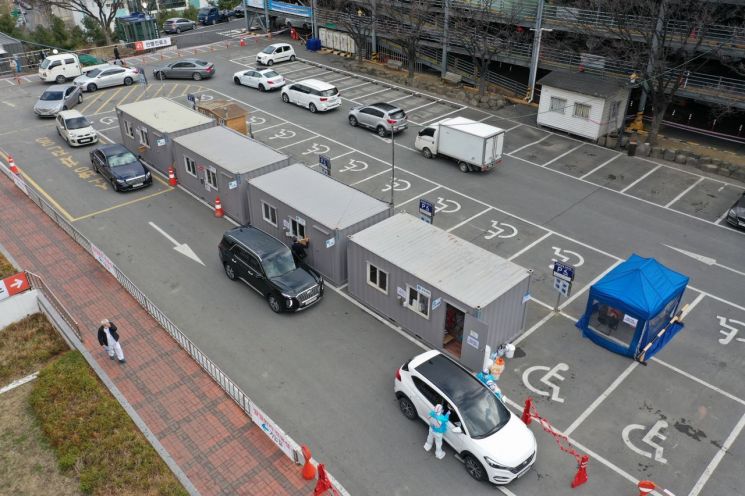 On the 27th, citizens who came to get tested for COVID-19 at the screening clinic of Yeungnam University Hospital in Daemyeong-dong, Nam-gu, Daegu, are receiving medical examination from healthcare workers while remaining in their cars.
 [Image source=Yonhap News]
◆Testing speed tripled... from 1 hour to 10 minutes=The testing time has been reduced to about one-sixth. The specimen collection time per person, which used to take over an hour, has been shortened to about 10 minutes. In general screening clinics, equipment must be disinfected and medical staff must change protective suits after each patient test. In contrast, at drive-thru clinics, the inside of the vehicle (disinfectant cloth) and the outside (disinfectant spray) are disinfected, and after the vehicle leaves, the surrounding area is disinfected. Because of this, waiting times are greatly reduced, allowing testing at three times the speed of general screening clinics (1 hour for 2-3 people) to 6-7 people per hour.
Drive-thru clinics have been appearing one after another since the 23rd at Chilgok Kyungpook National University Hospital, Daegu Yeungnam University Hospital, Sejong City, Goyang City, and others. Voices recommending drive-thru testing are also emerging in the medical community. Professor Moran Ki of the Department of Preventive Medicine at the Graduate School of International Cancer Center said, "You can rent an open space like a public sports ground, set up tents, and have people come by car and get tested inside the car like a drive-thru," adding, "If specimens are collected and people go home to wait for results, there is no need for separate isolation at hospitals or for many people to wait in front of screening clinics."
This method is also attracting attention abroad. Japan's NHK focused on Korea's drive-thru clinics on the same day, saying, "Unlike hospitals, it reduces contact with others, allowing for safe and rapid response." Laura Bicker, BBC's Seoul correspondent, posted a photo of the drive-thru screening clinic set up at Yeungnam University Hospital on Twitter, praising, "Korea quickly applied a brilliant idea."
© The Asia Business Daily(www.asiae.co.kr). All rights reserved.


















