Busan Port Authority Policy Evaluation Grades
2017: Grade 5 → 2018: Grade 2 → 2019: Grade 1 'Leap'
[Asia Economy Reporter Moon Chaeseok] It has been revealed that the 'Cheongnyeom Rookie,' composed of new employees with less than three years of experience at Busan Port Authority, is playing a significant role in fostering a culture of integrity.
On the 28th, the Anti-Corruption and Civil Rights Commission introduced the Busan Port Authority case as an 'Exemplary Integrity Case.'
Leveraging the characteristics of the institution, a 'triple monitoring system' was established to prevent safety accidents and corruption at construction sites.
Previously, inspectors participated in safety inspections at construction sites, but 'lenient inspections' became an issue. Therefore, personnel from the audit department and integrity citizen auditors were also involved in the inspections.
According to the Anti-Corruption and Civil Rights Commission, timely measures were taken on issues pointed out during joint inspections, resulting in no fatal accidents or corruption incidents at construction sites for two consecutive years.
Promotion of the Improper Solicitation and Graft Act (ISGA) to foreigners is also underway.
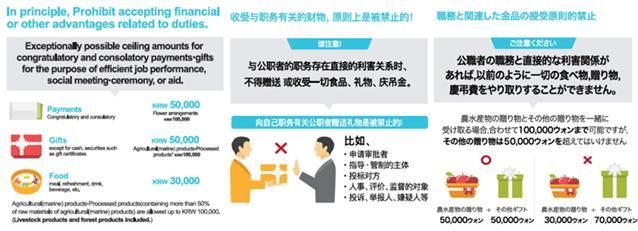
Promotional materials outlining the key points of the ISGA have been produced in English, Chinese, and Japanese and are being used to raise awareness among foreigners residing in or visiting Korea.
When employees visit foreign institutions or foreign institutions visit Korea, these materials are used to introduce the ISGA. Promotional materials have also been placed in facilities frequently visited by foreigners.
The materials have been shared with nine institutions, including Busan Metropolitan City.
The authority’s integrity policies are developed jointly by the 'Integrity Leaders,' mainly composed of executives, and the 'Cheongnyeom Rookie,' made up of new employees with less than three years of service.
As a result, the authority’s rating in the Anti-Corruption and Civil Rights Commission’s corruption prevention policy evaluation improved from grade 5 in 2017 to grade 2 in 2018, and to grade 1 last year. The policy evaluation grade is an indicator assessing public institutions’ efforts toward integrity.
The integrity grade also rose two levels, from grade 5 in 2018 to grade 3 last year.
Earlier, on the 7th, the Anti-Corruption and Civil Rights Commission introduced the 'Integrity Patrol' policy of the Korea Workers' Compensation and Welfare Service, which preemptively inspects risk factors for various corrupt practices to prevent structural and habitual corruption.
Im Yoonju, Director of the Anti-Corruption Bureau at the Anti-Corruption and Civil Rights Commission, said, "Sharing various excellent integrity policies promoted by institutions at all levels contributes to enhancing integrity in the public sector and serves as an opportunity to spread a culture of integrity throughout society. We will continue to discover and share exemplary cases going forward."
© The Asia Business Daily(www.asiae.co.kr). All rights reserved.

















