Ministry of Land, Infrastructure and Transport Releases Nationwide Building Statistics
Per Capita Residential Area 'Good' in Provinces, 'Poor' in Seoul
Number of Buildings Over 50 Floors Increased by 6 in One Year
Lotte World Tower Remains No.1 This Year with 123 Floors
[Asia Economy Reporter Moon Jiwon] The per capita residential building area in Sejong City was 40.50㎡, the highest among major regions nationwide. In contrast, Banseomyeon had only 30.52㎡ per capita, ranking as the worst residential environment in the country.
The Ministry of Land, Infrastructure and Transport released nationwide building status statistics on the 28th. According to these statistics, as of the end of last year, the total number of buildings nationwide was 7,243,472, an increase of 51,560 buildings compared to the previous year.
The total floor area increased by 10,743,000㎡ to reach 3,860,871,000㎡. The increase in total floor area last year was 447 times the floor area of the 63 Building in Yeouido, Seoul (238,429㎡).
By region, the total floor area in the metropolitan area including Seoul, Gyeonggi-do, and Incheon increased by 50,167,000㎡ to 1,740,232,000㎡, while the provinces increased by 56,576,000㎡ to 2,120,639,000㎡.
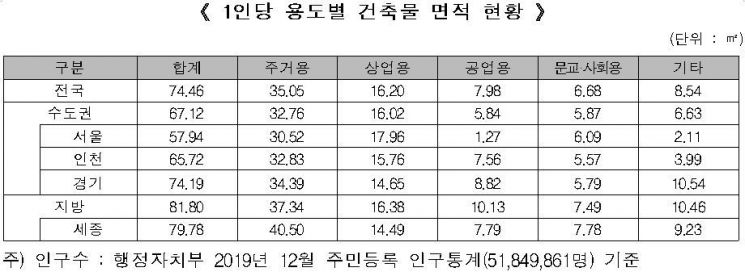
The per capita area of buildings nationwide increased by 2.02㎡ from the previous year to 74.46㎡. In the provinces, it increased by 2.50㎡ during the same period to 81.80㎡ per capita, but in the metropolitan area, it increased by only 1.61㎡, reaching 67.12㎡ per capita.
Looking at the per capita residential building area in major regions, Sejong City was the only one to exceed 40㎡. In the metropolitan area, Gyeonggi-do (34.39㎡), Incheon (32.83㎡), and Seoul (30.52㎡) followed in order. In Seoul, the per capita residential area was significantly lower than the metropolitan average (32.76㎡), the national average (35.05㎡), and the provincial average (37.34㎡), indicating a poor residential environment.
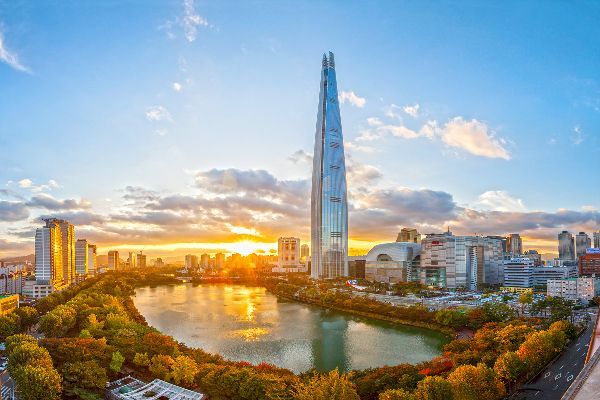
As of the end of last year, South Korea had a total of 113 super high-rise buildings with 50 floors or more, an increase of 6 buildings over one year. The tallest "highest building" is the Lotte World Tower in Songpa-gu, Seoul, completed in 2017, which has held the top spot in this category for three consecutive years.
According to the Ministry of Land, Infrastructure and Transport, the Lotte World Tower stands 555 meters tall, making it the seventh tallest building in the world. It is expected to maintain its number one position until the completion of Hyundai Motor Group's Global Business Center (GBC) in Samseong-dong, Seoul. The GBC will have 7 basement floors and 105 above-ground floors; although it has fewer floors than the Lotte World Tower (123 floors), its maximum height will be 569 meters, making it taller.
Currently under construction super high-rise buildings include Busan Lotte Town (107 floors) and Busan Hyundai Hillstate Ijin Bay City (69 floors).
By floor count, one-story buildings accounted for 4,433,000 buildings, representing 61.2% of all buildings. Buildings with 2 to 4 floors numbered 2,402,000 (33.2%), and 5-floor buildings numbered 174,000 (2.4%).
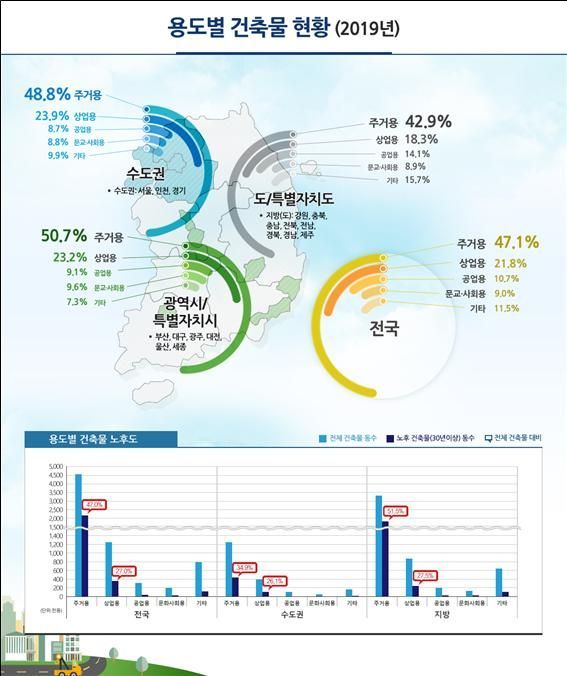
By usage, residential buildings accounted for the largest share with 1,817,390,000㎡ (47.1%), followed by commercial buildings with 839,976,000㎡ (21.8%) and industrial buildings with 413,999,000㎡ (10.7%).
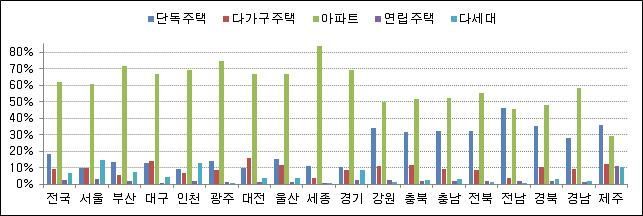
Among residential buildings, apartments had the largest total floor area at 1,129,976,000㎡ (62.2%), followed by detached houses at 334,175,000㎡ (18.4%), multi-family houses at 169,725,000㎡ (9.3%), row houses at 127,498,000㎡ (7.0%), and townhouses at 42,365,000㎡ (2.3%).
By province, apartments accounted for a large share in Sejong (83.5%), Gwangju (74.7%), and Busan (71.5%), while townhouses were significant in Jeju (11.4%), Seoul (3.4%), and Gangwon (2.6%). Multi-family houses had a large share in Seoul (14.6%), Incheon (12.7%), and Jeju (10.5%).
Buildings over 30 years old after approval for use totaled 2,738,500 nationwide, accounting for 37.8% of all buildings. By usage, aged buildings were most common in residential use in both the metropolitan area and provinces, at 34.9% and 51.5%, respectively.
© The Asia Business Daily(www.asiae.co.kr). All rights reserved.



















