Korean Air, Qantas Airways, Singapore Airlines, Cathay Pacific, etc.
Blanket and Headset Services Suspended
Complete Disinfection from Headsets to Overhead Bins at Hospital Surgery Level
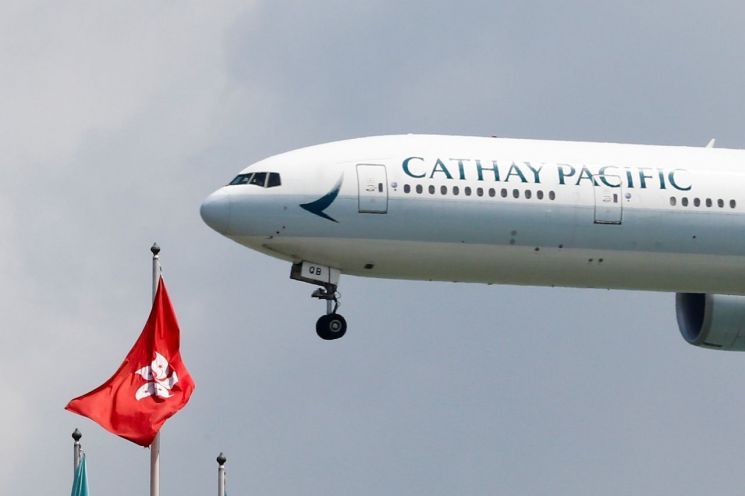
[Asia Economy Reporter Kwon Jae-hee] The aviation industry, hit hard by the spread of the novel coronavirus infection (COVID-19), is making every effort to disinfect aircraft.
On the 27th, Bloomberg reported that Korean Air of Korea, Qantas Airways of Australia, Singapore Airlines of Singapore, and Cathay Pacific Airways of Hong Kong have deployed the world's most powerful disinfectants capable of killing everything from sexually transmitted diseases to antibiotic-resistant bacteria to disinfect their aircraft.
In particular, Korean Air, Qantas Airways, and Scoot, a low-cost carrier of Singapore Airlines, which were deployed for evacuating their nationals from Wuhan, China, and Japanese cruise ships, have been confirmed to be focusing on aircraft sterilization to alleviate passenger anxiety.
Aircraft cleaning, which typically involved vacuuming, has been strengthened to the level of hospital operating rooms and advanced manufacturing industries.
Korean Air used the cleaning agent MD-125, which is used across all industrial sectors from medical fields to poultry farming, to disinfect Boeing 747 and Airbus A330 aircraft deployed for three Wuhan flights.
The MD-125 solution is used to sterilize 142 types of bacteria and viruses, including avian influenza, AIDS, and measles.
Korean Air not only wiped and disinfected the cabin but also replaced seat covers and kitchen curtains and disinfected the luggage compartments.
Aircraft deployed for Wuhan flights were able to resume service only after approval from the Korea Disease Control and Prevention Agency.
Additionally, Korean Air removed pillows and blankets from aircraft flying to China, Hong Kong, Taiwan, and Mongolia.
Qantas Airways used the hospital-grade disinfectant Viraclean, capable of killing various bacteria and viruses including hepatitis B and herpes simplex, to disinfect Boeing 747 aircraft deployed three times for transporting nationals from Wuhan and Japan.
Manufactured by Whiteley Australia, this product can also be used to disinfect heavily stained surfaces such as sweat and blood, as well as gloves and glasses.
Qantas conducted disinfection for 36 hours on aircraft that flew to Wuhan. Pillows, blankets, magazines, and headsets were all discarded, and the cabin was disinfected twice, including seats, floors, armrests, tray tables, overhead bins, and walls.
After undergoing this entire process, Qantas's Boeing 747 aircraft were redeployed this week on the Sydney-Santiago route.
Singapore Airlines always disinfects meal trays and TV screens after flights and replaces headsets, headrests, pillow covers, and blankets.
The air filtration system in Singapore Airlines cabins is maintained at the same level as hospital operating rooms.
Cathay Pacific, which is most affected by COVID-19, disinfects all cabin surfaces including baby cots after flights, and aircraft that had COVID-19 confirmed passengers undergo cleaning and disinfection again.
The airline does not provide hot towels, pillows, blankets, or magazines during flights to China and has also suspended in-flight duty-free sales.
© The Asia Business Daily(www.asiae.co.kr). All rights reserved.
![Clutching a Stolen Dior Bag, Saying "I Hate Being Poor but Real"... The Grotesque Con of a "Human Knockoff" [Slate]](https://cwcontent.asiae.co.kr/asiaresize/183/2026021902243444107_1771435474.jpg)
















