Ministry of Land, Infrastructure and Maritime Affairs Reports to President Today
All Ministries Focused on 'Reviving the Economy'
210,000 Customized Public Housing Units to be Supplied
GTX Line C Basic Plan to be Announced in November
Efforts to Rebuild the Stagnant Shipping Industry Underway
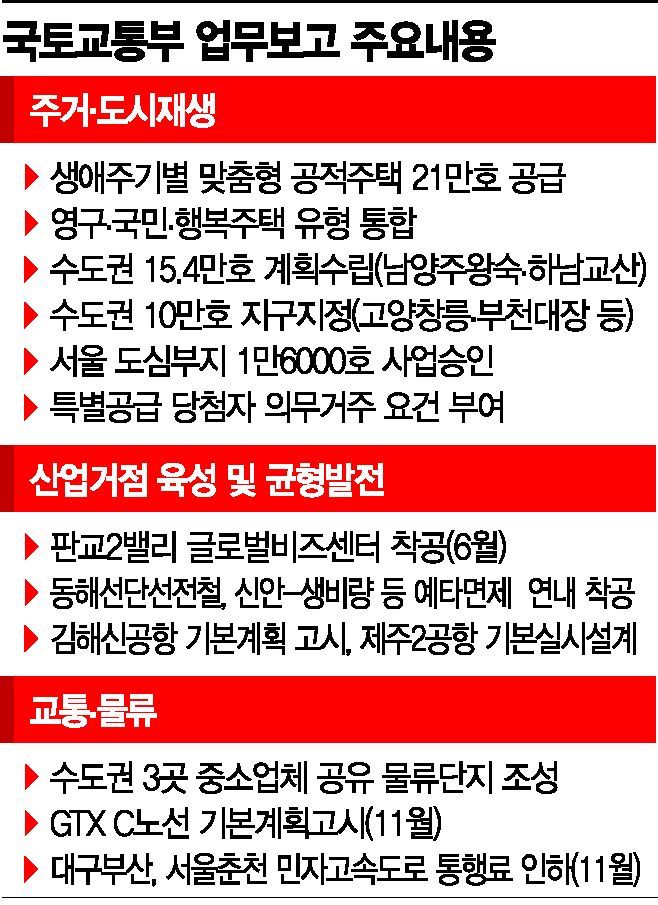
[Asia Economy Reporters Moon Jiwon, Lee Chunhee, Joo Sangdon] The Ministry of Land, Infrastructure and Transport (MOLIT) will expedite procedures such as designation and planning of districts including the 3rd New Town to supply 300,000 housing units in the Seoul metropolitan area.
On the morning of the 27th, at the 2020 work report held at the Blue House attended by President Moon Jae-in, MOLIT presented the '3 Major Goals and 8 Strategies to Boost Economic Vitality, and 2 Major Livelihood Issues' containing these details.
The keywords of the work report that day were 'economy' and 'livelihood.' It proposed three major economic vitality goals: ▲establishing regional economic hubs ▲activating regional SOC investment ▲creating jobs in land and transportation, and two major livelihood tasks: ▲expanding public rental housing supply ▲innovating a railway-centered transportation system. With the economy already sluggish and the COVID-19 pandemic overlapping, virtually all ministries are focusing on revitalizing the economy.
On the same day, the Ministry of Oceans and Fisheries also presented the reconstruction of the stagnant shipping industry as a key policy goal for this year. Notably, it emphasized the supply of 210,000 public housing units. Below is a summary and organization of the main work report contents from MOLIT and the Ministry of Oceans and Fisheries.
◆Expanding Public Rental Housing and Accelerating New Town Supply= One of the core contents of the Blue House work report that day was the expansion of public rental housing supply, which can directly affect the housing stability of ordinary citizens. The government plans to supply 210,000 public housing units this year to achieve an 8% stock rate of long-term public rental housing, and by 2025, raise it to 10%, which is within the top 10 among OECD countries.
It also set a goal to supply general housing for actual demanders in a timely manner to reduce market instability. First, in the metropolitan area, district plans will be established for 154,000 units in the 1st and 2nd designated districts, and the 3rd district with 100,000 units will be designated within this year. Housing supply will begin next year, aiming to supply a total of 300,000 units in the metropolitan area. The 40,000 units planned for supply in downtown Seoul will also have their procedures expedited, recruiting 1,000 residents this year.
Reforms to the subscription system will be promoted by November. To prevent excessive competition in the subscription market, which has recently become problematic, a residence obligation period will be imposed.
◆Activating Advanced Industry Hubs= In Pangyo 2 Valley, Seongnam-si, Gyeonggi-do, a Global Business Center capable of housing 100 companies will begin construction in June. In November, a Corporate Growth Center housing 300 companies and 195 units of Happy Housing will be built within Pangyo 2 Valley. Ten local urban high-tech industrial complexes will have Innovation Growth Centers combining startup and growth spaces.
Infrastructure construction will also be accelerated. Among the preliminary feasibility study exemption projects announced last year, 15 infrastructure construction projects worth 22 trillion won will be swiftly promoted through integrated basic and detailed design and turnkey contract methods. Projects such as the 20 billion won-scale single-track electrification of the Donghae Line are scheduled to start construction within this year.
Expansion of local airports will also be in full swing. MOLIT will begin construction of Ulleung Airport in June and start the basic plan for Saemangeum Airport. The controversial Gimhae New Airport and Jeju 2nd Airport will proceed with the announcement of the basic plan reflecting verification results and the basic and detailed design through coexistence measures within this year, respectively.
◆Expanding Railway Transportation Network= In the transportation sector, emphasis was placed on expanding the railway network. Following the start of the basic plan establishment for the Seoul metropolitan area GTX (Great Train Express) Line B last month, the basic plan for Line C will be announced in November. Regarding the western GTX (also known as Line D) presented in last year's 'Metropolitan Transportation Vision 2030,' a detailed plan will be released by the first half of next year.
New town areas will be designated as 'Special Measures Zones for Metropolitan Transportation Networks' to establish special measures. Unlike railway network construction, which requires time, metropolitan express bus (M-bus) routes that can be deployed immediately will be increased. MOLIT plans to establish at least five new M-bus routes annually in metropolitan areas going forward.
◆Promoting Reconstruction of the Shipping Industry= The Ministry of Oceans and Fisheries identified 'achieving results in shipping reconstruction' as its top priority this year. Based on Hyundai Merchant Marine's return to profitability, it aims to increase total shipping sales from 37 trillion won last year to 40 trillion won this year. Hyundai Merchant Marine will become a full member of 'THE Alliance,' one of the three major shipping alliances, starting April this year, and will deploy twelve 24,000 TEU ultra-large container ships by September.
The Ministry of Oceans and Fisheries will fully implement the 'Excellent Shipper Certification System' to help domestic shipping companies secure stable cargo and expand the guarantee scope of the Korea Ocean Business Corporation to support shipping companies in securing operating funds. Additionally, by August this year, criteria will be established allowing large corporations to enter aquaculture for species such as salmon and bluefin tuna.
© The Asia Business Daily(www.asiae.co.kr). All rights reserved.

















