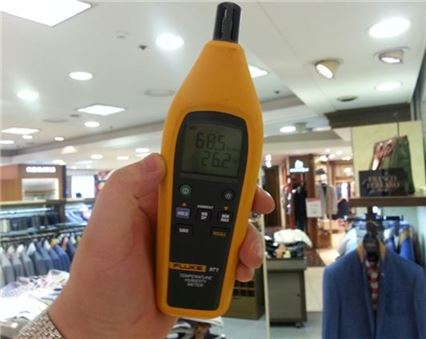
 Reference photo
[Asia Economy Reporter Kim Bo-kyung] It has been revealed that eight public institutions did not comply with the appropriate heating temperature of 18℃ or below.
The Ministry of Trade, Industry and Energy announced on the 26th the results of an energy demand management compliance inspection conducted on 249 public institutions from December 9 last year to the 21st of this year.
This inspection was carried out by a joint inspection team composed of the Ministry of Trade, Industry and Energy, local governments, and the Korea Energy Agency. The focus was on compliance with the appropriate heating temperature (18℃ or below), prohibition of personal heaters, and partial turning off of corridor lighting.
As a result, eight out of 249 institutions were found to have violated the appropriate heating temperature rule (violation rate of 3.2%). This shows a 7.9 percentage point improvement compared to the average violation rate of 11.1% over the past three winter seasons (2016?2018).
The institutions that did not comply with the appropriate heating temperature are: Korea Institute of Science and Technology Information, Grand Korea Leisure, Korea Forestry Promotion Institute, Korea Venture Investment Corp., Small and Medium Business Distribution Center, Small Enterprise and Market Service, Overseas Koreans Foundation, and Seoul Agro-Fisheries & Food Corporation.
An official from the Ministry of Trade, Industry and Energy stated, "We plan to strengthen compliance management by conducting re-inspections of institutions that did not comply with the appropriate heating temperature."
The Ministry also recommended and guided private high-energy-consuming buildings (annual energy consumption of 2000 TOE or more) to comply with the appropriate heating temperature of 20℃ or below this winter, in addition to public institutions.
Furthermore, together with local governments, civic groups, and the Korea Energy Agency, nationwide campaigns such as "Heating with Doors Closed" and energy-saving campaigns were promoted to encourage the daily practice of demand management among the public.
Kim Jeong-il, Director of Energy Innovation Policy at the Ministry of Trade, Industry and Energy, emphasized, "Since Korea is a high energy-consuming country that relies mostly on imported national energy, efforts to reduce unnecessary energy consumption must precede the transition to an advanced country-type low-energy consumption and high-efficiency structure."
He added, "Based on this winter’s demand management performance, we plan to implement more proactive demand management every winter and summer to ensure stable power supply and reduce greenhouse gases and fine dust."
© The Asia Business Daily(www.asiae.co.kr). All rights reserved.
















