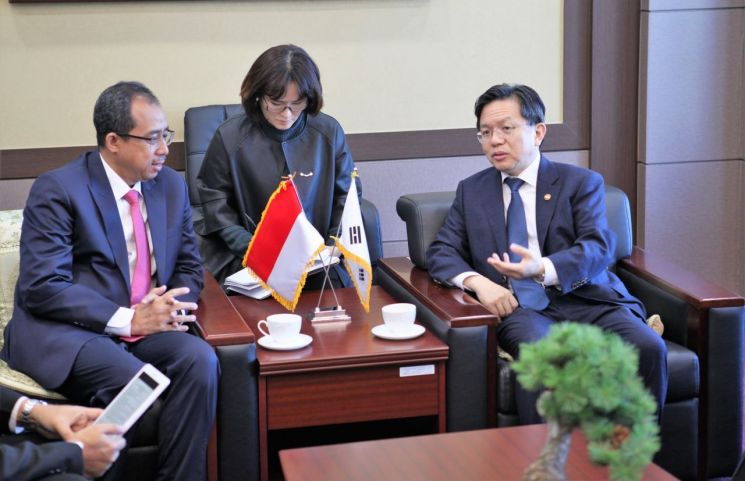
 Noh Seok-hwan, Commissioner of the Korea Customs Service (right), recently met with Heru Pambudi, Commissioner of the Indonesian Customs Service, to discuss cooperation in customs between the two countries. Photo by Korea Customs Service
[Asia Economy (Daejeon) Reporter Jeong Il-woong] The Electronic Origin Data Exchange System between Korea and Indonesia (hereinafter referred to as Inni) will be fully launched. This will enable companies in both countries to export and import without exchanging paper certificates of origin.
According to the Korea Customs Service on the 26th, this measure will be implemented starting next month. Before the implementation of the electronic exchange system, it was mandatory for each company to submit the original certificate of origin (paper document) when applying for preferential tariffs under the Free Trade Agreement (FTA).
For the same reason, companies had to send the certificate of origin to Indonesian customs via international mail or courier and undergo verification by the importing country's customs to confirm the authenticity of the certificate of origin. Additionally, companies had to endure difficulties such as delays in logistics processing during this process.
However, once the electronic certificate of origin exchange system between Korea and Indonesia is launched, both countries will exchange electronic documents mutually without the need to submit paper documents directly or undergo separate authenticity verification procedures.
The Korea Customs Service expects that this will increase the utilization rate of FTAs between the two countries by 9.6% and reduce customs and logistics costs by approximately 5.6 billion KRW annually. Above all, the Customs Service explains that the frequent customs clearance difficulties related to certificates of origin in Indonesia will be fundamentally resolved.
Meanwhile, the Korea Customs Service has made efforts to enhance exchanges and cooperation with Indonesia in response to the government's New Southern Policy and has been working since last year to introduce the electronic certificate of origin exchange system. Indonesia accounts for about 40% of the total GDP of ASEAN, making local market development aligned with the New Southern Policy.
Currently, efforts are underway to establish electronic certificate of origin exchange systems with other New Southern countries such as Vietnam, Thailand, and India.
The Korea Customs Service explains that if these efforts bear fruit and Korea and the 10 ASEAN countries complete the mutual electronic origin exchange system, an economic effect of approximately 74.9 billion KRW annually can be expected through customs and logistics cost reductions.
© The Asia Business Daily(www.asiae.co.kr). All rights reserved.
![Clutching a Stolen Dior Bag, Saying "I Hate Being Poor but Real"... The Grotesque Con of a "Human Knockoff" [Slate]](https://cwcontent.asiae.co.kr/asiaresize/183/2026021902243444107_1771435474.jpg)
















