Start of 32 Large-Scale Renewable Energy Projects Within the Year
"Enhancing Added Value and Competitiveness with Next-Generation Solar Cells and Floating Wind Power
Prioritizing Safety and Environment... Focusing on Orderly Deployment"
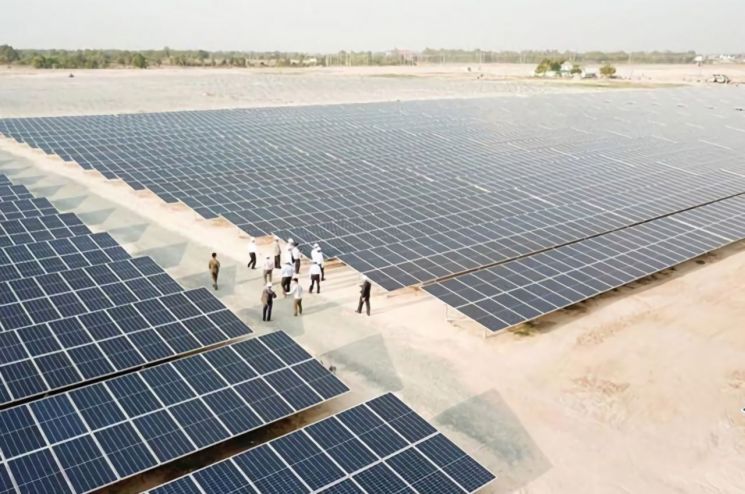
[Asia Economy Reporter Moon Chaeseok] The government announced that it will commence construction on 32 large-scale renewable energy projects this year and promote investments worth 11 trillion won over the next three years.
On the 26th, the Ministry of Trade, Industry and Energy stated that it plans to finalize and announce the "2020 New and Renewable Energy Technology Development and Utilization·Distribution Implementation Plan" on the 27th.
The implementation plan is established and executed annually by the Ministry of Trade, Industry and Energy after consultation with related ministries, pursuant to Article 6 of the "Act on the Promotion of the Development, Use, and Distribution of New and Renewable Energy (New and Renewable Energy Act)." It contains the goals for new and renewable energy distribution and technology development for the relevant year, as well as the main promotion strategies.
First, 32 large-scale projects totaling 2.3GW, including Hallim offshore wind power and Saemangeum solar power, will begin construction within this year. Including 1.9 trillion won this year, investments totaling 11 trillion won will be promoted over the next three years.
For solar power, 1.6 trillion won will be invested this year and 4.7 trillion won over three years. 28 complexes totaling 1,130MW, such as Yeongam solar power, will be completed, and 17 complexes totaling 1,640MW, including Saemangeum solar power, will begin construction.
For wind power, 300 billion won will be spent this year and 6.3 trillion won over three years. Nine complexes totaling 220MW, such as Jangheung wind power, will be completed, and 15 complexes totaling 640MW, including Jeju Hallim offshore wind power, will begin construction.
According to the law, the renewable energy supply obligation ratio will be raised from 6% last year to 7% this year, and the demand for Renewable Energy Certificates (REC) will be expanded. Accordingly, the mandatory supply volume this year has increased by 16.4% (4,435GWh) from 26,967GWh last year to 31,402GWh.
The Ministry of Trade, Industry and Energy also announced the implementation of a minimum efficiency standard (17.5%) for solar modules and a carbon certification system to promote the spread of high-efficiency and eco-friendly facilities and to encourage companies' research and development (R&D) investments. This system favors facilities that emit less carbon from solar materials to module production.
This year, 64.3 billion won will be invested in R&D for high value-added fields such as silicon solar cells, floating offshore wind power, and hydrogen core components. 20.3 billion won will be spent on solar and wind power, and 43.1 billion won on hydrogen.
Through this, the goal is to introduce silicon solar cells with a world-class maximum efficiency of 35% by 2025, which is higher than the existing maximum efficiency of 30%. Technology development will also be focused on high value-added fields such as floating offshore wind power up to 8MW and hydrogen core components.
Safety will be strictly managed. From now on, prior notification to residents will be mandatory when permitting power generation projects such as solar, wind, and fuel cells. To minimize environmental damage, related laws will be revised to mandate restoration of mountain areas during renewable energy power generation.
In July, a power generation project permit support system will be established to promote integrated management of renewable energy permit status between central and local governments.
The REC market will be integrated focusing on competitive bidding, while reviewing the linkage between bid quantities and annual distribution targets to systematically distribute renewable energy. Measures such as safety inspections of vulnerable facilities against wind and flood damage, strengthening solar power construction standards, and operating emergency response systems will also be implemented.
© The Asia Business Daily(www.asiae.co.kr). All rights reserved.

















