Need for Penalty Notice Procedure vs Minimization
Intense Tug-of-War in Policy Coordination Stage for 'Simplified Bundled Cancellation' to be Implemented This July
Tension Rises Over Policy Changes in the Wired Market Affecting 18 Million Poka Subscribers
[Asia Economy Reporter Koo Chae-eun] The three major telecom companies are engaged in a strategic battle over the 'penalty fee notification procedure' in the simplified cancellation policy for wired bundled products set to be introduced in July. Opinions are sharply divided between those who argue that the process should be minimized like number portability and those who insist that a penalty fee notification step should be included for user convenience.
◆Strong disagreement over 'penalty fee notification' = According to industry sources on the 26th, tension is mounting in the bundled product market for high-speed internet and IPTV, which has about 18 million subscribers. This is because the interests of operators are intricately intertwined regarding wired bundled products. The Korea Communications Commission is gathering opinions from operators, and the main point of contention is the 'penalty fee notification procedure.' Typically, high-speed internet and IPTV bundled products are used under a three-year contract, and if a subscriber switches either the high-speed internet or IPTV to another operator midway, they must pay a penalty fee.
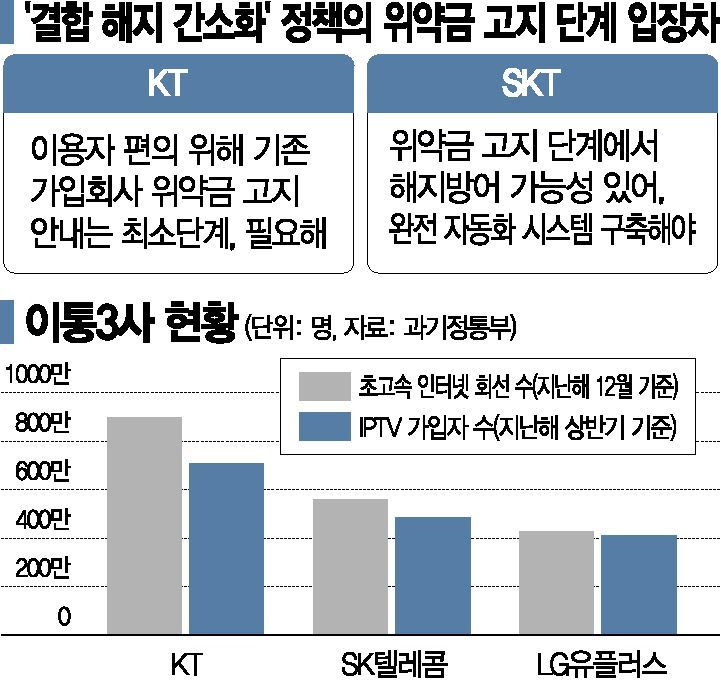
KT, which has the largest number of subscribers, argues that even if the bundled cancellation is simplified, a procedure to notify users of the penalty fee at least is necessary. They state that contact is required to retrieve equipment such as modems and set-top boxes that were provided to subscribers who were automatically unsubscribed from the bundled product, and during this process, a penalty fee notification call is essential. On the other hand, SK Telecom believes that to uphold the purpose of the system aimed at eradicating 'cancellation defense' marketing, automatic cancellation without a notification procedure is necessary. They argue that cancellation defense can still occur through penalty fee notification calls. A Korea Communications Commission official explained, "We plan to refine the system by collecting various opinions from operators."
◆Home rabbits vs. mountain rabbits = Inside and outside the industry, it is expected that KT, which has the largest number of wired subscribers, and SK Telecom, ranked second, will have complex calculations regarding the introduction of the new system. If the means of 'cancellation defense' disappears, KT, with the largest wired subscriber base, will be anxious about the 'home rabbits (existing subscribers) leaving,' while SK Telecom and LG Uplus, ranked second and third, will focus on 'catching mountain rabbits (moving subscribers).' As of the end of last year, the number of high-speed internet subscribers was 8,962,390 for KT, 5,612,220 for SK Telecom (including broadband and resale), and 4,283,914 for LG Uplus. As of the first half of last year, IPTV subscribers numbered 7,081,177 for KT, 4,855,775 for SK Broadband, and 4,110,187 for LG Uplus.
Meanwhile, the 'simplified bundled cancellation' policy allows existing telecom services to be automatically canceled without contact with cancellation defense teams when subscribers switch their high-speed internet or IPTV provider. The Korea Communications Commission has been promoting this policy to prevent excessive cashback and gift marketing competition during call center interactions aimed at cancellation defense, which leads to subscribers maintaining subscriptions against their will.
© The Asia Business Daily(www.asiae.co.kr). All rights reserved.

















