Bank of Korea 'Business Survey Index (BSI) and Economic Sentiment Index (ESI)'
All-industry BSI Lowest in 4 Years... Largest Decline Ever
Manufacturing Hit Due to Global Supply Chain Issues
Impact on Automobile and Electronics Companies
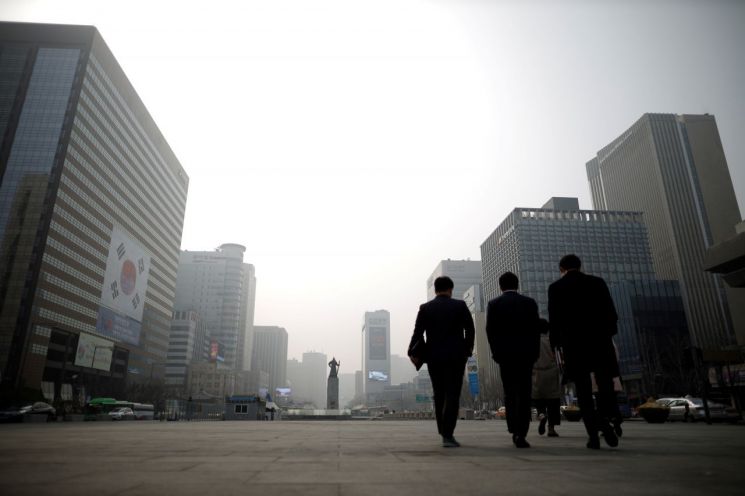
[Asia Economy Reporter Kim Eunbyeol] Due to the impact of the novel coronavirus infection (COVID-19), not only consumer sentiment but also corporate business sentiment has frozen. The level of corporate business sentiment was the lowest in four years, and the decline was the largest ever recorded.
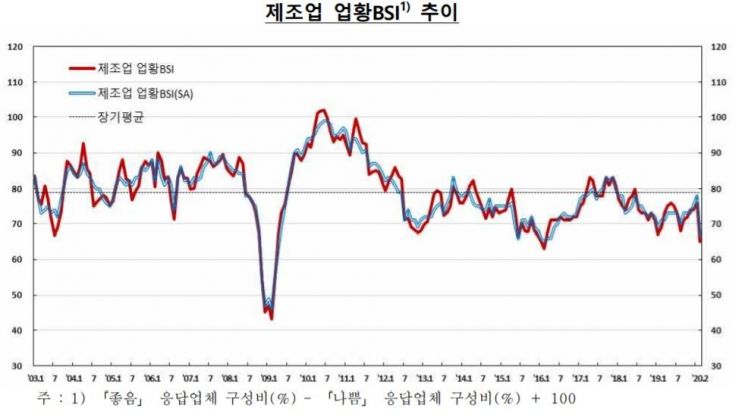
According to the 'February 2020 Business Survey Index (BSI)' announced by the Bank of Korea on the 26th, the overall industry BSI this month was 65, down 10 points from the previous month. This is the lowest since February 2016 (63), and the decline is the largest since statistics began to be compiled in 2003.
The decline in overall industry BSI was greater than during the Middle East Respiratory Syndrome (MERS) outbreak in June 2015, the global economic recession caused by the European debt crisis in July 2012, and the 2008 financial crisis. The largest previous declines were all 9 points.
The BSI is an indicator that reflects the business conditions as perceived by companies; a value below 100 means that more companies view the economy pessimistically than optimistically.
The spread of COVID-19 negatively affected both manufacturing and non-manufacturing sentiment. The manufacturing BSI recorded 65, down 11 points from 76 in the previous month. The manufacturing BSI is also at its lowest since February 2016 (63), and the decline matches the 11-point drop during the European debt crisis in July 2012.
By industry, business sentiment sharply declined in electronics, video, and communication equipment (-18 points), automobiles (-18 points), and metal processing (-11 points). By company size, large enterprises (-11 points), small and medium enterprises (-11 points), export companies (-13 points), and domestic market companies (-10 points) all deteriorated simultaneously.
Kang Chang-gu, head of the Corporate Statistics Team at the Economic Statistics Bureau, explained, "The decrease in exports of electronic components related to semiconductors and displays, and the temporary suspension of production by finished car manufacturers due to parts supply disruptions, had an impact," adding, "As the upstream industry (automobiles) showed sluggishness, the business sentiment in metal processing also declined."
He continued, "Compared to MERS and Severe Acute Respiratory Syndrome (SARS), the impact on manufacturers was greater," explaining, "Since Korean companies have many production bases in China and engage in processing intermediary trade, the impact on manufacturing appeared more significant." This indicates that the global supply chain entanglement caused manufacturing to be hit hard by the spread of infectious diseases.
The non-manufacturing business performance BSI fell 9 points from the previous month, mainly due to declines in wholesale and retail trade (-13 points), transportation and warehousing (-24 points), and information and communication (-10 points). The non-manufacturing BSI had previously fallen 11 points during the MERS outbreak. The main reasons were sluggish domestic demand due to COVID-19 and decreases in domestic and international passenger and cargo volumes.
In general, infectious diseases directly impact domestic demand, so non-manufacturing sectors suffer significant damage. However, since the February BSI survey period was from the 11th to the 18th of this month, before COVID-19 spread widely in Korea, the actual impact may be greater. The March overall industry business outlook BSI was 69, down 7 points from the previous month. The March business outlook BSI is also expected to decline further if the domestic impact of COVID-19 is fully reflected.
Meanwhile, the Economic Sentiment Index (ESI), calculated by combining the BSI with the Consumer Sentiment Index (CSI), recorded 87.2, down 8.5 points from the previous month. This is the lowest since March 2009, when the financial crisis occurred. The seasonally adjusted and irregular component-removed cyclical component of the ESI was 89.7, down 0.9 points. The ESI cyclical component is also the lowest since May 2009.
© The Asia Business Daily(www.asiae.co.kr). All rights reserved.

![User Who Sold Erroneously Deposited Bitcoins to Repay Debt and Fund Entertainment... What Did the Supreme Court Decide in 2021? [Legal Issue Check]](https://cwcontent.asiae.co.kr/asiaresize/183/2026020910431234020_1770601391.png)