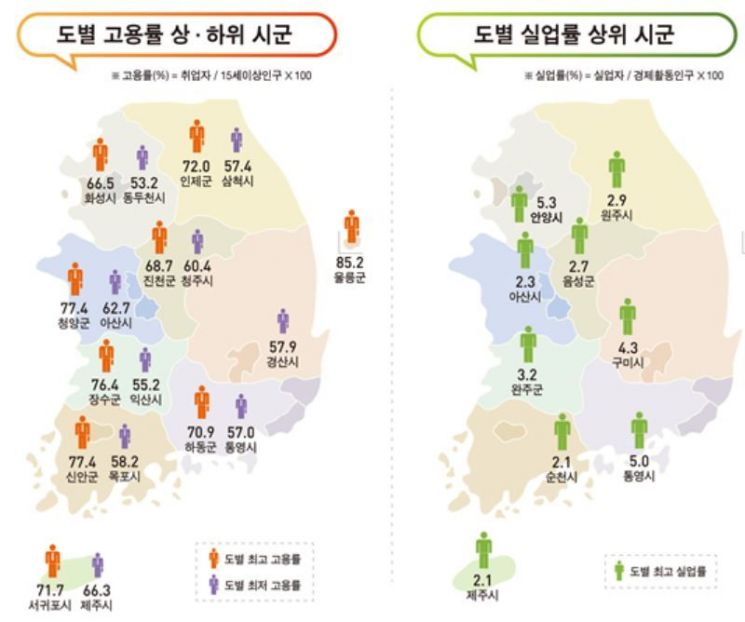
[Sejong=Asia Economy Reporter Kim Hyunjung] In the second half of last year, the employment situation in the employment crisis areas such as Geoje and Tongyeong in Gyeongnam showed slight improvement. Among all regions nationwide, Seogwipo City in Jeju had the highest employment rate, while Dongducheon City in Gyeonggi, where a U.S. military base was closed causing job losses, had the lowest.
According to the "2019 Second Half Regional Employment Survey: Major Employment Indicators by City and County" released by Statistics Korea on the 25th, the employment rates in the employment crisis areas Geoje and Tongyeong in the second half of last year (as of October) were 61.9% and 57.0%, respectively. These figures represent improvements of 2.8 percentage points and 0.2 percentage points compared to the second half of the previous year. During the same period, the unemployment rate in Geoje dropped by 2.4 percentage points from 7.1% in the second half of the previous year to 4.7%, and Tongyeong's unemployment rate also decreased from 6.0% in the second half of 2018 to 5.0%.
Geoje, which had experienced prolonged job market deterioration due to restructuring in the shipbuilding industry, had ranked first nationwide in unemployment rate from the second half of 2017 to the first half of last year, but in this survey, it fell out of the top rankings. Tongyeong City, which had remained around second place in unemployment rate during the same period, improved to fourth place this time. Jeong Dongwook, head of the Employment Statistics Division at Statistics Korea, explained, "The unemployment rate decline was significant in Geoje and Tongyeong, where unemployment had been high mainly due to shipbuilding."
Gunsan, where the closure of the Korean GM Gunsan plant cooled the employment market, also showed improvement in related indicators. The employment rate in the second half of last year was 55.6%, up 2.5 percentage points from 53.1% in the same period the previous year, and the unemployment rate dropped by 1 percentage point from 3.2% to 2.2%. Mr. Jeong said, "Gunsan City maintained a low employment rate in the second half of 2018 due to the closure of the Korean GM Gunsan plant, but followed the national trend and improved in the second half of 2019." He added, "The phenomenon of rising employment rates and falling unemployment rates was commonly observed in employment crisis areas such as Gunsan, Mokpo, Yeongam, Changwon, Tongyeong, and Geoje."
The regions with the highest unemployment rates nationwide in the second half of last year were Anyang (5.3%), Dongducheon (5.3%), and Gwangmyeong (5.2%) in Gyeonggi Province. In rural areas, Chilgok in Gyeongbuk (3.8%), Wanju in Jeonbuk (3.2%), and Goseong in Gyeongnam (2.9%) had high unemployment rates. Anyang, Dongducheon, and Gwangmyeong are regions where manufacturing, wholesale and retail trade, and accommodation and food services account for 40% of the economy, and the unemployment rate appears to have risen due to last year's economic downturn. In Dongducheon, the employment rate was the lowest (53.2%) due to the reduction of related jobs following the withdrawal of the U.S. military base.
The regions with the highest employment rates were Seogwipo in Jeju (71.7%), Dangjin in Chungnam (70.7%), and Yeongcheon in Gyeongbuk (69.0%). In rural areas, Ulleung in Gyeongbuk (85.2%), Cheongyang in Chungnam (77.4%), and Sinan in Jeonnam (77.4%) had high employment rates.
Looking at the overall employment rate, city areas recorded 60.5%, up 0.5 percentage points from a year earlier, and rural areas recorded 67.3%, up 0.8 percentage points. Statistics Korea explained that the difference is due to the high proportion of agriculture, forestry, and fisheries, which employ many elderly and women, in rural areas. The unemployment rate was 3.2% in city areas and 1.3% in rural areas, down 0.3 percentage points and 0.1 percentage points respectively from the second half of the previous year.
Meanwhile, this survey was conducted on household members aged 15 and over residing in 154 cities and counties across 9 provinces, excluding 8 special and metropolitan cities nationwide. The major employment indicators are collected twice a year, in April and October.
© The Asia Business Daily(www.asiae.co.kr). All rights reserved.
![User Who Sold Erroneously Deposited Bitcoins to Repay Debt and Fund Entertainment... What Did the Supreme Court Decide in 2021? [Legal Issue Check]](https://cwcontent.asiae.co.kr/asiaresize/183/2026020910431234020_1770601391.png)















