Real Estate Special Judicial Police (Special Investigation Unit) Crackdown Day 1
Deleted KakaoTalk Group Chat and Even Changed Cafe Name
Self-Censorship Saying "Let's Be Careful Due to Tense Atmosphere" Even Without Illegal Acts
Proposal to Use "Distribution Period" Instead of Resale Restriction Period
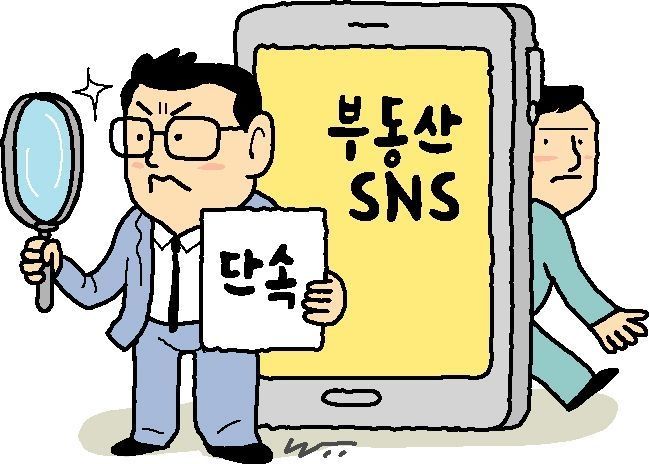
[Asia Economy Reporter Onyu Lim] Star instructor A, specializing in pre-sale rights, "blew up" (meaning deleted) a KakaoTalk group chat with 1,500 members on the first day of the real estate special judicial police (hereafter Special Judicial Police) crackdown on the 24th. The room was used for real estate consultations and information sharing. The instructor explained, "There have been no illegal activities such as apartment price collusion or unregistered brokerage so far," but added, "This decision was made to prevent any possible harm."
As the Special Judicial Police, composed of the Ministry of Land, Infrastructure and Transport, the National Tax Service, and the Financial Supervisory Service, began full-scale operations, star instructors who were active on social media are becoming very cautious. The Special Judicial Police are focusing their crackdown not only on existing targets such as up-down contracts and illegal trading of subscription savings accounts but also on brokerage activities in online spaces, price collusion, and violations of the Act on Labeling and Advertising. This is due to the recent prevalence of new types of real estate market disturbances, such as introducing development prospects of specific areas through social media while brokering listings.
Star instructors are trying to evade the crackdown by deleting KakaoTalk groups that could be subject to investigation or by changing the names of online communities. Real estate instructor B, who ran a private online cafe with 800 members, changed the cafe's name from "Real Estate Meeting" to "Diet Meeting." B said, "There were no star instructors or apartment price collusion in this group, but since the social atmosphere is tense, I will change it for now." Some online communities have even proposed using 'code words' to avoid the crackdown, such as using "restaurant" instead of "apartment" and "distribution period" instead of "resale restriction period."
The Special Judicial Police crackdown seems to be affecting social media where illegal activities have not been committed or where the legality is ambiguous. Some SNS group chats suspected of apartment price collusion have already closed down in anticipation of the crackdown, creating a tense atmosphere. Real estate instructor C explained, "KakaoTalk or online cafes themselves may not be illegal, but most instructors operating them engage in profit-making activities through online and offline lectures," adding, "The larger the community, the more likely it is to become a target of tax investigations, so they are being cautious."
However, there are voices questioning whether it is an excessive invasion of privacy for the government to extend investigations to private domains such as KakaoTalk. Critics also argue that even healthy information exchange is being stifled. D, a worker in their 30s who lost two KakaoTalk group chats after the Special Judicial Police crackdown, said, "It was useful to quickly exchange information and to use chat room polls when deciding whether to purchase," expressing regret that "the government crackdown has led to self-censorship, causing me to lose a network built over a long time."
© The Asia Business Daily(www.asiae.co.kr). All rights reserved.

















