$8.7 Billion Orders This Year
Highest in 5 Years
Middle East Orders Account for Two-Thirds
Hyundai and Samsung Hit Trillion-Won Jackpot
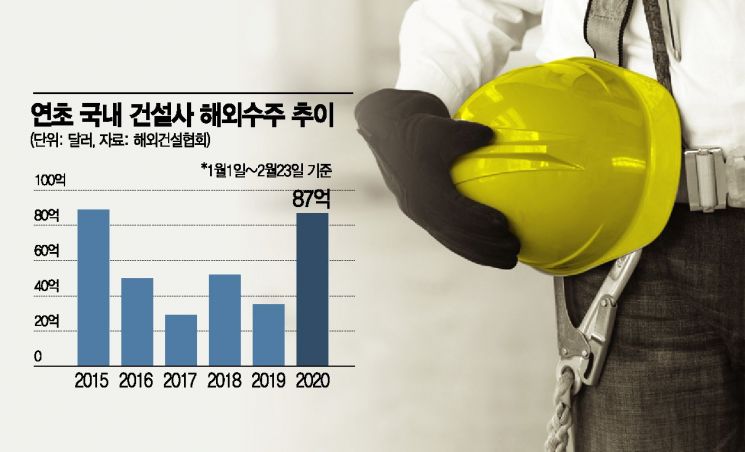
[Asia Economy Reporter Choi Dong-hyun] Domestic construction companies' overseas construction orders are showing a sharp rebound, recording the highest level in five years. Last year, orders amounted to $22.3 billion, marking a 31% decrease from the previous year and hitting the lowest point in 13 years, but now they are recovering from this slump. Particularly encouraging is the continuous stream of orders from the Middle East market, which had been sluggish for years due to international political instability and a sharp drop in global oil prices. However, experts caution that external variables such as the US-Iran conflict and the novel coronavirus disease (COVID-19) remain, so the situation cannot be easily viewed optimistically.
According to the Overseas Construction Comprehensive Information Service of the Overseas Construction Association on the 25th, domestic construction companies' overseas orders totaled $8.7 billion (approximately 10.54 trillion KRW) as of the 23rd of this year. This is the highest figure since 2015, when orders reached $8.9 billion during the same period. Compared to the average of around $4 billion during this period until last year, which was affected by the international oil price sliding to $20 per barrel (West Texas Intermediate, WTI) in 2016, this amount has more than doubled. So far this year, the number of overseas construction orders is 94, and the number of construction projects is 1,830, up 12% and 13% respectively compared to the same period last year.
By region, the Middle East stands out with its order performance. This market alone accounted for two-thirds of the total orders, amounting to $5.8 billion. This already surpasses last year's total Middle East orders of $4.8 billion. Asia accounted for $2.6 billion, or 29.8%, and Latin America secured $300 million in orders. By construction type, domestic construction companies traditionally excel in power plants and industrial facilities such as oil refining and chemical plants, which accounted for $5 billion or 58.6% of the total. This was followed by civil engineering (20.7%), architecture (17.2%), and telecommunications (1.1%).
Among the major construction companies, Hyundai Construction was the first to secure overseas orders this year. Hyundai Construction has accumulated orders worth 3.8 trillion KRW from the Middle East, Southeast Asia, Africa, and Latin America markets. Earlier this month, it made a splash by winning a 3.3 trillion KRW contract for the 'Panama Metro Line 3 Construction Project' from the Panama Metro Authority (MPSA). Hyundai Construction holds a 51% stake in this consortium project, with the remaining shares held by domestic construction companies POSCO Construction (29%) and Hyundai Engineering (20%).
Samsung C&T also reported its first order by signing the main contract last month for the 'Dhaka International Airport Expansion Project' in Bangladesh, worth 1.9196 trillion KRW. Following that, on the 18th, it secured the 'Fujairah F3 Combined Cycle Power Project' worth 1.15 trillion KRW, jointly with Japanese developer Marubeni Corporation, commissioned by the UAE Electricity and Water Authority, marking a smooth start to the year. A Samsung C&T official said, "The significance lies in the Middle East order," adding, "This order reaffirms our presence as a global EPC (Engineering, Procurement, and Construction) player in the Middle East power market."
The industry is closely watching the recovery of the Middle East market, which was a traditional stronghold for orders. According to global market research and analysis firm IHS Markit, the Middle East construction market is expected to grow by about 5% this year to reach $570.9 billion. Active infrastructure investments by Middle Eastern countries are expected to drive market growth. Saudi Arabia, the top country in cumulative overseas orders for domestic construction companies, is seeking industrial diversification by announcing 'Vision 2030' in preparation for the post-oil era and is promoting various new city, airport, and plant projects. A representative from a major construction company said, "Since last year, international oil prices have stabilized relatively, and there are several large projects to be ordered this year, so we are focusing on the Middle East," expressing expectations that "order performance will improve significantly compared to last year."
The Asian market, the second stronghold for construction companies' orders, also has a favorable market environment. Large-scale infrastructure development plans are expected to continue, especially in the New Southern region, which the government is focusing on. Indonesia is progressing with its capital relocation and National Strategic Projects (NSP), while the Philippines is recently expanding public-private partnership (PPP) projects.
However, concerns have been raised that if the geopolitical crisis surrounding the Strait of Hormuz intensifies and COVID-19 spreads further, the mood in the Middle East and Asian markets could be dampened. Park Sera, a researcher at Shin Young Securities, said, "If the COVID-19 issue prolongs, it could affect global oil supply and demand and plant orders," adding, "During the Middle East Respiratory Syndrome (MERS) outbreak in 2015, the construction industry also experienced significant adjustments."
© The Asia Business Daily(www.asiae.co.kr). All rights reserved.

















