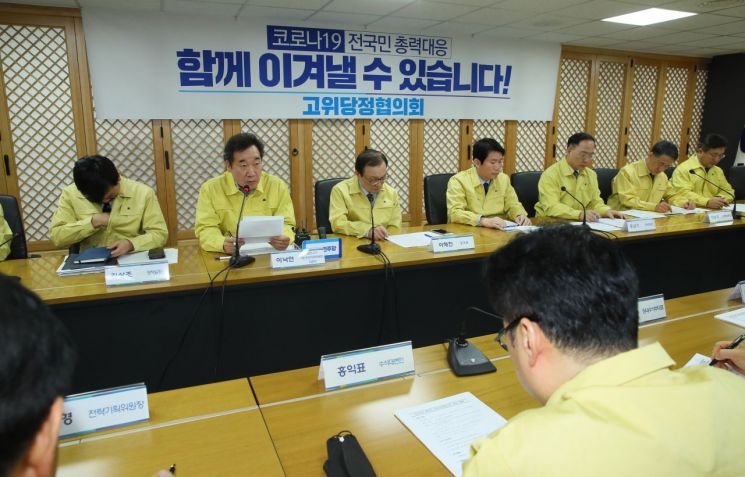
[Asia Economy Reporter Kang Nahum] The Democratic Party of Korea, the government, and the Blue House have decided to elevate their lockdown policies to a higher level to prevent the community spread of the novel coronavirus disease (COVID-19).
Hong Ik-pyo, the chief spokesperson of the Democratic Party of Korea, held a briefing on the 25th after a meeting of the party, government, and Blue House at the central party office in Yeouido, stating, "We have decided to actively block the spread of COVID-19 beyond the usual containment measures."
He said, "The government side is considering administrative measures to some extent regarding movement and related aspects," adding, "Specific details will be announced by the government after being approved at the Cabinet meeting today (the 25th)."
However, Chief Spokesperson Hong emphasized, "Implementing the 'maximum lockdown policy' means tightening the quarantine network to block the spread and community transmission of COVID-19," and clarified, "It does not mean completely sealing off access to regions."
The party, government, and Blue House also agreed to secure the maximum supply volume and establish stable supply measures to promptly resolve the ongoing mask supply instability issue. Specifically, they decided to set the public mandatory supply at 50% of daily production and limit current export volumes to 10%.
Furthermore, the public mandatory supply will be distributed stably to the public through Nonghyup (National Agricultural Cooperative Federation), post offices, and local governments rather than commercial distribution channels. Additionally, free supply to low-income vulnerable groups and medical personnel in Daegu and the Gyeongbuk region will be expanded.
For small and medium-sized self-employed businesses, the party, government, and Blue House plan to include tax benefits for landlords and self-employed individuals related to rent reductions in this supplementary budget and are also considering the President’s emergency financial order. Chief Spokesperson Hong said, "We have decided to prepare the supplementary budget as soon as possible, and if it is difficult for the National Assembly to operate normally, we will consider the emergency financial order," adding, "We will strengthen the active role of finance through special support for Daegu and Gyeongbuk regions suffering from the infectious disease, small and medium-sized enterprises and self-employed individuals, as well as active support for export companies."
Before the meeting, Representative Lee Hae-chan also advocated for the activation of the 'emergency financial order.' In his opening remarks, he said, "If the passage of the supplementary budget bill in the National Assembly is delayed, we must respond by activating the 'emergency financial order'."
The President’s activation of the emergency financial order has been previously mentioned by some ruling party members, including Assemblyman Min Byung-doo. According to the Constitution of Korea, the President may issue orders with the effect of law or take minimal financial and economic measures when urgent action is needed due to internal or external disturbances, natural disasters, or serious financial or economic crises, and when there is no time to wait for the National Assembly to convene.
Additionally, the party, government, and Blue House will promote management measures for mass gatherings where COVID-19 could rapidly spread. Non-urgent or low-necessity events will be postponed or canceled, and educational meetings will minimize face-to-face contact by utilizing online platforms.
Moreover, events held in confined, narrow spaces or crowded outdoor areas will also be postponed or canceled. Participation will be restricted for those with travel history or symptoms. Vulnerable groups such as infants, the elderly, pregnant women, and those with chronic diseases will be advised to refrain from attending events, with guidelines revised and implemented accordingly.
Furthermore, if local government officials attempt to prevent participants from gathering, police officers will be authorized to respond based on the Police Duties Execution Act, and strict measures such as arrest will be enforced if lawful public duties are obstructed. In cases where gatherings proceed despite local government bans, the police will notify the prohibition and take strict judicial actions against organizers and participants under the Infectious Disease Control and Prevention Act and laws related to assemblies and demonstrations.
Regarding this, Chief Spokesperson Hong said, "This is not targeting any specific gathering, but if there is a risk related to COVID-19, administrative authorities will actively make judgments," adding, "It means that for any gathering, if there is concern about the spread of infectious diseases due to the size and nature of the event, legal restrictions will be actively considered."
© The Asia Business Daily(www.asiae.co.kr). All rights reserved.

















