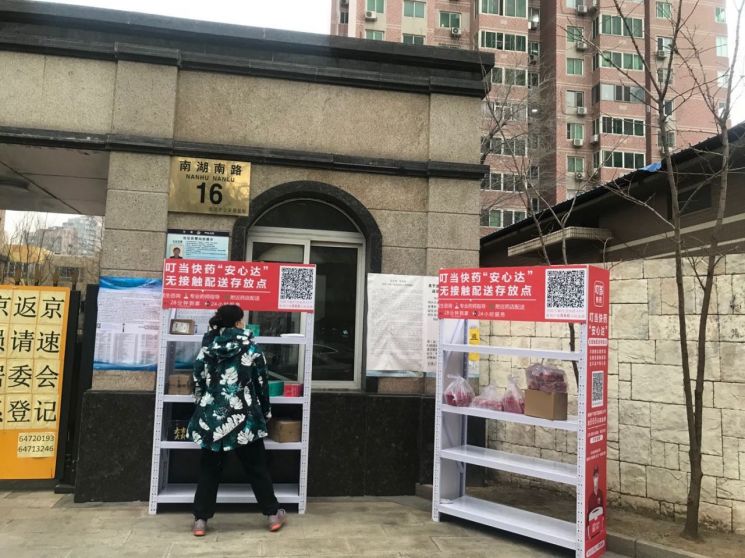
 In front of the entrance to an apartment complex in Wangjing, Beijing, China, where many Koreans reside, there is a designated space for collecting daily necessities and delivery items. Many apartment complexes in Wangjing are enforcing the guideline that requires a 14-day self-quarantine upon arrival from Korea to Beijing.
[Asia Economy Beijing=Special Correspondent Sunmi Park] #. School notice. Recently, news has come that the spread of COVID-19 in Korea is relatively severe. Students with Korean nationality, please do not return to Beijing for the time being. (Notice from a Chinese elementary school)
#. I came to Korea temporarily with my children to avoid the virus, but I have to return to China soon. I am worried that I might be denied entry. (Korean community in China)
As the number of confirmed COVID-19 cases in Korea quickly exceeded 800, China, the origin of the virus, has started to quarantine or strengthen control measures on Koreans entering the country. Although these are not official positions of the Chinese central government but measures taken by local governments and society, this contrasts with Korea’s still passive stance on banning Chinese entry and not imposing separate quarantine measures, which is expected to intensify criticism toward the Korean government.
On the 25th in Beijing, quarantine measures for incoming travelers are being implemented mainly in the Wangjing area, where many Koreans are concentrated. From the previous day, apartment complexes in this area have been enforcing the guideline that "those coming from Korea to Beijing must self-quarantine for 14 days." Only after 14 days of home quarantine without any abnormal symptoms will the residential committee issue a pass allowing movement. Until now, foreigners who had not stayed in China for 14 days or who entered through Beijing Airport were exempt from the 2-week self-quarantine. However, due to the rapid spread of confirmed cases in Korea, the policy was urgently changed.
Among the Korean residents, there is great anxiety about the quarantine measures spreading in the local community. Many Koreans have temporarily stayed in Korea due to concerns about the spread of COVID-19 in China and are preparing to enter China ahead of the March school opening season for elementary, middle, high schools, and universities.
In various local Korean communities, concerns are spreading that entering China at this time might lead to quarantine, along with rumors that forced quarantine is actually being carried out. The previous day in Shenzhen, Guangdong Province, about 30 Koreans on a flight from Korea were quarantined and tested due to a Chinese passenger showing fever symptoms. It has also been reported that some regions such as Weihai in Shandong Province plan to impose forced quarantine for 5 to 7 days on arrivals from Korea, but it has been confirmed that these measures have not yet been implemented.
However, in regions outside mainland China with autonomous rights such as Hong Kong, Macau, and Taiwan, restrictions on Korean entry are being actively enforced. Hong Kong issued a "red travel alert" for visits to Korea and from 6 a.m. on the day banned entry of non-Hong Kong residents coming from Korea or those who have visited Korea within the last 14 days. Macau also classified Korea as a high-risk COVID-19 infection area starting from the 23rd.
China’s measures are expected to become controversial as they differ from Korea’s situation, where serious consideration of restricting Chinese entry is lacking. A Beijing diplomatic source said, "There have been many rumors in recent days that Koreans entering China are being forcibly quarantined," adding, "The Chinese government has not officially announced any restrictions on Korean entry yet." The source further explained, "Quarantine is being carried out at the community level, but it is not at the stage of forced quarantine."
On the same day, the Chinese state media Global Times reported, "In Shandong Province, which is geographically close and has close relations with Korea, Chinese citizens are demanding the provincial government restrict Korean entry." The northeastern Chinese province of Jilin has also set a policy to directly transport passengers arriving on flights from Korea at Yanji International Airport to their destinations under official supervision. Koreans arriving in Yanbian through Yanji International Airport must sign a legal liability statement and follow a 14-day self-quarantine. In preparation for situations where a confirmed case is found on a flight requiring all passengers to be quarantined intensively, a separate quarantine facility capable of accommodating more than 100 people has been prepared in Yanbian.
© The Asia Business Daily(www.asiae.co.kr). All rights reserved.
![User Who Sold Erroneously Deposited Bitcoins to Repay Debt and Fund Entertainment... What Did the Supreme Court Decide in 2021? [Legal Issue Check]](https://cwcontent.asiae.co.kr/asiaresize/183/2026020910431234020_1770601391.png)
















