Request for Continued International Support for the Korean Peninsula Peace Process
Minister Kang: "The Korean Government Proposes Various Inter-Korean Cooperation Projects to Create Conditions for Resuming North Korea-US Dialogue"
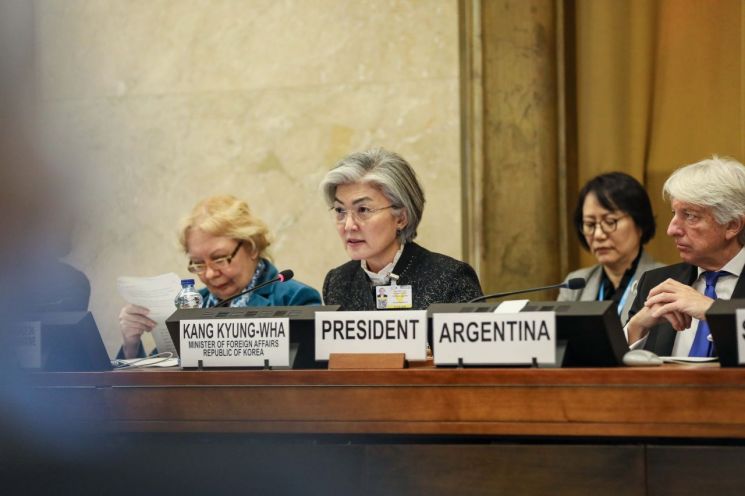
[Asia Economy Reporter Lim Cheol-young] On the 24th (local time), Minister Kang Kyung-wha attended the high-level session of the Geneva Conference on Disarmament (CD) and emphasized the importance of strengthening the international disarmament and non-proliferation regime, while also requesting the international community’s continued support for the resumption of negotiations between North Korea and the United States and the peace process on the Korean Peninsula.
At this high-level session, minister- and vice minister-level officials from over 30 countries delivered speeches on international disarmament and non-proliferation issues. Minister Kang has attended the conference and delivered keynote speeches for three consecutive years since 2018.
Minister Kang stated, “The international security environment is fluid and complex due to the weakening of the international nuclear arms control regime, the emergence of new technologies, and the expansion of activities into outer space and cyberspace,” adding, “The Geneva Conference on Disarmament (CD), the only multilateral disarmament negotiation forum in the international community, must contribute more to revitalizing disarmament-related discussions.”
In particular, she added, “As the 50th anniversary of the entry into force of the Nuclear Non-Proliferation Treaty (NPT) is celebrated this year, I hope that the CD will make progress in disarmament negotiations to produce meaningful outcomes at the NPT Review Conference and further contribute to restoring trust in the international disarmament and non-proliferation regime.” NPT parties hold review conferences every five years to assess treaty implementation.
Furthermore, as part of efforts to contribute to strengthening the international disarmament and non-proliferation regime, Minister Kang introduced the “Youth, Disarmament and Non-proliferation” resolution, which Korea led to be adopted by consensus among UN member states at last year’s UN General Assembly to encourage youth participation in disarmament discussions. The Korean government led the adoption of this resolution at the First Committee of the 2019 UN General Assembly, which encourages voluntary activities to promote empowering youth, engaging youth, and educating youth in disarmament discussions.
Minister Kang also emphasized the need to promptly resume negotiations between North Korea and the United States. She said, “We will continue to pursue the peace process on the Korean Peninsula for complete denuclearization and the establishment of lasting peace,” adding, “To maintain and strengthen the momentum of dialogue, it is important that negotiations between North Korea and the United States resume as soon as possible.”
In this regard, she stated, “The Korean government has proposed several inter-Korean cooperation projects and aims to create conditions for the resumption of North Korea-US dialogue through these projects,” requesting the international community’s continued support for the peace process on the Korean Peninsula.
Mr. Chairperson, Secretary-General of the CD,
Distinguished representatives of all countries,
It is an honor to return to the Geneva Conference on Disarmament (CD) and deliver a speech today. However, I am deeply concerned that we are facing another difficult year amid an increasingly complex international security environment.
Tensions are rising worldwide. As seen in the termination of the INF Treaty (Intermediate-Range Nuclear Forces Treaty) and the uncertain future of New START (New Strategic Arms Reduction Treaty), the nuclear arms control regime appears to be shaking. In addition, the emergence of new technologies such as autonomous weapon systems and hypersonic weapons, as well as the expansion of human activities into outer space and cyberspace, have further complicated the situation. These bring fundamental changes to the strategic balance and increase unpredictability in strategic planning.
There is an urgent need to reverse these difficult trends, restore international stability, and strengthen international security. Amid many potential difficulties, trust in the CD, the only multilateral disarmament negotiation forum in the international community, may further decline.
Over the past 40 years, the Geneva negotiating body has produced several milestone documents such as the Comprehensive Nuclear-Test-Ban Treaty (CTBT), but it has been deadlocked for more than 20 years without producing any substantive outcomes.
Therefore, we need to seek ways to revitalize work through a new review of this body and move toward disarmament negotiations. Our government welcomes the leadership efforts of the six chairs (P6) this year who have agreed to work jointly toward this goal.
To break the deadlock and restore the CD to its original function, a practical, flexible, and realistic approach is required. Reducing the number of agenda items adopted annually to focus on urgent issues could enhance the CD’s effectiveness in addressing current security challenges. Also, considering the CD’s failure to move toward negotiations, member states might try to reach consensus on non-binding measures such as rules, norms, and codes of conduct on specific agenda items to advance substantive discussions. Furthermore, discussing ways to improve the efficiency and effectiveness of the CD’s current working methods would be helpful.
Mr. Chairperson, distinguished representatives,
This year marks the 75th anniversary of the UN’s founding and the 50th anniversary of the NPT’s entry into force. The Nuclear Non-Proliferation Treaty has been the cornerstone of the international disarmament and non-proliferation regime. However, we are witnessing a deterioration in the international security environment. While arms control is faltering, global defense spending is increasing.
The 2020 NPT Review Conference is scheduled to be held under these serious circumstances. Failure to produce meaningful outcomes at the Review Conference would be a severe blow and an outcome no one desires. If progress can be made in areas such as negotiations on the Fissile Material Cut-off Treaty (FMCT), the likelihood of success at the Review Conference will increase. In the long term, this will help restore trust in the international disarmament and non-proliferation regime.
In our country’s case, we have actively worked to contribute to strengthening the disarmament and non-proliferation regime. Last year, we submitted a UN General Assembly resolution titled “Youth, Disarmament and Non-proliferation.” Thanks to broad support from UN member states, the resolution was adopted by consensus. This resolution aims to empower, engage, and educate youth in the field of disarmament and non-proliferation, seeking to overcome long-standing stalemates and confrontations through new perspectives and opinions from youth in disarmament discussions.
Distinguished representatives,
As you well know, our government has pursued the peace process and dialogue efforts on the Korean Peninsula to achieve complete denuclearization. Dialogue has been stalled in recent months, and despite our continued patience and efforts to resume dialogue and cooperation, regrettably, North Korea has not yet returned to the negotiating table.
Nevertheless, our government will continue efforts toward complete denuclearization and the establishment of lasting peace on the Korean Peninsula. To maintain and strengthen the hard-won momentum of dialogue, the prompt resumption of North Korea-US dialogue is crucial.
We are ready to engage in dialogue with North Korea as a way to facilitate and accelerate North Korea-US talks. Earlier this year, President Moon Jae-in proposed several inter-Korean cooperation projects and called for North Korea’s response. Through these projects, our government aims to open the door to dialogue with North Korea, lead the prompt resumption of North Korea-US talks, and strengthen conditions for sustained dialogue and cooperation. We will pursue this while faithfully implementing sanctions against North Korea.
In the journey toward complete denuclearization and lasting peace on the Korean Peninsula, our government expects the unwavering and continuous support of the international community.
Mr. Chairperson, distinguished representatives,
No one can dispute the importance of disarmament in strengthening international security and promoting strategic stability. Considering the current security environment and the challenges we face, we can no longer afford to waste time and effort restoring trust in the CD.
The Republic of Korea is ready to cooperate with all other member states seeking to advance disarmament discussions and revitalize the CD’s work. We hope that all member states will cooperate under clear objectives so that the CD can achieve substantive and meaningful progress this year. Together, we must provide the necessary momentum for the successful outcomes of the 2020 NPT Review Conference to be held this April.
© The Asia Business Daily(www.asiae.co.kr). All rights reserved.
![User Who Sold Erroneously Deposited Bitcoins to Repay Debt and Fund Entertainment... What Did the Supreme Court Decide in 2021? [Legal Issue Check]](https://cwcontent.asiae.co.kr/asiaresize/183/2026020910431234020_1770601391.png)















